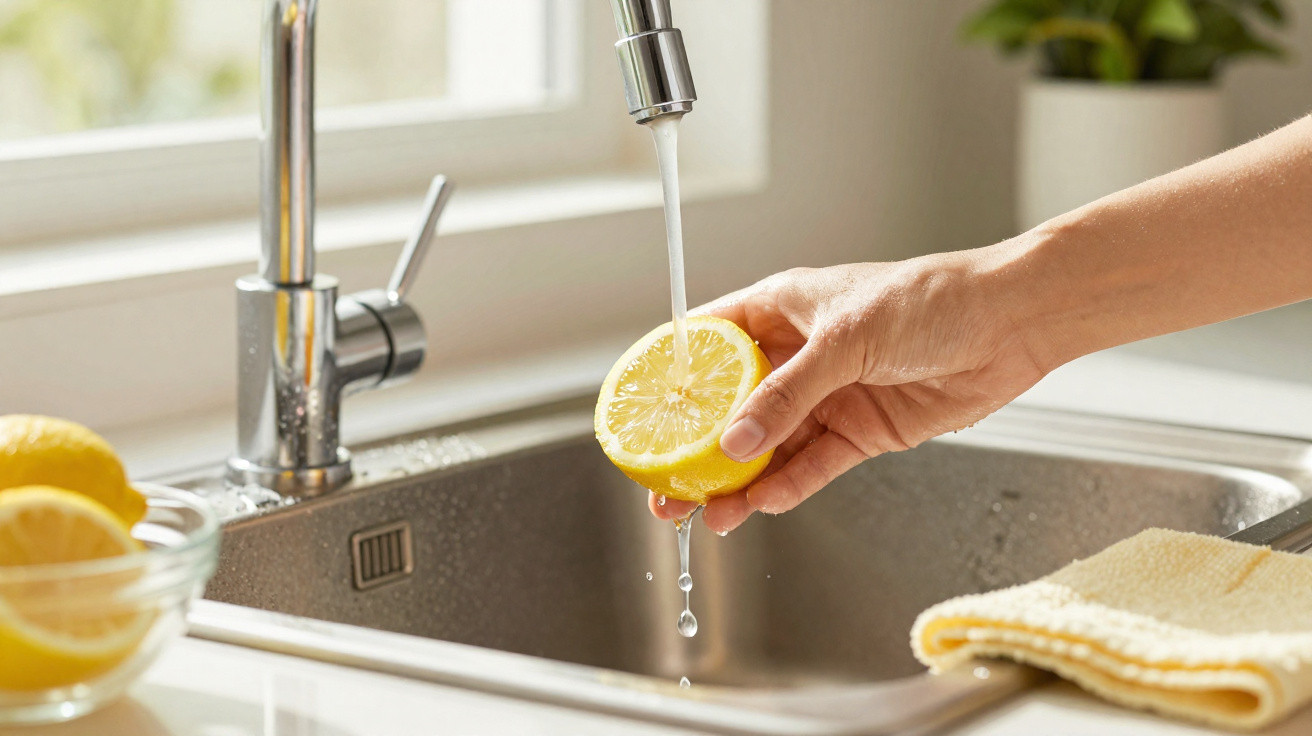
The first time I rubbed a cut lemon over my bathroom tap, I expected absolutely nothing. I had read one of those online “grandma hacks”, rolled my eyes and picked up half a rather sad leftover lemon from the fridge. My chrome tap was dull and spotted, with white crusty rings that seemed completely immune to ordinary cleaning sprays.
I pushed the lemon against the metal, heard a faint fizz, and watched the white marks melt away within seconds. The strangest part came after I rinsed and dried the tap: water began to bead up and run off as though it were a freshly waxed car.
Something unseen had altered that surface.
Why lemon defeats hard water stains
If you live in a hard water area, the bathroom tap is effectively the frontline in a battle between mineral deposits and shine. Every shower and hand wash leaves tiny droplets behind, which dry into flat, chalky marks. Eventually, those marks become limescale that seems to require endless scrubbing.
Lemon halves hardly look like serious cleaning tools. They look more like a garnish. But as soon as the juice touches that white crust, it begins to fade almost magically. The tap reflects the room again, as if you have achieved a professional-standard clean using expensive products.
Imagine a Sunday morning when the light falls into the bathroom at just the right angle. That is when the reality shows itself. The tap you “cleaned” the previous day is already speckled with tiny white freckles. They gather at the base, along the spout and beneath the handle. Most people reach for the nearest brightly labelled bottle with a warning symbol on the back.
A friend replaced that product with a lemon after her toddler kept trying to grab the limescale remover. She cut one in half, rubbed the tap, left it for a few minutes, wiped it down and sent me a photograph. The result was absurd: the previously greyish chrome looked new, while the cloudy ring around its base had disappeared. She had not scrubbed at all.
There is a straightforward chemical explanation behind this small miracle. Hard water marks consist mainly of calcium carbonate and magnesium salts, minerals related to chalk and limestone. They adhere to the metal and gradually form stubborn layers. Lemon juice contains plenty of citric acid, a mild organic acid that can nevertheless react with these minerals.
Rubbing the cut lemon over the tap allows the acid to break down the chalky deposits into soluble compounds that are easily rinsed away. The juice also lightly degreases and etches the surface, lifting soap scum and body oils that would otherwise hold more scale in place. That is why the restored shine can look not merely cleaner, but noticeably crisper.
The lemon method for a longer-lasting shine
Begin with a dry tap. This matters more than it may seem, as the lemon juice needs direct contact instead of being diluted by water. Take half a fresh lemon and give it a gentle squeeze so that juice forms on the cut surface. Rub it slowly over the entire tap: the spout, handle, base and even the fiddly crevices where white residue gathers.
You may hear a gentle fizz where the limescale is thickest. That is the acid reacting. Leave the juice on the metal for three to five minutes. On particularly stubborn areas, hold a small piece of lemon peel against the mark as a mini compress. Rinse with warm water, then polish gently using a soft microfibre cloth. This is when the proper mirror-like shine emerges.
Many people hurry through this trick and achieve only half the effect. They pass a lemon over the tap as though blessing it, rinse at once, then complain that the marks remain. The acid needs a short period of contact to work through thicker mineral deposits.
Another frequent error is following the lemon with a dirty or abrasive sponge, which can scratch chrome and take away the shine you have just restored. A soft cloth is all that is needed because the limescale has already dissolved by then. Realistically, nobody does this every day. However, a thorough lemon “treatment” every week or two can greatly slow the build-up and preserve that bright, hotel-bathroom appearance for far longer.
“People think the lemon is only cleaning,” explains a home-care chemist I interviewed, “but what really impresses me is the micro-film it leaves behind. It slightly changes how water spreads and dries on the metal.”
Here is the extra benefit: once you rinse away the lemon and buff the tap dry, a very fine layer of natural lemon compounds remains behind - citric acid residue, essential oils and traces of the peel’s natural waxes.
- Cleans: Breaks down calcium and magnesium deposits on contact.
- Polishes: Removes grease and gently smooths the metal for a brighter reflection.
- Protects: Creates a light hydrophobic film that encourages water to bead and roll away.
- Freshens: Neutralises bathroom odours with a subtle, natural citrus fragrance.
- Saves money: Replaces several specialist cleaners with one leftover lemon half.
The invisible shield that stops water droplets clinging
After giving the tap a proper lemon rub, you may spot something interesting the next time you turn it on. Water gathers into rounded beads and rolls away, rather than spreading into flat patches that cling to the surface. This suggests the surface has become less receptive to water. The delicate lemon film works like a tiny raincoat for the tap.
That does not mean the tap will remain spotless indefinitely. It simply means that every splash leaves behind less residue, because droplets are less likely to sit there and dry in place. After a few days, there should be fewer fresh marks, while the previous shine lasts longer than it would after a quick spray and wipe. Some readers say they even find themselves switching on the bathroom light simply to admire the tap. It is a small but strangely satisfying pleasure in an otherwise ordinary day.
| Key point | Detail | Value for the reader |
|---|---|---|
| Natural descaler | Citric acid breaks down hard water minerals and soap scum | A deep clean without harsh chemical fumes |
| Protective film | A light residue from the juice and peel alters the way water beads | Fewer new marks and a longer-lasting shine |
| Everyday practicality | Makes use of leftover lemon halves from cooking or drinks | A low-cost, low-effort routine that works in real life |











Comments
No comments yet. Be the first to comment!
Leave a Comment