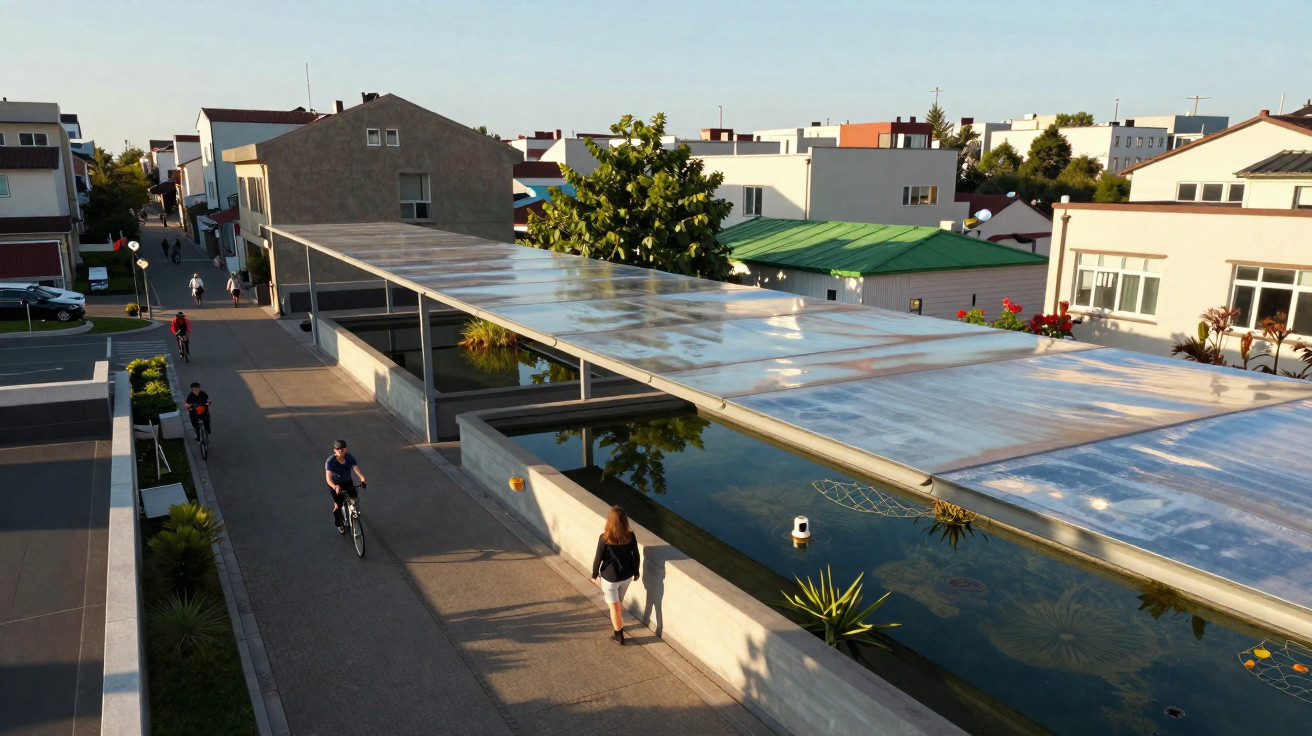
Engineers are suspending bright, reflective canopies above streets and courtyards, then discreetly directing rising hot air into rooftop ponds that absorb it at midday. On the hottest days, the outcome is a local heat island reduced by three, and at times four, degrees - not merely a concept, but cooler steps and easier breathing.
I am on a city block where shade does more than sit still. A silver canopy stretches across the pavement like a sail, with an underside that diffuses daylight into a soft glow. The movement of air is visible: it is gently drawn towards the building edge, creating a quietness that seems to settle the street.
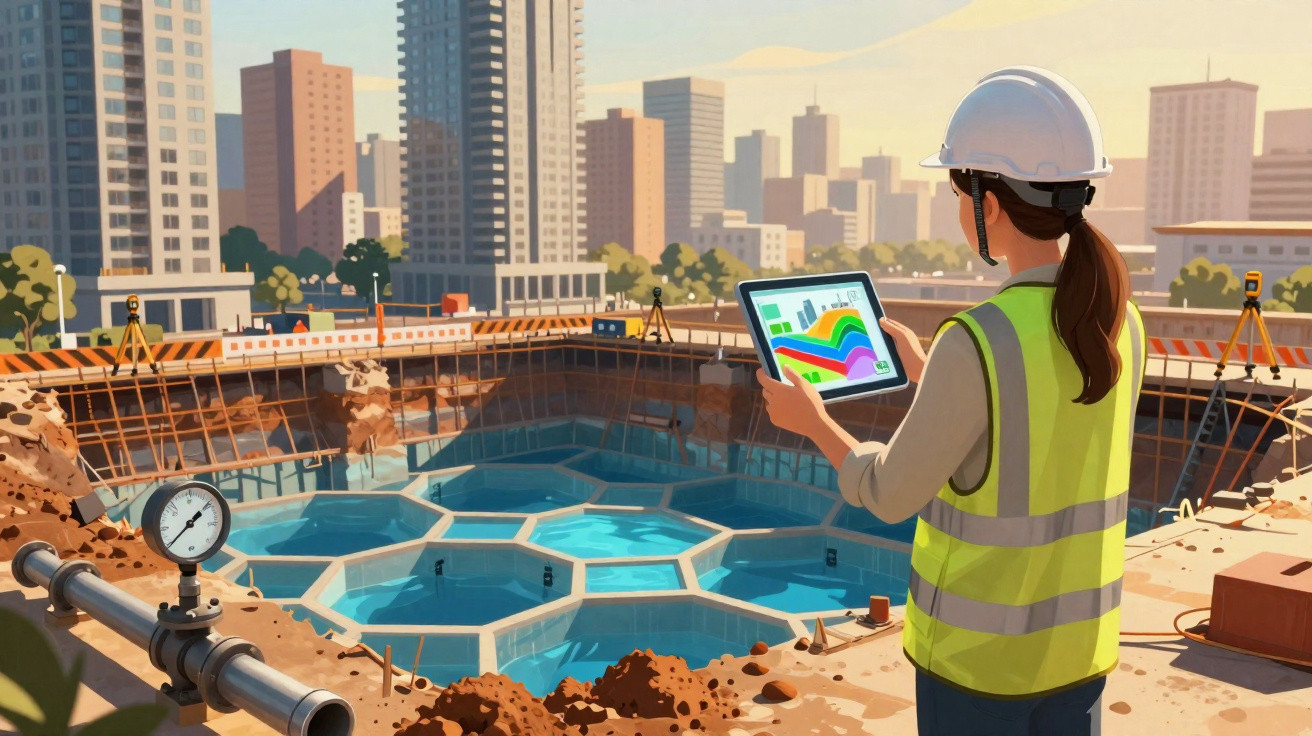
Above, a thin layer of water sits on the roof, no deeper than a hand, shimmering in the intense sun. A modest baffle channels the ascending heat over this reflective surface, where it vanishes as vapour. Those on the pavement may not see this sequence, but they notice it as a pushchair moves from fierce heat into comfort. It is like walking beneath a raised lid. The shadows are doing their job.
Shadows that steer the wind, and ponds that drink heat
Once you watch a reflective canopy, its patterns become apparent. Light-coloured surfaces send back solar energy that asphalt would otherwise absorb, while also producing a temperature difference. That difference drives a small natural system: air beneath the canopy remains cooler, air beyond its edge heats up, and the warmer air lifts in a gradual plume, directed by the canopy's form towards the roofline.
On one trial block, installation teams positioned the canopy's highest ridge in line with the afternoon wind. The hottest air moved towards slim façade vents, rose through a channelled opening, and then passed over the roof pond almost silently. Sensors on the street showed that midday air temperatures fell by about 2°C, while ground surfaces dropped by 6–10°C compared with the uncovered pavement next door. On the worst days, the difference is not subtle. Children no longer jumped between small patches of shade. They just walked.
The principle is almost disarmingly straightforward. Reflect more sunlight to prevent surfaces from overheating. Channel rising convection so that it does not linger above pedestrians. Place several centimetres of water where that airflow reaches the roof at noon, when humidity is low and evaporation has its greatest effect. One millimetre of water evaporating from one square metre takes in around 2.45 megajoules of heat - sufficient to lower air temperatures when repeated across many rooftops. Applied block by block, it can shift a neighbourhood's daily peak towards something bearable.
The playbook: map, angle, sip, repeat
Begin with a summer heat map. Walk the route at 1 p.m. and identify the painful spots where asphalt radiates heat and glass reflects glare. Take measurements where possible, although your skin can be a useful indicator. Install canopy panels with their ridges and openings aligned to the prevailing afternoon wind. Heat needs an exit route: use narrow openings along building edges rather than allowing it to collect above the pavement. Start where people gather, then connect the dots.
On the roof, create a 3–5 cm-deep pond with pale, UV-stable liners and a coarse wicking mat to distribute water evenly. Include a low edge and a small overflow leading to a downpipe cistern. The pond should remain exposed at midday, then be lightly covered overnight with floating mesh to limit needless losses. A small pump may encourage circulation during the strongest sunshine before switching off. Gravity and sunlight should do most of the work. Let’s be honest: no one does that every day.
Many common errors result from well-meaning, rushed decisions. A canopy set too low may hold hot air at head height, whereas one placed too high will not create enough draw. Black shade cloth may appear inviting but becomes hot; instead, select high-albedo materials with light-diffusing textures that reduce glare. Do not allow rooftop water to stagnate - maintain slight movement, keep it shallow, and stop it becoming mosquito habitat through flow and mesh. Water consumption concerns are understandable, yet audits indicate that these systems can operate using captured rainwater and limited top-ups, particularly alongside drought-tolerant planting. You’re designing a rhythm, not a machine.
“We stopped trying to cool the whole sky,” an urban designer told me. “We cool the space where people live, then we shepherd the rest to a place that can handle it.”
- Typical midday air drop on pilot blocks: 1.5–3.5°C; surface temp drop: 6–12°C
- Target canopy height: 3.2–4.5 m; ideal gap at façade: 20–40 cm for a steady draw
- Roof pond depth: 3–5 cm; add wicking mat and floating mesh for even evaporation
- Water budget: prioritize rain capture; top-up needs are modest in most climates
- Maintenance: monthly rinse, quick mesh check, seasonal liner inspection
What cooler streets unlock
As the heat eases, the pace of the city shifts. Bus shelters become places to read again, queues for street food return, and lunchtime basketball resumes. Businesses on shaded routes report that visitors stay longer, while parks formerly used only in the morning gain a second life in the evening. This is about more than comfort: it brings back spontaneity.
Health departments welcome the results: fewer heat-stress calls have been recorded near the pilot projects, alongside more older people walking during late afternoons. Schools using reflective shade and roof ponds describe calmer playgrounds. We have all crossed a glaring square and felt the sun drain our resolve. Cooling through shadows is not a luxury improvement. It is dignity.
The next phase is likely to be collective. City blocks could coordinate canopy angles so that the draft travels onwards. Rooftops could manage ponds together as an urban commons. Local makers could introduce modular sail panels that incorporate art as well as engineering. The physics may be ancient, but its civic application is new. It poses a simple question that can prompt neighbours to act: where should the shade fall first?
| Key point | Detail | Why it matters to the reader |
|---|---|---|
| Reflective canopies steer convection | Align ridges with the afternoon wind; vent warm air towards roofs | Cooler pavements without heavy machinery |
| Roof ponds evaporate at noon | 3–5 cm of water over a wicking mat; floating mesh at night | Removes heat where it gathers and reduces peak stress |
| Block-by-block rollout works | Begin with stops, schools and markets; then link corridors | An actionable, affordable plan for your street |







Comments
No comments yet. Be the first to comment!
Leave a Comment