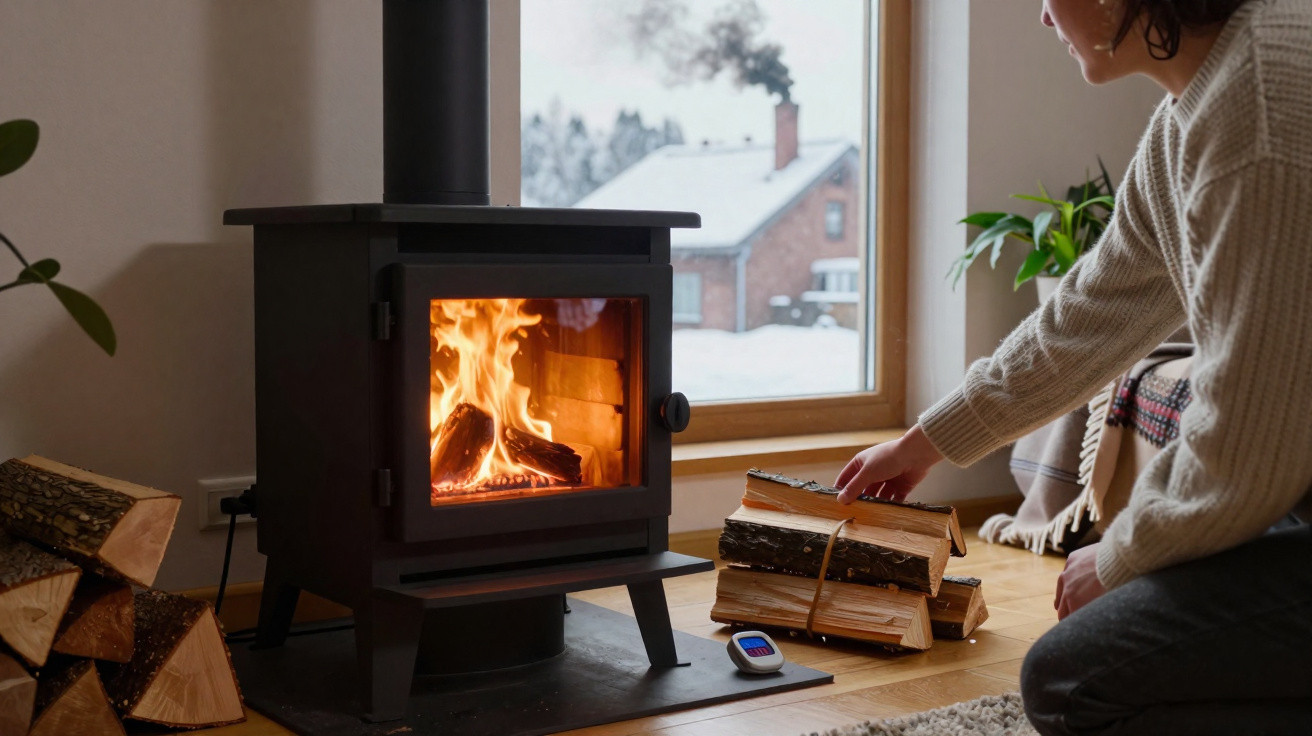
It is 7:12 p.m., the first properly cold evening of the year, and the entire street carries the scent of woodsmoke and nostalgia. Outside, your neighbour is struggling with a wheelbarrow full of logs, breathing like an ageing steam engine. You look towards your own nearly depleted woodpile and feel a familiar knot in your stomach: if you run the stove as you did last year, this winter will cost a fortune.
Indoors, the fire is already snapping away, yet you know that half its warmth is vanishing directly up the flue. It is easy to imagine pound notes drifting away with the smoke.
What if you could use half as much wood… while keeping the same comforting warmth?
What if your living room was still glowing in February, while your stack of logs looked almost untouched?
Why some people burn mountains of wood for nothing
Watch people light their stoves on a winter evening and the same mistakes soon appear. The door stays open for too long, smoke pours into the room, logs are piled in without thought, and the air vents are adjusted at random as if they were a faulty radio. Afterwards, they complain that their stove “doesn’t heat very well” and that wood “burns so fast these days”.
In most cases, neither the stove nor the logs are to blame. It is the way the fire is handled, usually without much thought.
We use a wood stove as though it were a campfire, then wonder why the house is cold at 3 a.m.
Consider Pierre, who lives in a stone house on the edge of town. By the end of February last winter, he had used six full cubic metres of oak and beech. It is the sort of figure that makes your back ache before you have even moved a log. He kept the stove going all day, with its door partly open and huge, roaring flames that looked spectacular in Instagram stories.
What did that achieve? His living room was sweltering at 8 p.m., cool by midnight and icy by morning. His chimney sweep told him plainly: “You’re heating the birds, my friend.” This year, with the same stove, house and logs, three straightforward adjustments have almost halved his consumption. People do not believe him until they enter his home and feel the difference.
The principle is harshly straightforward. A poorly operated stove sends heat through the roof, draws warm air from the room and makes you keep adding logs. A properly managed stove behaves like a slow, controlled store of heat. Fewer flames, more embers. Less spectacle, greater consistency.
We fixate on “big fires” when the goal should be clean, prolonged burns and soft heat radiating from metal or stone. Fire is not supposed to entertain you; it’s supposed to work for you while you’re doing something else. The difference between a dramatic blaze and an efficient one is precisely where your woodpile vanishes.
Seven clever tricks that cut your log use (and annoy the neighbours)
The first method is almost ridiculously simple: light the fire from the top rather than the bottom. The “top-down” approach feels counterintuitive the first time you try it. Put the largest logs at the base, add medium-sized pieces above them, then place kindling and firelighters on top, creating a reversed sandwich. Light just the upper layer, then shut the door fairly soon afterwards, leaving the air supply reasonably open at the start.
Rather than producing an immediate inferno, the fire works its way slowly and steadily down through the stack. There is less smoke, fewer reloads and more even warmth. Before long, the stove itself begins to give off a gentle radiant heat, keeping the room warmer for longer instead of delivering 20 minutes of impressive heat followed by disappointment.
The second trick is to regard your logs as valuable food rather than a pile of random sticks. They must be dry, stored correctly and surrounded by circulating air. That means avoiding a damp corner beneath a tarpaulin, where they are half rotten by November. We all know the moment: you pick up a suspiciously heavy log and hear moisture hissing as it reaches the fire. That noise is your heat becoming steam and escaping from the room.
Dry wood burns more cleanly, more slowly and at a higher temperature. The stove glass remains clearer, creosote in the chimney is reduced and you need to reload less frequently. Your neighbour may still be splitting “green” logs in December, while you quietly use last year’s supply like a self-satisfied squirrel.
The third tip, and the one that can transform everything, is to reduce the primary air further than feels natural once the fire is established and the stove is hot. Do not starve the fire, but close it enough to prevent the flames from roaring. Look for gentle, unhurried flames that lap at the logs rather than rage around them.
“If your flames look like a rock concert, you’re wasting wood,” laughs Marc, a chimney sweep who’s been cleaning flues for 25 years. “The best burns I see are almost boring to watch. Glass clear, stove hot, logs slowly collapsing into a bed of embers.”
- Begin with plenty of air and strong heat, then reduce the airflow gradually.
- Add more wood onto a proper bed of embers, rather than three miserable blackened pieces.
- Choose smaller logs when you need rapid heat and larger ones for longer burns.
- Resist prodding the fire every five minutes.
In truth, hardly anyone follows this routine perfectly every day. Even so, those who get closest are the people still standing in March with half a woodpile left.
Why your neighbours will hate you by February
Heating efficiently with wood has an odd social consequence. As your neighbours trudge through the snow to collect “just one more load”, you are quietly reading on the sofa with warm feet, a stove purring like a contented cat and only two logs burning inside. Your curtains are not stained yellow by smoke, your lounge does not smell of a bonfire, and you have not spent every Saturday sawing and stacking wood.
Eventually, someone will ask, “You’ve already ordered more wood this year?” You will reply, perhaps a little sheepishly, “Not yet, I still have plenty from last winter.” That is the point when the real, quiet resentment starts.
There is a fourth, more subtle tactic: direct the heat towards the spaces where you spend time, rather than the areas you simply pass through. Shut doors to unused rooms, adjust your curtains and use a basic fan on a low setting to gently move warm air towards the coldest part of the house. A small fan placed on the floor and aimed towards the stove can disrupt the pocket of trapped heat and distribute warmth more evenly.
Your neighbour may turn the stove up to sauna temperatures simply to notice any warmth in the rear bedroom. You, by contrast, move the air rather than adding more logs. Each degree gained through circulation is one log left unburned.
The fifth technique is psychological: accept a house that is slightly cooler, but much more consistent. Rather than seeking 24°C at 8 p.m. before waking to 15°C, aim to maintain a steady 20–21°C. Your body adjusts, you sleep better, mornings feel less punishing and the woodpile barely shrinks.
You no longer need an “emergency reload at 11:45 p.m.” Instead, you can make calmer, earlier reloads using larger logs that burn slowly through the night. That dependable comfort quickly becomes addictive. Oddly, it also makes it obvious who is wasting wood in your street. Their chimneys chug like old diesel engines, producing thick, dark smoke. Yours gives off only a pale, almost invisible trail.
Living with less wood and more warmth
Once you have experienced what a properly managed stove can achieve, it subtly alters the pace of winter. You stop judging comfort by how many logs have been burned and begin to notice different signs: how the floor feels beneath your feet, how quickly your mug of tea goes cold and how well the room holds its temperature when the fire settles into embers.
Each log starts to represent time rather than simply timber: 45 minutes, an hour or two hours of stored sunlight from a summer long gone. Using that time recklessly suddenly seems slightly absurd. You burn more slowly, view your remaining stack with both pride and relief, and begin passing these small tips to friends, while half worrying that you sound obsessed.
Some people will dismiss them, others will take notice, and a few will quietly resent the fact that your living room is warmer than theirs despite fewer deliveries and fewer back-breaking afternoons.
Ultimately, the real trick is not having the largest woodpile, but requiring the smallest one.
| Key point | Detail | Value for the reader |
|---|---|---|
| Top-down fire start | Lighting the fire at the top creates a slower, cleaner downward movement of flames | Less smoke, fewer reloads and more even heat over time |
| Dry, well-stored logs | Wood seasoned for at least 18–24 months and kept in ventilated storage | More heat from every log, less creosote, cleaner glass and chimney |
| Controlled air and stable temperature | Reducing airflow after the fire is established, with a steady 20–21°C target | Longer burns, fewer logs used and a more comfortable indoor climate |
FAQ:
- Question 1 How much wood can I realistically save with better stove habits in one winter?
- Question 2 Is a modern stove really that much more efficient than an old one?
- Question 3 Does burning slower mean I’ll create more creosote in my chimney?
- Question 4 What kind of wood burns the longest and gives the best heat?
- Question 5 How do I know if my wood is dry enough without fancy tools?














Comments
No comments yet. Be the first to comment!
Leave a Comment