It begins with a notice by the entrance to the building: “Please remove your garden furniture from communal areas. Municipal enforcement office.”
You arrive home carrying shopping bags, glance into the courtyard and there they are: three abandoned plastic chairs, a rickety table whose colour has long been bleached away by the sun. Beside them sits a barbecue, coated in congealed grease as though someone is about to take a seat again. But nobody does. Not for weeks. Not for months. The furniture becomes scenery: rubbish pretending to be comfort.
More and more cities no longer want to see precisely this scene.
Suddenly, it is no longer simply about chairs and tables. It is about noise, fire safety, escape routes, microplastics – and the question of who truly owns a city’s outdoor space.
From a cosy seating area to an urban problem
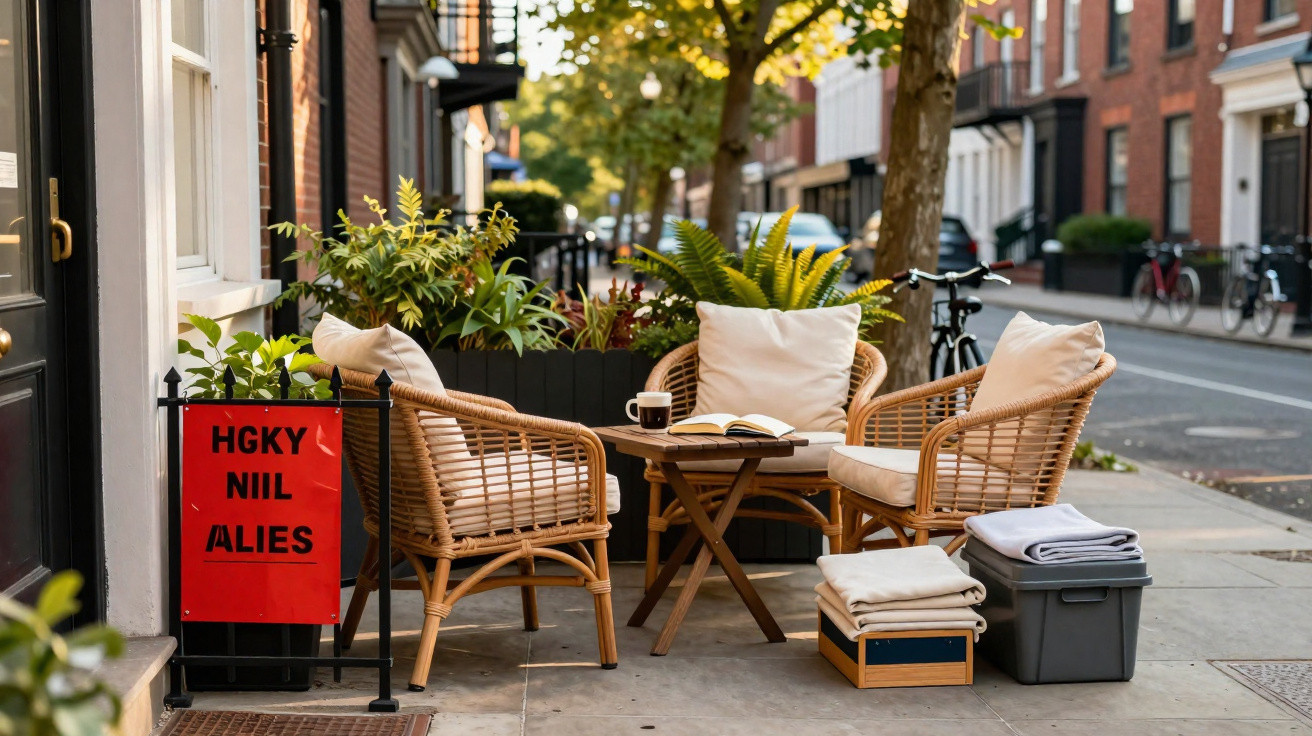
We all know the pattern: the first warm day of the year arrives and balcony and courtyard setups appear everywhere. Cheap folding chairs, sprawling lounge sets and brightly coloured sun loungers make every back yard look like a seaside promenade. At first, it feels charming: an urban summer, a touch of southern atmosphere between wheelie bins and bicycles.
Yet when autumn arrives, much of it is simply left in place. Rain pools in cushions, timber starts to rot, fabrics develop mould, and plastic fades and cracks. What looked like a joy for life in April resembles a poorly maintained bulky-waste depot by November. This is exactly where a growing number of cities are taking action.
Look at Hamburg, Cologne, Vienna and Zurich: notices are increasingly appearing in back yards and on pavements, stating things such as “furnishings must be removed at the end of the season” or “permanent storage of garden furniture prohibited”. In some neighbourhoods, municipal enforcement officers carry out systematic inspections; elsewhere, complaints come from local residents.
On one street in Cologne-Ehrenfeld, for example, an increasing number of items gradually appeared on the pavement. First came two chairs, then a table, and suddenly a sofa beneath a makeshift tarpaulin. Pedestrians had to step into the road, while pushchairs could no longer get through. The city’s final record stated: “Obstruction of public space through permanent furnishing.” It may sound bureaucratic, but it tells a very real story of irritated residents and stubbornly worn-out comfort.
The plain truth is that cities are more than private extensions of people’s living rooms. When garden furniture remains outside for months, the atmosphere changes. “Everyone sits together” turns into “one household is taking over the space”.
There is also an environmental dimension. Cheap plastic furniture breaks down under UV radiation, wind and frost. Tiny particles come loose and end up in the soil, drains and rivers. Eventually, local authorities have to collect special waste that formally belongs to no one. In narrow fire access lanes and courtyards, tables and seating groups obstruct escape routes that should remain clear. What may look like an individual lifestyle choice can collectively have major consequences for safety, urban cleanliness and the sense of community.
What cities require for garden furniture – and how to avoid trouble
Most rules are worded without much fuss, but they are fairly clear: garden furniture may remain outdoors when it is in use, but it must not be permanently “stored” there. Many cities base their approach on the “season”. In practice, this means temporary furniture is acceptable from spring to early autumn; after that, chairs, tables and sun loungers should be taken indoors, onto a balcony or into a cellar.
A useful rule of thumb can be drawn from many local by-laws: furniture that is visibly weatherproof, well maintained and used regularly is generally tolerated. Items that look partly broken, moss-covered or permanently unused are treated as stored waste. City authorities tend to focus less on questions of style than on signs of neglect and danger.
The most common mistake is putting everything outside in May and not touching it again until October. Seat cushions stay out in the rain, the parasol hangs crookedly during storms, and the table becomes somewhere to leave empty plant pots. Let us be honest: nobody carries an entire lounge set back into the cellar after every evening.
But this convenience is where the relationship with the city starts to shift. Those living on the ground floor can be inclined to see the front garden or pavement immediately outside the building as an extension of their flat. Neighbours one floor up, however, may experience the same furniture as an obstruction, a source of noise or something that “is never going away”. One person’s sense of home becomes another’s feeling of being imposed upon.
An urban planner from southern Germany puts it this way:
“We have nothing against chairs outside the door. We object to furniture becoming real estate – just without planning permission.”
Anyone wishing to prevent conflict can follow three straightforward principles:
- Put out only as much as is genuinely used – and use it regularly.
- Choose quality over quantity: a few sturdy, repairable pieces rather than entire plastic landscapes.
- Have a clear winter break: bring inside anything that is not permanently weatherproof and fixed in place by the first prolonged spell of rain at the latest.
These three points will not solve every neighbourhood dispute, but they reduce the chance that your favourite chair will eventually appear in a municipal enforcement report.
What is at stake: the streetscape, neighbours and responsibility
At first glance, the debate over garden furniture seems absurdly minor. A few chairs. A table. Perhaps a sun lounger. Yet it reflects a bigger question: how much private space can we claim in public or semi-public areas without needing to discuss it with everyone else?
Some cities use these new bans to address the appearance of entire neighbourhoods more broadly. Decaying furniture, oversized lounge sets in fire access lanes or cheap stacks of plastic chairs in front of listed façades all create the sense that “it does not matter, someone will clear it away”. Other residents respond by retreating. They spend less time outside and talk to one another less. Then people wonder why the neighbourhood suddenly feels “cold”.
At the same time, the issue touches an emotional level that never appears in regulations. Anyone with very little living space values every opportunity to occupy a small piece of the outdoors. The unsteady chair outside the front door becomes a quiet assertion: “This is where I live, this is where I am staying.” When cities take firmer action, many people feel this need itself is under attack.
The challenge is to distinguish between legitimate use of shared space and inconsiderate permanent occupation. No regulation in the world can manage that perfectly. Ultimately, it requires conversations in the corridor, brief notices on the communal board and small agreements: who removes what, and when? Who gets how much space? And what happens if someone does not take part at all?
Perhaps that is the hidden core of this whole story: garden furniture left outdoors permanently is a symptom. Of a lack of storage space. Of cheap consumption that is bought quickly and abandoned even faster. Of cities caught between quality of life and order.
When more and more local authorities introduce bans, it is not a campaign against your favourite sun lounger. It is an attempt to preserve a minimum level of shared control over common space. The most interesting question remains: do we use this opportunity to speak to one another, or do we wait until the next yellow notice appears at the entrance and everything has already been decided?
| Key point | Detail | Benefit for the reader |
|---|---|---|
| Cities prohibit permanent furnishing | After several months, garden furniture is classed as “stored waste” and may be removed or penalised | Better understand why notices from municipal enforcement officers appear and how to avoid fines |
| Environmental and safety considerations | Weathered plastic releases microplastics, while furniture blocks escape routes and pavements | Reassess your own behaviour in the courtyard or on the pavement and identify risks |
| Practical guidance for residents | Keep only used furniture outside, choose quality, and observe a clear winter break | Reduce disputes with neighbours and authorities without giving up comfortable outdoor space |
Frequently asked questions
- Question 1 What does leaving garden furniture outside “permanently” mean from the city’s perspective?
- Question 2 Can balcony furniture stay outside all year round?
- Question 3 What could happen if I do not remove my furniture despite being asked to do so?
- Question 4 How can I agree a fair arrangement for the courtyard with my neighbours?
- Question 5 Does it make a difference whether my furniture is made of wood, metal or plastic?













Comments
No comments yet. Be the first to comment!
Leave a Comment