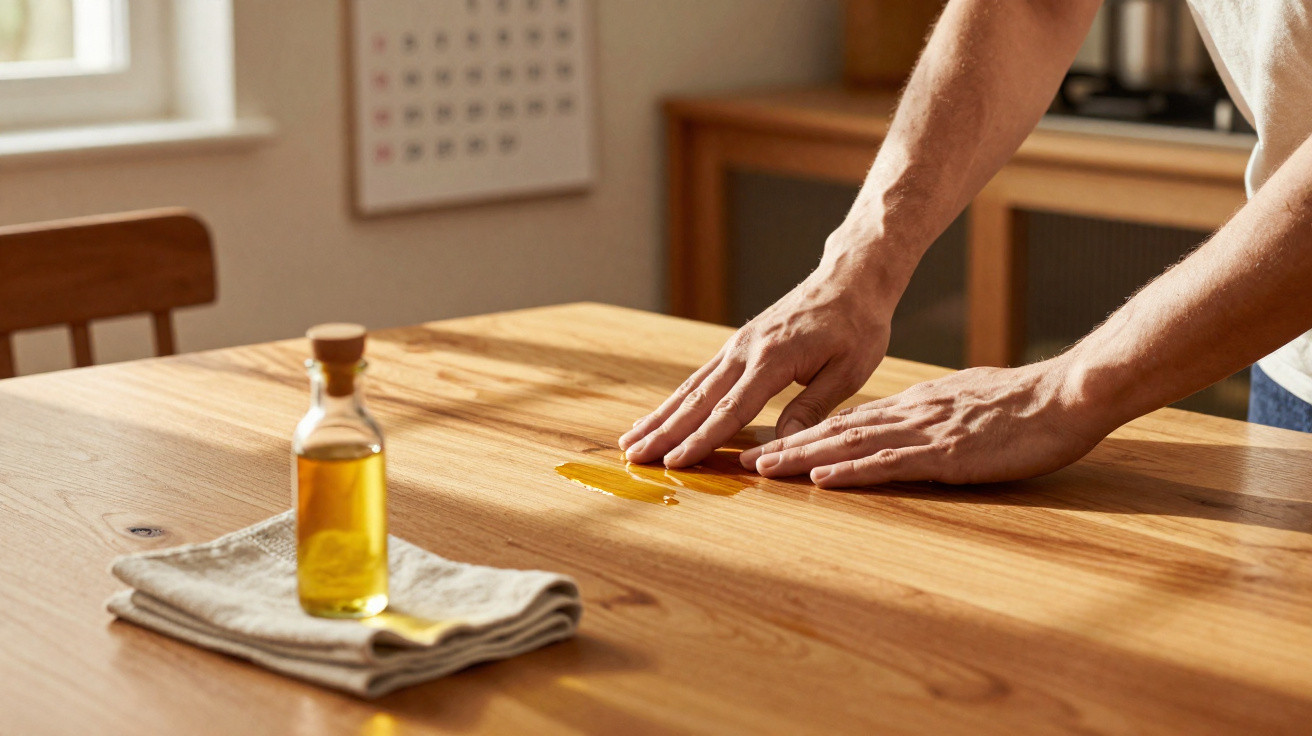
The oak table that once shone in the late-afternoon sun now appears worn, almost grey. There is a coffee ring in one place and a dry patch in another, like skin left without moisturiser for too long. When you pass your hand across it, the surface feels… parched.
Yet one corner still reflects the light. In that small spot, where oil has accumulated somehow over the years, the timber appears richer, warmer and younger. The difference is stark. It is the same table and the same wood, but it has led two entirely different lives: one gradually dulling, the other quietly cared for.
You start to ask yourself when the shift occurred: when did looking after it become neglecting it? Then a simple truth becomes clear: wood’s beauty does not vanish. It merely waits to be brought back to life.
The understated power of a monthly oil routine
Most wooden furniture is not ruined by one dramatic mishap. Instead, it loses its lustre through small acts of repeated disregard: a mug set down without a coaster, afternoon sunlight hitting the same area every day, or cleaning sprays that remove more protection than they provide. Wood is tough, but it is also porous, responsive and slightly temperamental.
Oiling it every month works rather like pressing reset. It nourishes the fibres, restores the colour and slows the gradual ageing that is easy to overlook. The result is not as immediate as a new coat of paint. You notice it five years later, when the table still seems to have stories in front of it rather than only behind it.
There is a tactile enjoyment in the process as well: the resistance of the cloth, the smell of natural oil and the subtle sheen that emerges while you buff. It feels less like a chore and more like a conversation with the material. In time, this modest routine distinguishes furniture that simply endures from furniture that genuinely develops character.
Consider a kitchen worktop. It is often the hardest-working wooden surface in the home, subjected to knives, hot pans, spilled wine and damp vegetables. When it is allowed to dry out, its fibres open, stains penetrate deeply, and the finish becomes uneven and rough. Before long, you hide it beneath chopping boards, then tablecloths, and eventually regret.
Now imagine that same worktop receiving oil each month. One family in Lyon monitored their solid beech worktop for six years, applying a straightforward food-safe oil roughly every four weeks. During the first year, its colour grew deeper. By year three, fine scratches had merged into a gentle patina. Six years on, visitors still described it as “new but vintage.” That is the ideal balance.
By contrast, a joinery workshop in Bristol tested two matching oak benches. One was oiled monthly; the other was treated “whenever we remember”. After three years, the neglected bench had black water marks around its legs, raised grain and a need for sanding. The regularly maintained bench was smooth, honey-coloured and free from deep staining. Same timber, same room, entirely different routines.
There is a straightforward explanation for why monthly oiling is so effective. Wood cells behave like thousands of tiny drinking straws. When they are dry, they readily take in anything that reaches them: water, coffee, skin oils, sauce or wine. This can cause staining, swelling and warping. Once those cells contain a compatible oil, however, they are less eager to absorb liquids. Spills remain closer to the surface rather than soaking straight in.
Oil also brings out the grain by altering how light interacts with the fibres. Dry timber scatters light, making it appear pale, chalky or even dusty. Oiled timber both absorbs and reflects light more softly and deeply. This is why a table may look flat one month, then almost three-dimensional after a careful oiling the next.
There is a psychological benefit too. A monthly routine makes you properly inspect your furniture. You spot a small chip before it worsens and notice early sun bleaching before it turns into a faded ghost patch. It becomes a dialogue with time rather than a fight against it.
How to oil wooden surfaces like a professional - without being one
The monthly routine begins well before you reach for the bottle. Start by cleaning the surface, using a slightly damp cloth rather than harsh sprays. If it is greasy, use a mild soap. The aim is to remove crumbs, dust and old sticky residue, not to strip the timber back to its bare state.
After it is completely dry to the touch, place a small amount of oil onto a clean, lint-free cloth. Think teaspoon rather than ladle. Work along the grain in long, unhurried strokes. You are not painting the timber; you are working the oil into it. Leave the first coat for 10–20 minutes, then return with a second dry cloth to remove the surplus.
That final stage is where the transformation takes place. Buffing removes oil the timber cannot take up while drawing out its soft sheen. The finish should feel velvety rather than tacky. If it still feels oily the following day, you applied too much. You will know to use less next month.
Here is the truth glossy interiors magazines rarely acknowledge: most people oil their furniture once, when it is new, and then fail to think about it again for years. Life becomes busy. You move home. Children arrive. Looking after the worktop slips far down the list. Let us be honest: nobody really does this every day.
That is precisely why a manageable schedule matters. For most regularly used indoor wooden surfaces - dining tables, worktops, desks and chopping boards - monthly is an excellent rhythm. Frequently used pieces in particularly dry or humid homes may require a little more care, while less-used furniture may need slightly less. Still, setting a reminder for the first weekend of every month already puts you ahead of 90% of people.
The major errors? Applying vegetable cooking oils that can turn rancid; failing to wipe away excess and leaving thick, sticky layers; combining random products without checking their labels; and sanding too aggressively whenever a mark appears. Timber does not need punishment. It needs gentle care, consistency and a light hand.
“I tell clients the same thing I tell new guitar owners,” explains Mark, a cabinetmaker who’s been working with walnut and oak for 25 years. “You’re not just preserving the object. You’re slowly teaching it how to age well. Oil is part protection, part conversation.”
For anyone who prefers a straightforward checklist, here is a brief monthly routine to consult on a Sunday morning:
- Clean the surface with a slightly damp cloth, then allow it to dry fully.
- Use a soft cloth to apply a small quantity of suitable wood oil, moving with the grain.
- Leave it for 10–20 minutes, then buff off every trace of visible surplus until the finish is dry to the touch.
- Leave the surface overnight before heavy use or exposure to water.
- Every 6–12 months, review the piece: does it need a more thorough refresh or light sanding?
Living with wood that becomes more beautiful, rather than more fragile
There is something quietly grounding about furniture that improves with age. This is not the artificial “aged look” bought from a shop, but genuine patina formed cup by cup and season by season. A properly oiled table carries its stories without shouting about them: the almost invisible ring from last winter’s mulled wine, or the softened scratch left when a child pulled a toy car across it.
Monthly oiling does not remove the marks of life. It integrates them into a harmonious finish. It is the difference between scars that still appear fresh and scars that have healed. This is why people who maintain the habit often find their view of their home changing. Surfaces cease to be “things to protect at all costs” and instead become living backdrops that accompany the family.
Practically speaking, the long-term approach is worthwhile. Nourished furniture is less likely to crack during dry winters than neglected timber. Its edges are less prone to chipping, and its colours do not fade into a sad, uneven yellow. When the time comes to sell, give away or pass on a piece, you are not beginning with damage limitation. You are offering something that already has a future.
The routine itself also brings a quiet mental reward. Ten minutes spent oiling a table means ten minutes away from screens, notifications and overthinking. It is a small physical task with a visible result. You watch the surface change beneath your hands, and you have made that change happen. Some people meditate. Some go running. Others oil the dining table and breathe.
So, when you next pass a tired sideboard or a dull oak worktop, stop for a moment. Its original colour is still beneath the dryness, waiting to emerge. A bottle of quality oil, a soft cloth and one unhurried Sunday each month may be all that separates “old furniture” from a “future heirloom”. The wood is ready. Are you?
| Key point | Detail | Benefit for the reader |
|---|---|---|
| Make monthly maintenance a routine | Select one fixed day each month to clean, oil and buff | Makes consistency easier without creating a daily mental burden |
| Use the correct oil | Choose oils suitable for wood (linseed, tung, food-safe mineral oil or professional blends) | Prevents rancidity, stains and sticky finishes |
| Always buff | Wipe away surplus after 10–20 minutes for a dry-to-the-touch finish | Creates a more pleasant surface, longer life and a premium appearance |










Comments
No comments yet. Be the first to comment!
Leave a Comment