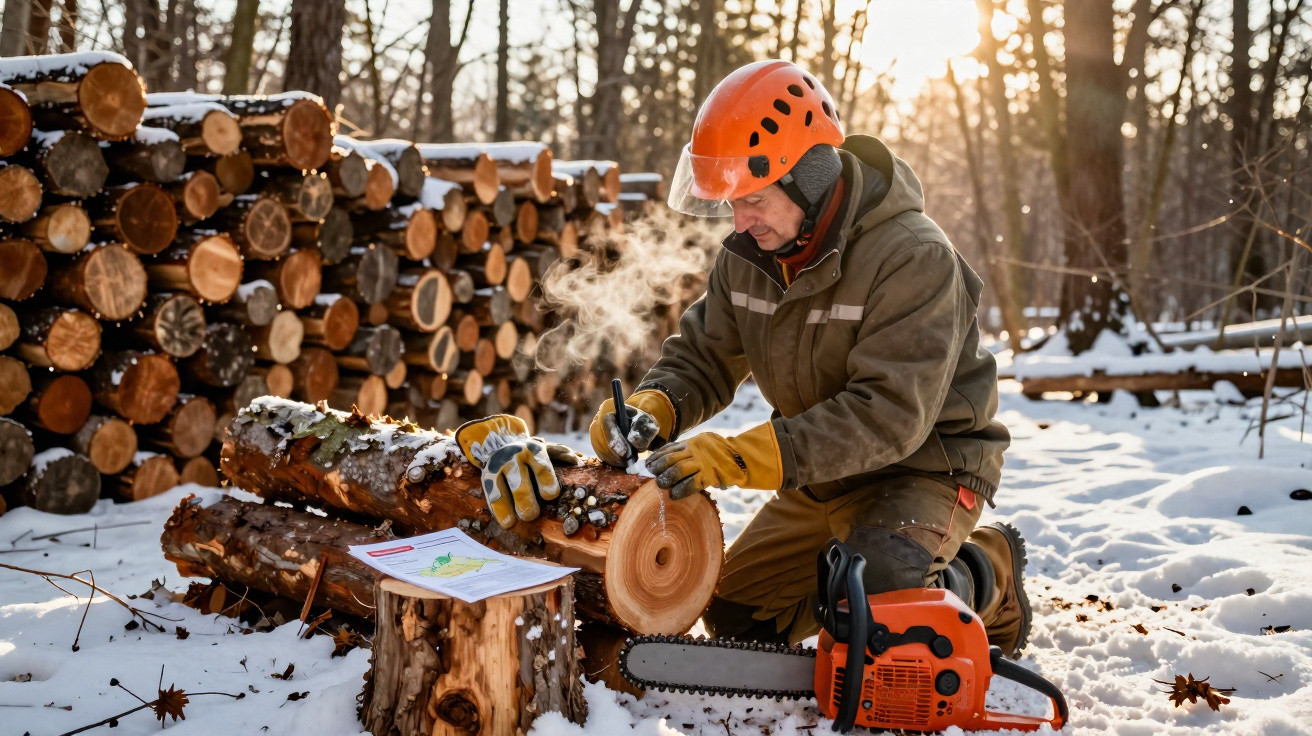
Across parts of Europe, a medieval entitlement still exists both in present-day legislation and in the muddy boots of people walking into woodland. While plenty of households rely on electric heaters and costly pellets, a smaller number continue to stock their sheds with logs obtained through an old community scheme rather than paid for with a bank card.
What this “free firewood” story is really about
The proposition can sound implausibly straightforward: legally obtaining free, or nearly free, firewood each winter. There is no hidden membership scheme or ingenious tax arrangement involved. Instead, it relies on a little-mentioned system called affouage.
Affouage is an historic right that lets local residents collect firewood from communal forests under strict rules and quotas.
Originating in medieval village communities, affouage allowed households to cut timber from nearby woodland to get through the cold months. It is easy to assume that a custom like this disappeared with feudalism. However, in France, parts of Belgium, Luxembourg and several Alpine areas, it remains in use in a notably modern form, governed by forestry codes and local authority decisions.
How the ancient right of affouage works today
Affouage is not an open invitation for anyone to enter a forest carrying a chainsaw. It operates through a tightly controlled local procedure.
Who can benefit
Eligibility is generally tied to residency. In many municipalities, applicants must either appear on the local electoral roll or have their main residence in the area. Owners of second homes and non-residents are at the end of the line, if they are eligible at all.
Each year, the local council determines whether affouage will be available. Storm damage or extensive thinning can result in a generous allocation. During droughts or pest infestations, however, a municipality may halt the programme to safeguard the woodland.
What residents actually receive
Participants cannot simply choose an oak tree they like and take it away. Forestry officers or council teams identify particular plots and trunks. Residents are then assigned either:
- a specified plot where they may clear designated trees or deadwood; or
- a fixed quantity of timber, measured in cubic metres or “stères”, piled beside a forest track.
An allocation commonly has further restrictions, covering the wood species, permitted trunk diameter and precise limits of the plot.
The core idea remains the same as in the Middle Ages: the forest belongs to the community, and the community shares its fuel, under rules that protect both trees and people.
When cutting is allowed
Affouage work is normally carried out in the colder part of the year. Many councils begin the season after leaf fall, when ground conditions help to reduce harm caused by vehicles and people. Municipal orders set out the approved cutting period, including firm opening and closing dates.
Cutting beyond those dates may result in a fine or the loss of future access rights. Woodland officials inspect the sites more often than some residents might imagine.
The physical work behind “free” wood
The financial benefit requires considerable effort. Under traditional affouage arrangements, households have to:
- cut or fell the assigned trees;
- remove branches and separate usable logs;
- move the timber to accessible tracks or take it home; and
- stack and season the logs for at least one year.
Some councils provide an “already cut” alternative, although this costs more. Residents are still responsible for loading and stacking the wood.
Why the practice still matters in 2025
Energy prices bring old ideas back into focus
As gas and electricity prices fluctuate across Europe, households are looking for heating options with more predictable costs. Properly managed firewood, particularly from communal woodland, can protect families from sudden increases in energy bills.
A home heated with wood may use 6 to 10 cubic metres over a winter, according to its insulation and local climate. At shop prices, this can amount to several hundred euros. Via affouage, the same quantity may be available for only a small administrative payment.
Affouage doesn’t magically erase heating costs, but it can turn a painful winter bill into a manageable local charge and some hard weekend work.
Environmental and social angles
Communal timber usually travels only a few kilometres between the stump and the stove, unlike imported pellets or firewood transported over long distances. This short supply chain reduces transport emissions while retaining spending within the local economy.
Foresters can also use affouage to complete essential thinning work. Allowing residents to remove selected trees and deadwood lowers the amount of fuel available for wildfires and encourages healthier development among the remaining trunks.
There is a social benefit as well: weekends in the forest generate a form of collective activity that energy apps cannot offer. Neighbours exchange chainsaw advice, lend each other trailers and compare their log piles. Village WhatsApp groups end up full of trailer photographs rather than restaurant dishes.
What you usually have to do to qualify
| Step | What typically happens |
|---|---|
| Contact the town hall | Residents enquire whether an affouage campaign is planned and ask how to register. |
| Sign up on time | Names are added to a list; the council fixes a deadline and may sometimes use a lottery. |
| Pay the fee | A modest payment covers administration and, in certain cases, forestry work. |
| Receive a plot or volume | The council or forestry service identifies the trees or timber piles assigned to you. |
| Cut and collect | You arrange the equipment, labour and transport while observing safety requirements. |
Tools, safety and legal rules
Affouage may appear quaint, but accident figures paint a different picture. Chainsaws, falling limbs and steep ground all present genuine hazards. Many municipalities now require:
- protective equipment: a helmet, gloves, reinforced-toe boots and chainsaw trousers;
- basic instruction before anyone is permitted to fell standing trees;
- restricted working hours to protect wildlife and limit noise; and
- children to be kept out of active felling areas.
Insurance may also be relevant. In some locations, households need to provide proof of liability cover before taking part. Where residents do not have the necessary skills or equipment, informal co-operatives may emerge, linking experienced cutters with people who can help with transport or stacking.
How much money residents can realistically save
Savings differ substantially, but the following typical example gives an indication:
- A household requires 8 cubic metres of seasoned hardwood for winter heating.
- Retail price: often equivalent to 80–100 euros per cubic metre delivered.
- Market cost: 640–800 euros per season.
- Affouage fee: sometimes around 20–40 euros, plus fuel for tools and vehicles.
Over five years, a committed family can keep several thousand euros in their account, at the cost of a few long Saturdays in the woods.
The figures look different if a household has to purchase a chainsaw, trailer or log store. Nevertheless, many participants already have basic equipment or share it with relatives. For those people, the return on the investment can arrive quickly.
What if your town does not offer affouage?
Although affouage is firmly rooted in continental Europe, other places offer organised access to timber through different arrangements.
Alternative paths to low-cost firewood
- Deadwood permits in public forests – Some forestry bodies sell inexpensive permits allowing residents to collect fallen branches or logging leftovers along designated tracks.
- Sawmill offcuts – Nearby mills frequently sell offcuts, slabs and end pieces cheaply. They dry quickly and work well in smaller stoves.
- Tree surgeon waste – Arborists routinely chip or remove branches from urban trees. In several areas, they now link up with households able to take logs rather than have them sent to landfill.
- Community wood banks – Some towns, especially in colder rural locations, operate wood banks where volunteers cut and store firewood for residents on low incomes.
These choices do not reproduce affouage’s precise legal structure, but they are based on the same principle: organised access to local biomass instead of reliance on distant energy markets.
Beyond the bargain: hidden risks and quiet advantages
Burning wood, whether sourced through affouage or by another route, raises technical and health issues that are often overlooked. Damp logs create smoke, soot and creosote. Stoves that are not properly maintained use energy inefficiently and release fine particles into household and neighbourhood air.
Households using this historic entitlement must still pay for a competent chimney sweep, a modern stove with efficient combustion and an appropriate ventilation plan. A low-cost winter can become costly if a chimney fire leads to an emergency-service callout.
On the other hand, wood heating can work alongside other measures. A family could use high-efficiency electric heaters on mild autumn evenings before turning to wood during severe cold spells, reducing pressure on local electricity networks. Some councils even advocate this combined approach to help prevent blackouts in extreme weather.
As arguments about energy security and climate policy become more intense, the obscure medieval term affouage continues to form a quiet link between the past and the present. It shows policymakers that local answers do not invariably depend on advanced technology or complicated markets. Sometimes they require only clear rules, a chainsaw and the readiness to work for warmth.











Comments
No comments yet. Be the first to comment!
Leave a Comment