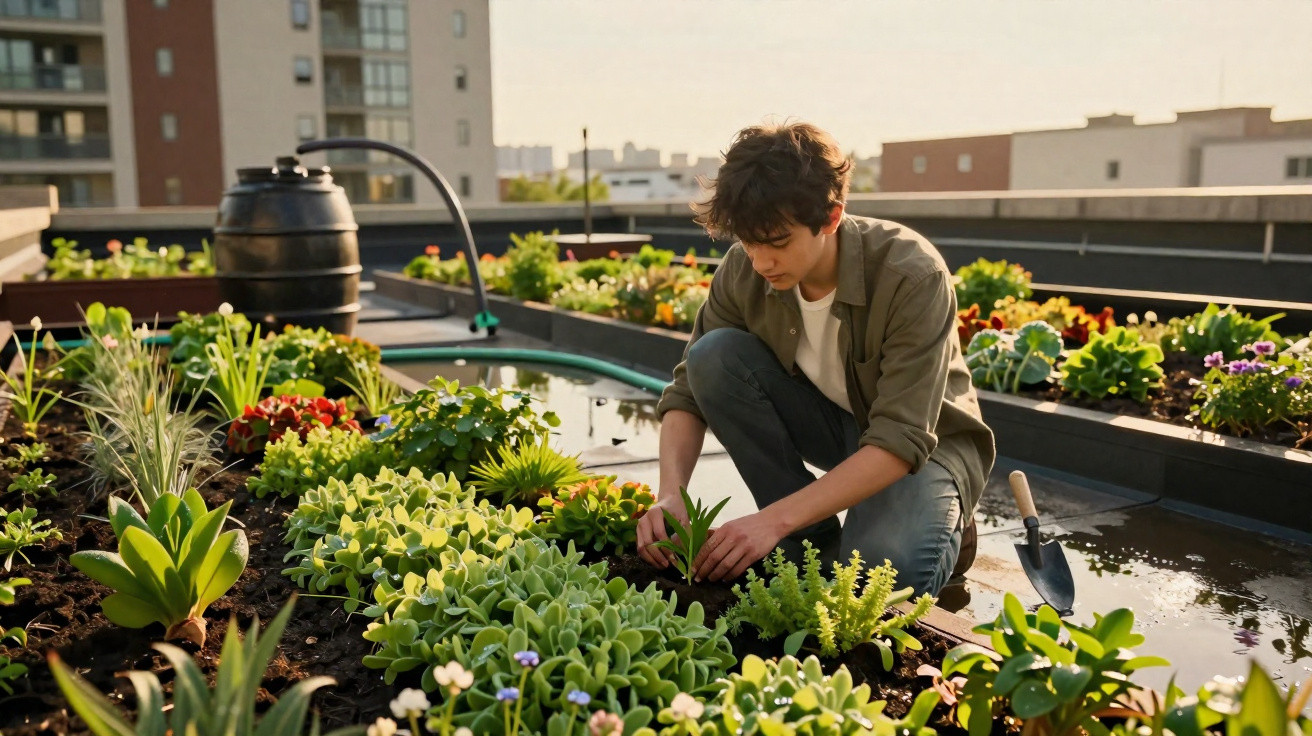
Pavements throw back the light, building fronts store the heat, and people search in vain for a patch of shade that simply is not there. Then one day, you look up. Above a grey building, a roof terrace bursts with greenery: tall grasses, small flowers and insects skimming low, like a suspended secret garden. Traffic noise suddenly feels less harsh, muffled by this living layer. The air seems slightly cooler. It feels as though you have found a crack in the mineral city. It is no mirage. It is a roof with a new purpose.
From baking rooftops to living canopies
Walking through a major city in summer can feel like crossing an enormous oven. Flat, black, bitumen roofs soak up heat throughout the day, then release it in the evening, just when everyone wants some cool air. As air-conditioning units hum away, temperatures climb another notch, creating the familiar urban heat islands. Roofs are everywhere, yet for a long time they were treated as nothing more than inert lids. They are now becoming strategic surfaces. Covered with plants, growing medium and sometimes small trees, thousands of roofs are quietly changing the way cities breathe, absorb water and function.
Toronto, for instance, has required large new buildings to incorporate green roofs for more than a decade. The outcome is that over 700,000 m² of vegetated roofing has appeared above its streets, creating a patchwork of gardens that remain invisible from the pavement. In Paris, the roofs at Porte de Versailles now host one of the world’s largest rooftop urban farms, where lettuces grow only metres from advertising hoardings. In Singapore, HDB residential developments have turned concrete slabs into planted platforms, cutting surface temperatures by several degrees. Taken individually, these schemes may look modest. Combined, they are beginning to influence the local climate.
Behind the poetry of suspended gardens lies a very practical mechanism. Plants transpire, while water held in the growing medium evaporates, and this straightforward biological cycle lowers the surrounding temperature. Reductions of 2 to 5 °C near a roof are often cited, sometimes more during a heatwave. At the same time, the soil and root layers can hold back 70 to 90% of rainfall from light showers, easing pressure on overloaded sewer systems. A green roof works rather like a slow sponge: it stores water, releases it gradually or returns it to the air. Since plants also filter certain pollutants, trap particles and provide a haven for wildlife, every roof can become a miniature reserve where there was previously only bitumen.
How cities and residents are turning green roofs into climate tools
The approach seen across different places is simple in principle: turn a dead surface into a living one. A basic layered structure - waterproof membrane, protective layer, drainage, growing medium and vegetation - can create a lightweight extensive green roof planted with sedums and hardy grasses. More ambitious schemes use intensive roofs, which are deeper and able to support vegetable plots, shrubs and small paths. Cities that make this shift successfully do not rely solely on a few eye-catching flagship projects. They revise planning rules, provide grants and treat roofs as part of their climate strategy, just as they do parks or tram networks. A roof then becomes one part of the urban puzzle rather than a decorative gimmick.
To be honest, few people think about this every day. Most never consider what is happening above their ceiling. Yet local schemes in Germany and Switzerland have demonstrated that straightforward financial incentives can transform uptake. In Stuttgart, for example, the local authority reimburses up to half the cost of a green roof, provided it meets specified technical standards. Within a few years, industrial buildings, car parks and even schools gained vegetation. In Copenhagen, a green-roof requirement for new developments triggered a wave of private schemes, often led by motivated leaseholders who valued energy savings as much as the prospect of an inviting shared terrace.
The most frequent mistakes come from viewing a green roof too much as decoration and not enough as a system. A successful roof must suit the local climate, the load the structure can carry, its water-retention capacity, its slope and the available maintenance. Planting water-hungry species in a Mediterranean city risks producing a graveyard of scorched plants alongside exorbitant watering bills. By contrast, allowing wilder, less controlled planting will often result in resilient roofs that withstand scorching summers and severe winters. When considering a green roof, hydrology should come before appearance, not the other way round. This is where architects, planners and ecologists learn to collaborate, sometimes for the first time.
Tips, pitfalls and what it really takes to make a roof come alive
For a green roof to work fully as a natural air conditioner and water store, the first essential step is to consider water as a journey. Where does it arrive, where does it collect and how quickly does it leave? Sound design includes retention areas, suitable drainage layers and, at times, small edges that hold water long enough for it to soak in. Modular systems using pre-planted trays make this easier on smaller roofs: they store water beneath the plants and release it slowly. Fitting a moisture sensor or even a simple visual indicator helps show how the roof ‘drinks’ and ‘transpires’ through the seasons. The aim is not a flawless garden, but a smooth cycle between rain, soil, air and plants.
Many property owners worry about maintenance, imagining hours of gardening under blazing sunshine. In reality, a well-designed extensive roof generally needs only a few visits each year: checking outlets, carrying out limited targeted weeding and inspecting the waterproofing. Intensive roofs need more attention, but they also provide usable outdoor space. A common temptation is to control every detail, down to each clump of grass. Allowing some spontaneity changes everything. Pioneer plants will appear, and the original range of vegetation will evolve. That dynamism is part of the system’s strength. One simple recommendation is to think in terms of an ‘ecosystem’ rather than a ‘floral arrangement’, particularly where the objective is lasting temperature reduction and maximum rainwater storage.
“A green roof is not a luxury garden in the sky. It’s infrastructure, as strategic as a storm drain or a power line - just a lot more beautiful,” explains an urban planner involved in the transformation of several industrial districts in Europe.
- Select local, drought-tolerant species to reduce the need for watering.
- Include the green roof in a wider plan covering water harvesting, insulation and solar panels.
- Start on a small extension or garage to test the approach before rolling it out more widely.
What these thousands of green roofs are really changing in our lives
When a city is viewed from a lookout point, something becomes immediately apparent in places where green roofs have multiplied. Dark, gleaming surfaces give way to islands of plant texture, almost as if the city has grown a second skin. The benefits are evident in the figures - reduced surface temperatures, less run-off and better insulation - but also in tiny details: a bumblebee resting on a clover flower eight storeys up, or a blackbird pecking on a terrace that did not exist five years ago. These subtle signs convey a simple message: a city is not condemned to remain a block of mineral materials. It can become a living environment again, even where everything appears fixed.
The movement is also altering how we experience urban life every day. Businesses are converting their roofs into planted break spaces and finding that staff are less keen to escape the city at lunchtime. Schools are installing small elevated vegetable gardens, where children discover that lettuce does not begin life in a packet. Residents in shared apartment blocks are learning that a green roof can lower their air-conditioning bills and extend the lifespan of waterproofing. Along the way, these projects create jobs, from design through to maintenance, while building links between neighbours who previously did not speak to each other. What begins as a simple ‘environmental gesture’ becomes a cultural transformation in urban living.
One quiet question remains, hanging between the towers: how far could this go if every roof were treated as a piece of fertile land? Some urban planners already discuss aerial ecological corridors, linking vegetated roofs so that insects and birds can move between them. Others envisage coordinated water-management systems in which every roof acts as part of a vast smart network for storing and gradually releasing water, reducing the pressure on sewers during storms. The thousands of roofs already installed around the world may only be the beginning. Next time you walk through a city, look up. Part of the climatic future of cities may be unfolding just above you, out of sight.
| Key point | Detail | Why it matters to the reader |
|---|---|---|
| Green roofs and lower temperatures | Local reduction of 2 to 5 °C, with fewer heat islands | Understand how a roof can make a neighbourhood more comfortable to breathe in during summer |
| Rainwater management through vegetated roofs | Retains 70 to 90% of light rainfall and slows run-off | See how a simple roof can help protect against flooding and overloaded sewers |
| Biodiversity and new uses | Habitat for insects and birds, plus living spaces for people | Imagine roofs as gardens, farms or shared terraces, rather than merely technical surfaces |









Comments
No comments yet. Be the first to comment!
Leave a Comment