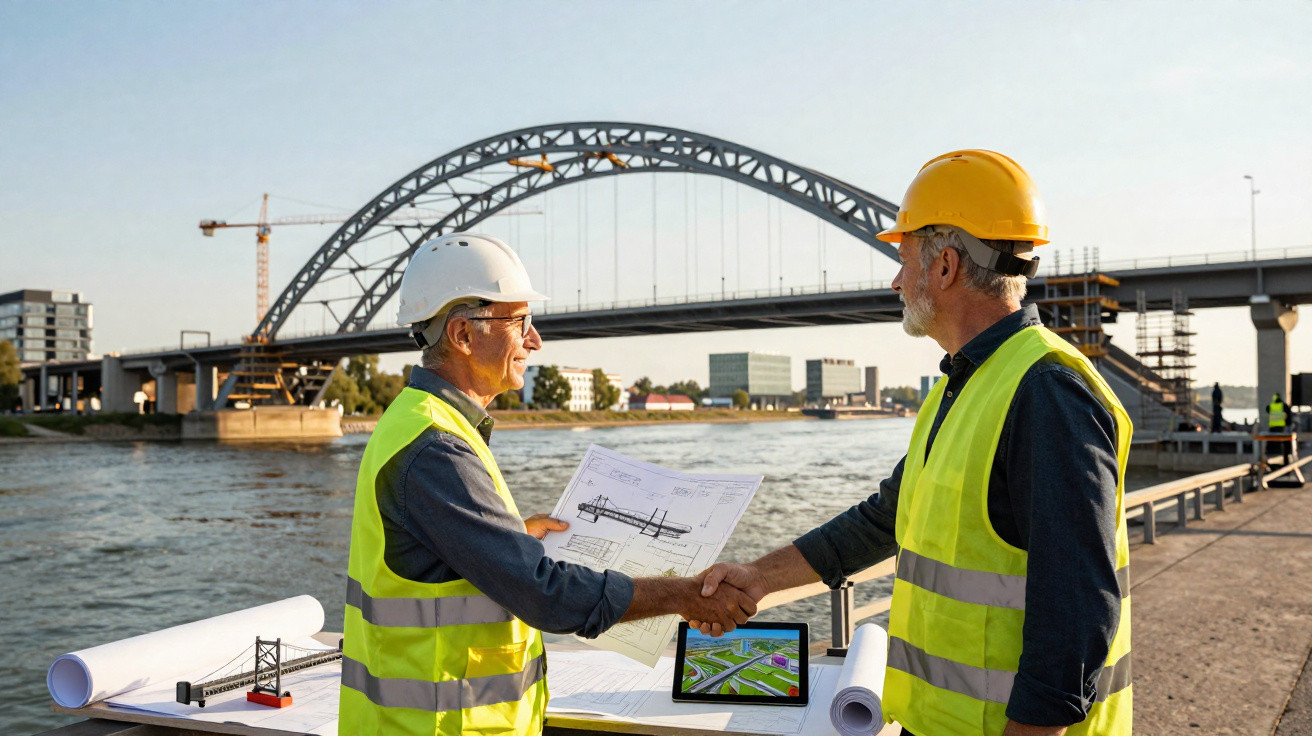
A French construction group that already carries significant weight in European rankings has made a decisive move into the German market.
This is far more than a one-off contract. It marks a step up that links landmark infrastructure works with close control over the technology behind Germany’s most modern buildings.
Eiffage raises its game in Europe’s largest construction market
As Europe’s fourth-largest construction and public works group, France’s Eiffage has decided its observation phase in Germany is over. Its next move is considerably more ambitious: to become a leading participant in complex projects, spanning structural steel through to the technical systems that make a building function.
The key element of this shift is Salvia’s acquisition of HTW Engineers. Salvia is Eiffage Énergie Systèmes’ German subsidiary. The deal moves the French company beyond being simply another major overseas contractor, positioning it instead as an integrated player with both decision-making capability and operational capacity within Germany.
The acquisition of HTW Engineers changes Eiffage’s presence in Germany: from a contractor delivering major works to a full engineering partner, from design through to operation.
HTW Engineers: why the business matters so much to Eiffage
Established in 1969, HTW Engineers is a German engineering firm known for handling demanding schemes for both public-sector and private clients. In 2024, the company generated around €10 million in revenue and employed approximately 80 people.
HTW’s office network clearly illustrates the strategy:
- Düsseldorf: a base serving the industrial west, close to major corporate groups and logistics hubs;
- Berlin: a gateway to major public projects and institutional buildings;
- Leipzig: focused on a north-eastern region undergoing rapid urban renewal.
HTW’s core activities cover almost everything that turns a concrete structure into an efficient, habitable place:
- Water treatment and plumbing networks;
- Heating, ventilation and air conditioning (HVAC);
- Electrical engineering and building automation;
- Safety and detection systems;
- BIM modelling, which brings project data together in a digital environment.
An analogy helps explain its role: if the main structure is a body’s skeleton, HTW looks after its nervous and circulatory systems. Without this technical layer, a building cannot operate comfortably, safely or economically.
Salvia gains local expertise, not merely extra capacity
For Salvia, Eiffage Énergie Systèmes’ German arm, the rationale for the acquisition is straightforward. Rather than relying on external partners to design technical installations, the subsidiary can now control that expertise in-house, through German teams that speak the language of clients and regulators.
With HTW, Salvia gains a strong position in the earliest stages of each project, when engineering choices determine construction costs, energy consumption, ease of maintenance and the usable life of buildings.
Being involved at the design stage means influencing everything from the first sketch to the final screw, rather than merely delivering what others have designed.
This additional capability matters even more in a procurement model widely used in Germany: design-and-build contracts, under which the same consortium both designs and constructs the scheme. Those that control the design secure greater negotiating power, visibility and better margins.
Monheimer Tor showcases integrated German engineering
The Monheimer Tor project in Monheim am Rhein offers a practical example of what HTW can deliver. The complex is undergoing a comprehensive redevelopment of the Rathauscenter I and II centres to become a multifunctional urban hub.
The programme includes:
- A hotel with 142 rooms;
- Integrated parking;
- Expanded retail space;
- A six-screen cinema;
- Areas designed to support urban movement and economic activity in the town centre.
In a project of this nature, building-services engineering is not a minor technical matter. It is what enables hospitality, retail, leisure and mobility to coexist without overloading energy, climate-control and safety systems.
Major bridges, major signals: Eiffage’s German expansion
The HTW acquisition has not taken place in isolation. It forms part of a run of substantial German contracts won by Eiffage, particularly for large-scale steel structures.
Levensau Bridge: a 10,000-tonne calling card
One of the most prominent examples is the new Levensau Bridge on the Kiel Canal. The overall contract is worth €183 million, with €82 million allocated to Eiffage. It is a 10,000-tonne steel giant, measuring 241 metres in length and 42 metres in height, designed to serve for decades on a strategically important route.
Before that, the group had already secured another major tender: the new A1 motorway viaduct over the River Rhine in Leverkusen. This €358 million package was awarded in 2023, with €126 million going to Eiffage. The contract covers demolition of the existing bridge and construction of a 2×4-lane structure using 16,000 tonnes of steel, with completion scheduled for the end of 2027.
These schemes demonstrate where Eiffage is already well established: large steel structures, complex logistics, lengthy timescales and high political visibility. What it lacked was the complementary, “invisible” side of buildings and urban infrastructure. That is precisely where HTW fits in.
Germany as Europe’s laboratory for renewal and efficiency
With turnover of €143.5 billion in 2021 and almost 75,000 active companies, Germany’s construction market is Europe’s largest. Recent growth, however, has come less from entirely new towers and districts than from upgrading an ageing property stock.
Three areas are taking priority:
- Energy refurbishment of existing buildings;
- Regeneration of town centres and older retail areas;
- Upgrading public infrastructure to meet more demanding climate and digital standards.
KfW, Germany’s public development bank, plays a central role in this activity. During one recent cycle alone, it provided €8.6 billion in loans and grants for energy-efficiency and modernisation works. For groups such as Eiffage, this represents a continuous pipeline of projects combining technical expertise with strict environmental targets.
Germany is establishing itself as a major testing ground for companies able to combine advanced engineering, urban renewal and decarbonisation targets in long-term contracts.
From bridge to smart building: the value chain is completed
By acquiring HTW Engineers, Eiffage can now cover almost the full cycle of a complex project: foundations, structures, internal technical networks, digital integration and efficient operation. The group no longer has to rely on partners to design building systems, and it gains flexibility to offer complete solutions to local authorities and private investors.
| Stage | Key capability | Who is involved |
|---|---|---|
| Design | BIM, building-services sizing, structural calculations | HTW + Eiffage engineering teams |
| Construction | Civil works, steel structures, system installation | Eiffage Construction and Eiffage Métal |
| Commissioning | Testing, system adjustments, digital integration | Salvia / Eiffage Énergie Systèmes |
| Operation | Maintenance, energy optimisation, retrofit | Local subsidiaries and service contracts |
What is at stake for the sector and German cities
The more assertive arrival of a French group in the German market affects the local competitive balance. Mid-sized domestic companies may face pressure in large-scale tenders, where the combination of financial strength and integrated engineering is important.
Conversely, cities and regional governments gain additional options for delivering projects that require coordination across transport, housing, retail and climate targets. In regenerations such as Monheimer Tor, competition is likely to centre on who can deliver greater functionality with lower energy use and fewer emissions.
For institutional investors, the transaction also sends relevant signals. A more “German” Eiffage suggests that long-term contracts and revenues may become less dependent on France’s economic cycle, spreading risk across markets that often do not move at the same pace.
Concepts that help explain these developments
Two terms appear frequently in this kind of news and deserve clarification:
- BIM (Building Information Modelling): a methodology in which all information about a building – from plans to maintenance data – is contained within one digital model. It reduces construction errors, simplifies future refurbishment and makes it possible to simulate energy consumption before construction begins.
- Design-and-build: a contractual model in which the same consortium designs and constructs the project. Those taking on this role generally have greater control over costs and programmes, but also bear greater responsibility if failures occur.
In an energy-transition context, both elements become decisive. A poorly designed bridge or building constructed today may become an expensive asset to adapt in 15 years’ time. By contrast, a project created with detailed BIM modelling and an emphasis on energy efficiency is more likely to increase the asset’s value and lower operating costs.
If Eiffage can combine HTW’s German precision with the industrial scale of a major French group, the impact could extend beyond individual contracts. A model may emerge for exporting complete urban-renewal packages, combining bridges, tunnels, smart buildings and maintenance services over several decades.



Comments
No comments yet. Be the first to comment!
Leave a Comment