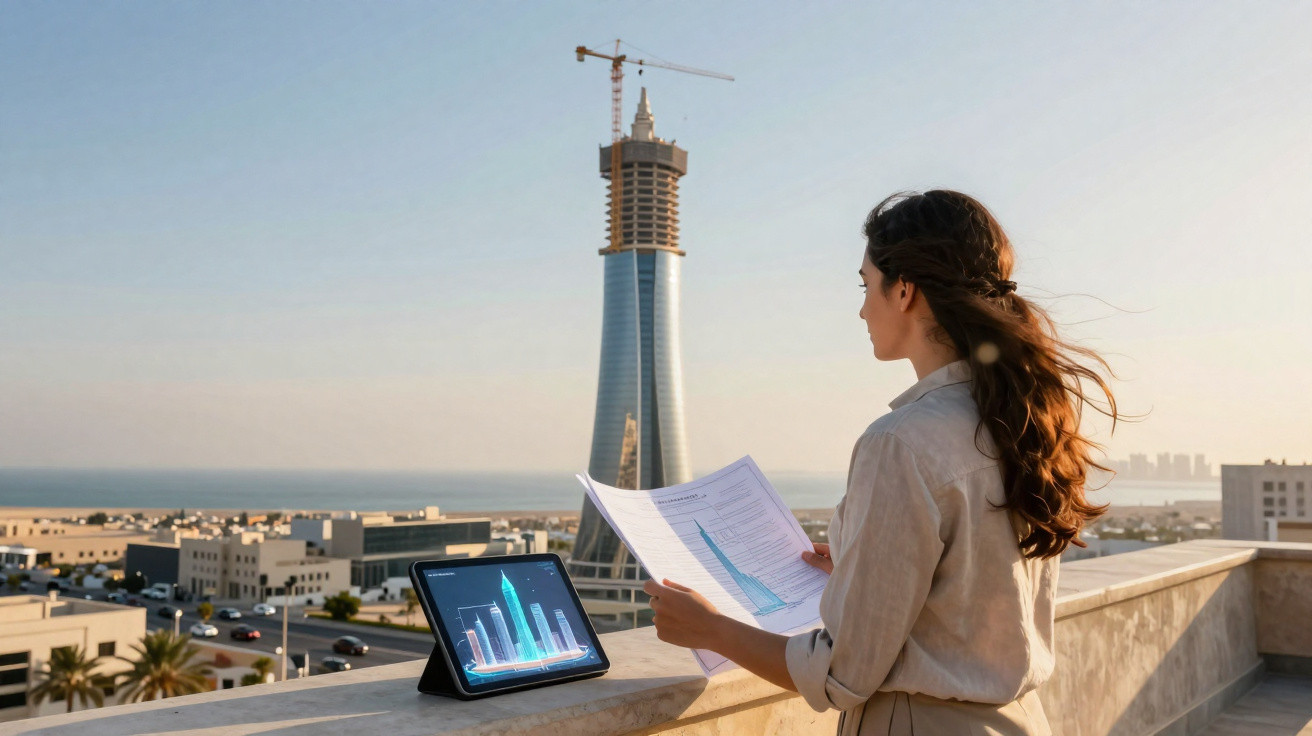
At first, the horizon appears vacant: little more than a blurred boundary separating beige desert from a white sky. Once your eyes acclimatise, however, you find yourself at the base of a concrete colossus under construction. Cranes hover in the heat like metal insects, while a thicket of reinforcing steel reaches into the air.
Hard-hatted workers move in short bursts before stopping to wipe perspiration from their faces. A supervisor gestures towards a core that already rises above most urban towers. “One kilometre,” he says quietly, seemingly to himself. The figure lingers in the air longer than the dust.
Forget Burj Khalifa. Forget Shanghai Tower. Saudi Arabia is preparing to bring the sky a little nearer.
The race to touch the clouds has returned
For several years, the international contest to build ever higher seemed to have eased. Burj Khalifa remained an unrivalled spire above Dubai, while Shanghai Tower curled into the clouds behind its greenish glass. Saudi Arabia is now resetting the contest with a more audacious, almost defiant proposition: exceed what anyone considered practical and aim directly for 1,000 metres.
This is no small extension. It is an effort to redraw the hierarchy of the world’s skylines. A kilometre represents a mental barrier as much as an engineering threshold; once it is passed, every other “supertall” tower may seem unexpectedly restrained.
In plans and construction programmes, the scheme is frequently still known by its former name, Jeddah Tower. First launched in the early 2010s before being halted for years, it has abruptly resumed, supported by Saudi Arabia’s sweeping Vision 2030 ambitions. Its official goal is to rise beyond 1,000 metres and take the world’s “tallest building” title from Dubai in dramatic style. To put that in perspective, it is approximately three Eiffel Towers placed one atop another, or double the height of the Empire State Building.
Early concepts showed a streamlined, tapering needle, clad in glass that would shimmer beside the Red Sea. Work reached roughly 250 metres before stopping, leaving behind an unsettling stump that came to represent interrupted ambitions. Restarting construction turns that partly completed core into a different kind of site: a test bed. Saudi leaders are seeking more than a record-setting tower; they want a vertical emblem of a new age of tourism, commerce and soft power, visible for miles through the desert haze.
Urban planners quietly acknowledge that supertall towers rarely make conventional commercial sense. They are costly, complicated and risky, but countries pursue them nonetheless. The reason is that height creates a story. A one-kilometre skyscraper signals to investors, visitors and competing cities: we are serious, wealthy and willing to make major bets. As Burj Khalifa did for Dubai, this tower is intended to draw worldwide attention to Saudi Arabia’s west coast and take the kingdom’s reinvention beyond oilfields and pilgrimage routes. In a digital age fixated on virtual worlds, there remains something remarkably primal about constructing a giant that can be seen and touched.
Engineering Jeddah Tower’s one-kilometre leap
Getting to 1,000 metres is not a matter of simply adding several storeys. Each additional metre magnifies the forces acting on the building. At that altitude, wind behaves less like an ordinary breeze and more like a restless sea. Engineers must shape the tower so gusts divide around it rather than strike broad, flat surfaces. The present proposal uses a narrow, three-petalled form that tapers as it rises, directing airflow sideways instead of confronting it head-on.
Below the desert surface, the foundations spread like a root system. Huge piles are bored into the ground, filled with concrete and steel, and connected by a foundation mat several metres thick. This underground slab keeps the tower secure as it moves - and it will move. The motion will not be dramatic, but residents and hotel guests at upper levels may notice a faint, gradual swaying on windy days.
A kilometre of height also alters a more ordinary experience: travelling by lift. Conventional lifts cannot simply be lengthened indefinitely, because cables become excessively heavy and journeys take too long. The building’s vertical transport network must therefore operate as a world in its own right, using sky lobbies, transfer levels and next-generation lifts with lighter materials or even rope-less technology. Getting people efficiently from ground level to an observation deck above 900 metres is as much a traffic-management issue as a technological one.
In principle, the tower will offer more than a view. It is intended to function as a mixed-use vertical district, incorporating a luxury hotel, high-end flats, offices, entertainment floors and an observation deck capable of taking the breath away even from experienced travellers. If completed in full, it could become the focal point of a broader Red Sea coastal development, with shopping centres, waterfront promenades and residential neighbourhoods extending outward in ripples from its base.
The figures reveal another dimension. Initial estimates put the cost of the tower alone at more than $1.2 billion, excluding infrastructure and neighbouring districts. Construction’s repeated stops and starts have already extended both the programme and the budget. Even so, Saudi Arabia’s Public Investment Fund has substantial resources, and the country is accustomed to planning in decades rather than quarters. The wager is that one extraordinary structure can draw foreign investment, new airline routes and international brands keen to place their logo on the world’s tallest billboard.
Critics pose pointed questions. Who, in reality, will live and work at such a height? How much power will it require in a region already confronting severe heat? And what does spending billions on a mega-tower imply while ordinary Saudis deal with issues such as affordable housing and secure employment? Skyscrapers don’t exist in a vacuum. They reflect the societies that finance them, revealing both their aspirations and their blind spots. The one-kilometre ambition requires the kingdom - and everyone observing it - to face the conflict between spectacle and substance.
What this 1km tower could mean for everyone else
You may never visit Saudi Arabia, much less take a lift to the 160th floor. Even so, developments of this kind subtly influence how cities change across the globe. Architects in Europe, Asia and the Americas are already examining the Jeddah design and applying its lessons to lower, more functional buildings. High-strength concrete blends, aerodynamic façades and new damping systems are the sort of experiments that often filter down into office developments and residential blocks worldwide.
There is also the matter of imagination. A one-kilometre skyscraper changes the collective sense of what can be achieved. After people watch photographs and TikTok clips from its observation deck, their internal definition of “tall” will be reset. Urban tourists who grew up with Burj Khalifa as their wallpaper will gain a new destination of pilgrimage. City marketers from Jakarta to Lagos are watching carefully as they decide whether to pursue height themselves or find a different means of distinguishing their cities.
At an everyday level, the project also advances discussions about climate and resilience. A mega-tower in a hot coastal environment must address heat control, water consumption and resistance to storms. Intelligent façades that limit solar gain, advanced glazing and integrated shading systems will not remain confined to Saudi Arabia. They are likely to shape building regulations and green certification worldwide, including for mid-rise homes. Let’s be honest: nobody reads technical standards for enjoyment, but the materials and systems trialled on this tower may quietly appear in your next workplace, a future hotel room or even your own block of flats.
Urban psychologists identify a more emotional aspect as well. Existing beneath a one-kilometre tower changes a city’s character and atmosphere. Some people feel uneasy about height and density, whereas others feel invigorated and “plugged into” a larger world. When visitors stand at the observation deck and look down across the Red Sea coast, they will see fast roads, mega-shopping centres and housing clusters resembling circuitry on a motherboard. That view strengthens a high-tech, high-speed image of modern life. Most of us have experienced the moment of looking from an aeroplane window at tiny streets and flashing cars, then abruptly questioning what we are doing with our own days.
Behind these images, a subdued competition is under way. Dubai, through Burj Khalifa, has enjoyed tourism bragging rights for more than a decade. Shanghai Tower gave China a major urban symbol. Saudi Arabia now seeks its own vertical standard-bearer, alongside Neom, The Line and other projects that capture headlines. Across the region, this means both co-operation and rivalry. Airlines compete for routes and stopovers, property funds measure returns against one another, and young people across the Gulf view these skylines on Instagram while deciding where they hope to study or work.
For all its spectacle, the scheme also brings inequality into view. A penthouse near the clouds is likely to cost more than many people will earn across their entire lives. The service workers, maintenance crews and construction labourers who make that experience possible often live in much more modest homes beyond view. Reaching the one-kilometre mark will not remove that divide; it will make it more visible. Some Saudi voices are already calling for investment to be distributed more evenly, into mass transport, affordable homes and public parks, rather than concentrating so much prestige in one needle of glass and steel.
“Super-tall towers are less about floor space and more about storytelling,” notes one Middle East-based urban economist. “When a country builds one, it’s really writing a message to the world – and to its own people – about who it wants to be.”
For those following the project from a distance, three questions recur:
- How will this alter the worldwide list of essential cities to visit over the next 10–15 years?
- Will competition for height generate more innovation in sustainable materials, or simply produce more vanity projects?
- What kind of life are we creating when increasing amounts of it take place 300, 600 or 900 metres above the ground?
A new skyline and story - but whose future?
Imagine opening day: helicopters humming overhead, drones recording every angle and dignitaries assembling beside a red carpet that appears minute against the tower’s vast face. Social feeds fill with an identical image - people leaning by the glass, phones held towards the view, with the Red Sea winding in the distance like a metallic strip. For several weeks, perhaps months, the world looks in one direction and repeats one word: “Wow.” Then ordinary life resumes.
Well after the headlines have disappeared, someone will begin a dawn shift at a café on the 40th floor, grinding coffee as the city comes to life below. A cleaner will remove fingerprints from a viewing-deck rail 850 metres up. A security guard will observe the unbroken flow of tourists arriving and leaving, their faces merging into one long current of short-lived amazement. The extraordinary always becomes ordinary for someone working behind the scenes.
This is the point at which the one-kilometre ambition becomes more than a number. It raises a harder, more intimate issue: what future are we creating when national pride, engineering brilliance and immense wealth meet on one vertical line against the sky? To some, that line will represent possibility and hope; to others, it will seem a monument to excess during a period of climate pressure and social strain.
Skyscrapers have always inspired both affection and hostility. New York’s Empire State Building, ridiculed as an “Empty State” in the 1930s, eventually became a cherished landmark. Kuala Lumpur’s Petronas Towers shifted from being seen as corporate vanity to a national emblem. Burj Khalifa began as a bold gamble before appearing on billions of smartphone wallpapers. This Saudi tower is likely to follow a comparable path, moving from controversy to familiarity and from speculation to selfies.
Whether you celebrate it or challenge it, a one-kilometre skyscraper cannot easily be overlooked. It cuts through the sky, and it divides opinion too. Perhaps that is the true force of a scheme like this: it compels debate about progress, identity and the things humanity chooses to celebrate. Not everyone can influence where the next tallest building will stand. Everyone can, however, decide what such height signifies to them.
| Key point | Detail | Why it matters to the reader |
|---|---|---|
| Record-breaking height | Target of 1,000+ metres, surpassing Burj Khalifa and Shanghai Tower | Helps explain why this project is changing the hierarchy of global skylines |
| Engineering experiment | New approaches to wind, foundations, lifts and heat management | Demonstrates how leading technology from this tower could shape future buildings near you |
| Symbolic power | A central part of Saudi Arabia’s Vision 2030 and urban brand strategy | Provides context for debates around ambition, inequality and what “progress” means today |



Comments
No comments yet. Be the first to comment!
Leave a Comment