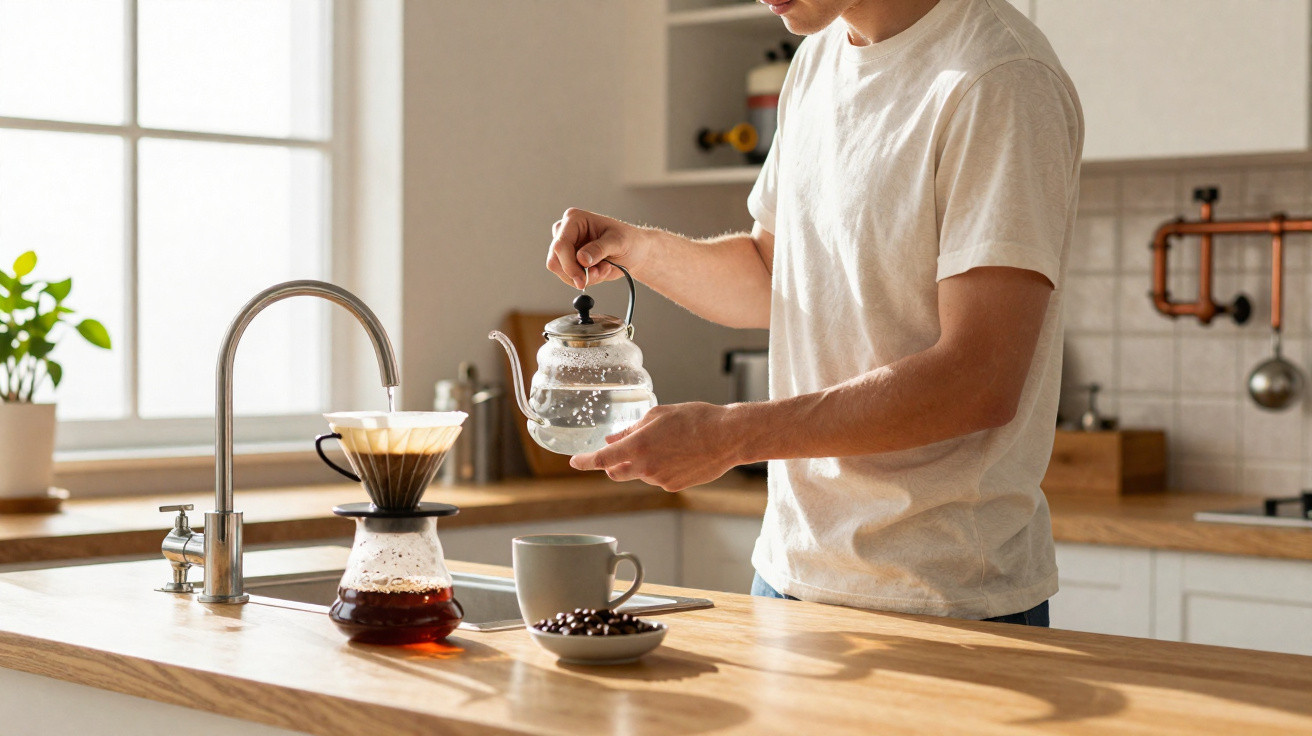
The coffee machine is running, your head is still half on the pillow, and turning on the hot side of the tap can seem like a smart shortcut. Hot water faster, caffeine faster, awake faster – that is the thinking. French health authorities are now firmly discouraging this habit: hot tap water belongs in the bathroom or at the sink, not in your cup.
Why authorities advise against hot tap water for coffee
Health ministries and regulatory bodies apply a straightforward principle: only cold tap water is officially classed as drinking water and is therefore subject to strict monitoring. Hot water supplied from the tap is not checked in the same way.
The two types of water take different routes. Cold water generally travels straight from the public supply network to the kitchen. Hot water, however, passes through domestic pipework and hot-water cylinders. Along this route, substances may leach into the water or germs may multiply, without regular testing of what eventually leaves the tap.
“According to the authorities, anyone making coffee or tea should always use cold tap water – even if hot water from the tap seems more convenient.”
This advice is particularly relevant for households in older properties, pregnant people, babies and children. In reality, though, it concerns anyone who drinks tap water or uses it for cooking – including fans of classic filter coffee and espresso.
Hot water and old pipes: how more metals can reach your cup
One of the main concerns is literally hidden inside the walls: the pipes. Many older homes still have fittings or pipes containing lead, while newer installations are mainly made with copper and nickel. All of these metals can transfer in small quantities into water when they remain in contact with it for an extended period.
The potentially problematic combination is metal + stagnant water + heat. Water that sits in pipes or a cylinder has time to dissolve material from the system. When the temperature rises as well, this chemical process happens more quickly.
- Older properties carry a greater risk of residual lead in their pipework.
- In newer buildings, traces of copper and nickel in particular may pass into the water.
- Warm or hot temperatures encourage this movement of metals into the water.
Measurements show that the same pipe can release around twice as much lead into water at a temperature of 25 degrees as it does at 15 degrees. Anyone using warm or hot water straight away is therefore taking these dissolved substances with them into the saucepan or kettle.
The common argument that the water will be boiled anyway is only partly correct. Boiling kills micro-organisms, but it does not remove metals. In fact, as water evaporates during boiling, the concentration of dissolved substances in the water left behind increases.
The overlooked issue of hot-water cylinders
The water heater is another key factor, whether it is a conventional cylinder or a modern electric tankless water heater. Cylinder systems in particular keep a larger volume of water at comfortable bathing temperatures for many hours. That may suit people who enjoy a shower, but it is not necessarily ideal from a microbiological perspective.
Legionella and other germs thrive within a temperature range that can occur in some hot-water systems, especially where equipment is poorly maintained or set too low. Hot-water systems are usually set to 55 to 60 degrees to keep the risk limited. Even so, they were never intended to provide drinking water directly for everyday consumption.
“The hot-water cylinder is designed for the shower, washbasin and kitchen sink – not as a drinking-water source for coffee, tea or baby food.”
Put simply, filling a coffee pot directly from the hot tap means drawing water from a part of the system that is viewed more as water for household use than as a drink.
Simple rules for safer coffee at home
The good news is that no one needs to give up their morning caffeine. A few small changes to everyday habits are enough, and most take no more than a few seconds.
What authorities and experts recommend
- Always use cold water: Use cold tap water as standard for coffee, tea, soup or pasta water, then heat it afterwards.
- Let the water run: After overnight or following a long weekend away, run the cold tap for one to two minutes before filling the kettle or coffee pot.
- Take extra care in older properties: In older flats or houses where lead pipes may be present, allow a more generous flushing time.
- Do not pour away the flushed water: Water run off first can still be used for watering plants, cleaning or rinsing.
Experts advise pregnant people and young children to follow these measures even more consistently. Lead, for example, can build up in the body and interfere with nervous-system development, particularly during early childhood. Although most households remain below the limit values, authorities see no room for convenience on this issue.
Can you taste the difference in coffee?
Health is clearly the priority, but taste is also worth considering. Coffee is highly sensitive to water quality. Water hardness, mineral content and contaminants all affect aroma, acidity and bitterness.
Filling a machine or French press with fresh cold tap water will usually result in a cleaner aroma. Metal traces or stale water from a cylinder can distort the flavour, making coffee taste musty, slightly metallic or simply “flat”.
| Water source | Possible effect on coffee |
|---|---|
| Fresh cold tap water | Balanced flavour, cleaner aroma |
| Hot water from the tap | Greater metal risk, dull or metallic aftertaste |
| Tap water left standing for a long time | Flat, stale flavour |
Many baristas have long advised using only fresh cold water in espresso and filter coffee machines. The warning from health authorities now supports this approach from a hygiene and toxicological standpoint too.
Practical steps households can take
Anyone concerned that their plumbing may still contain lead can ask their water supplier or landlord. In many areas, suppliers provide information sheets and, in some cases, testing services. Private laboratories also test tap water, usually for a fee.
A few further everyday measures can improve safety and flavour:
- Descale the coffee machine regularly so that residues do not build up inside the system.
- Do not use warm water from the tap for baby bottles: always draw fresh cold water, then heat it or allow it to cool as needed.
- Clean tap aerators and strainers because particles and biofilm can collect there.
- After a prolonged absence such as a holiday, flush all pipes thoroughly for a short time before drinking or cooking again.
Understanding limit values and terms
The 10 micrograms of lead per litre mentioned above is the current limit for drinking water. A “microgram” is one millionth of a gram, so it represents an extremely small quantity. Children’s bodies are nevertheless particularly sensitive because they drink a comparatively large amount in relation to their weight.
Lead is known as a cumulative poison, meaning that the body eliminates it only slowly. Regularly consuming small quantities can, in the worst case, create a gradual build-up. This does not cause immediate poisoning, but over time it can affect learning ability, concentration and blood formation.
With copper and nickel, the concern is more likely to be gastrointestinal symptoms or skin reactions. Nickel is also among the more common contact allergens, and higher levels in water may cause difficulties for sensitive people.
Adjusting coffee rituals without giving up enjoyment
The central message behind these warnings is not: “Tap water is dangerous.” Instead, it is that the source within the system and the way water is used both matter. Consistently choosing cold water that has been allowed to run briefly for coffee and cooking removes several risks at once.
In practical terms, this means changing the morning routine once. Rather than turning on the hot tap immediately, let the cold water run briefly first, fill the kettle or machine, and only then heat it. The extra effort is somewhere between ten seconds and one minute – and offers greater reassurance for both health and flavour.










Comments
No comments yet. Be the first to comment!
Leave a Comment