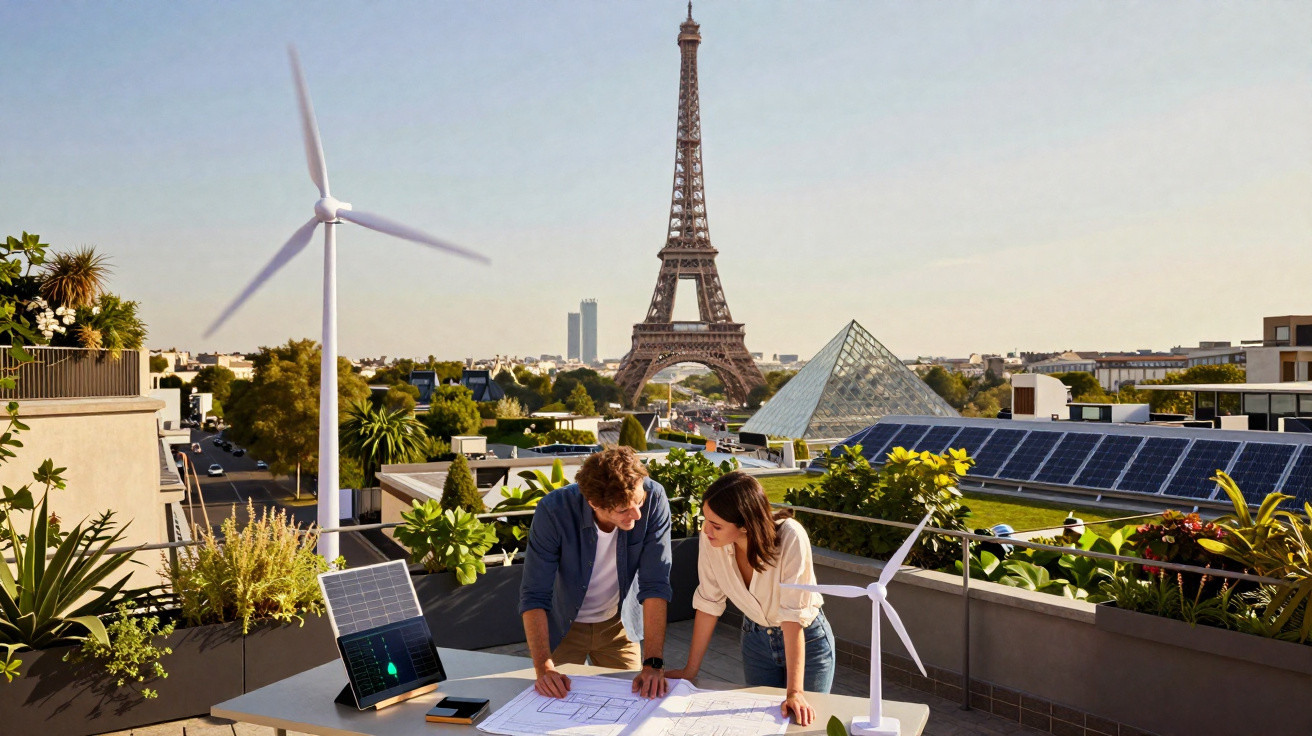
Paris is facing a radical transformation: landmarks including the Eiffel Tower, the Louvre and Haussmann buildings are set to become both climate-resilient and greener by 2050.
France’s capital is experiencing increasingly hot summers, more intense rainfall and rising energy costs. Ironically, its best-known landmarks are among the least prepared, having been designed at a time when climate change was not considered. Urban planners, architects and climate scientists are therefore developing a vision that still sounds futuristic today: Paris 2050, featuring bioclimatic museums, planted façades and even wind turbines high above the ground.
How climate change will reshape Paris by 2050
Anyone crossing Place du Trocadéro in the height of summer can already feel how intensely stone and asphalt retain heat. Climate models predict that, by 2050, Parisian summers will feel more like those of Mediterranean cities. Longer hot spells, known as heatwaves, are expected to become more common, while the risk of flooding will also increase throughout the year.
This places historic structures under pressure from both sides. Heavy stone walls absorb heat during the day before releasing it overnight. Metal structures expand more significantly, while ageing pipes and roofs cope less effectively with torrential rain. Many of these buildings were never intended to offer comfortable conditions at 40 degrees in the shade.
The central question is: how can historic heritage be protected without turning the city into an open-air museum, while still preparing it for a significantly hotter climate?
Bioclimatic Paris: combining heritage protection and climate action
Experts use the term “bioclimatic architecture” for buildings designed to work with their local climate rather than against it. In Paris, this principle is now being applied to some of the world’s most celebrated structures.
- Reducing urban heat through additional greenery and water features
- Buildings that use less energy and, in some cases, generate it themselves
- Materials that cope more effectively with fluctuating temperatures
- Technology kept as unobtrusive as possible to preserve the visual appearance
Initial measures are already visible around major attractions. More than 17,000 square metres of currently sealed ground between Trocadéro and Champ de Mars are due to be opened up and planted. Former expanses of stone will become cooler green corridors that disrupt urban heat islands.
The Eiffel Tower as a renewable-energy laboratory
Wind power at the landmark
The vision is most striking at Paris’s most recognisable symbol: the Eiffel Tower. Engineers are considering ways for the monument not only to operate in a climate-neutral manner, but also to serve an active environmental purpose. Some proposals include two discreet small wind turbines that could be incorporated into its steel framework.
While these vertical wind turbines would not generate huge volumes of electricity, the symbolism would be substantial: a monument of the industrial age quietly producing its own green power. They could be supplemented by solar panels on the roofs of service buildings and upgraded lighting requiring far less energy.
The Eiffel Tower remains iconic – yet inside it operates like a modern, efficient energy hub.
Modern systems, historic appearance
The key challenge is installing this technology without altering the familiar postcard view. Any additions would need colours and proportions suited to the steel structure. Existing maintenance walkways could conceal cables and equipment. Visitors should retain an experience that feels as authentic as possible, while an advanced energy and cooling system operates behind the scenes.
The Louvre as a cool refuge during heatwaves
The Louvre faces an equally delicate challenge. Its artworks must remain protected from temperature fluctuations, humidity and UV radiation. At the same time, climate targets require museum operators to reduce energy use without sacrificing visitor comfort.
A number of mutually reinforcing measures are possible:
- Planted roofs on ancillary buildings would limit heat build-up on roof surfaces.
- Intelligent shading systems on glazed areas could adjust according to the sun’s position.
- Modern cooling systems with low electricity demand could be partly supported by groundwater.
- Improved airflow in exhibition spaces could reduce the need for cooling.
The famous glass pyramid would remain untouched, although it might receive subtler shading measures or specialist coatings that reflect solar radiation more effectively. The aim is a kind of “climatic cocoon”: sweltering heat outdoors, with stable conditions inside for both art and visitors.
Haussmann buildings between past and future
The characteristic residential buildings of the 19th century define much of Paris, with their pale stone façades, wrought-iron balconies and mansard roofs. They are full of charm but difficult to improve in energy terms. Their thick walls provide some protection from heat, yet many roofs and top-floor flats become ovens in summer.
Urban planners are developing ways to retrofit these properties without compromising their character:
| Building element | Possible adaptation |
|---|---|
| Roof | planted surfaces, a light-coloured coating, additional internal insulation |
| Façade | protection from direct sunlight through adjustable external shutters or textile elements |
| Courtyard | tree planting, fountains and light-coloured ground surfaces for cooling |
| Building systems | modern, quiet ventilation systems with heat recovery |
Green courtyards are particularly important. Trees and plants can noticeably lower temperatures, retain water and improve air quality. They also give residents places to retreat during hot periods without having to travel far to parks.
More greenery, less concrete: tackling heat islands
The planned removal of sealed surfaces across 17,000 square metres around the Eiffel Tower and Champ de Mars is only one part of the strategy. Planners expect every shaded area to matter in a much warmer Paris. Asphalt and exposed stone become extremely hot during the day and radiate that heat after dark, creating heat-island effects.
Green areas and light-coloured surfaces function like natural air conditioning. They evaporate water, provide shade and reflect more sunlight. New trees, water-misting installations and planted pergolas could therefore appear at many tourist hotspots in future. For visitors from around the world, this would mean less time walking in blazing sunshine and more spaces with pleasantly cool air.
What terms such as “heatwave” and “renewable energy” mean
Certain specialist terms appear repeatedly in discussions of Paris 2050. A brief explanation makes the planned changes easier to understand.
What meteorologists mean by a heatwave
A heatwave occurs when temperatures remain clearly above the normal level for a region over several consecutive days. In Central Europe, specialists generally refer to a heatwave when daily maximum temperatures exceed 30 degrees for at least three days in a row, often accompanied by tropical nights in which temperatures barely fall below 20 degrees.
For cities such as Paris, this is particularly problematic because heat stored in buildings creates an additional burden. Older people, children and those with pre-existing health conditions are especially affected. Air conditioning alone cannot solve the issue, as it consumes energy and releases waste heat into the city. This is why structural adaptation has become such a major priority.
Renewable energy as part of urban planning
Renewable energy comes from sources that replenish continuously on human timescales: wind, sunlight, water, biomass and geothermal energy. In a dense city containing many historic buildings, wind and solar power are particularly suitable, supplemented by heat drawn from groundwater or waste heat.
Small wind installations on landmarks, solar panels on museum extensions and heat pumps in basements may appear unremarkable at first, but over time they ease pressure on the electricity grid and reduce CO₂ emissions. The more successfully this technology is integrated into architecture, the more likely residents and tourists are to accept the changes.
What could make Paris a model city for Europe
Many major European cities face comparable challenges: valuable historic buildings, severe heat stress and rising energy costs. If Paris can sensitively adapt icons such as the Eiffel Tower and the Louvre, it could provide examples for Rome, Vienna, Prague and cities in Germany as well.
The tension between heritage protection and climate adaptation will remain delicate, but successful pilot projects could show the way forward. A green roof on a Haussmann residential building that is barely visible from the street, or wind turbines on the Eiffel Tower that blend into its steel framework, demonstrate that historic architecture can evolve without losing its soul.
For travellers from German-speaking countries, this could mean that by 2050 Paris still looks familiar but feels different: cooler, quieter and greener. For the city itself, this metamorphosis could be the decisive step towards continuing its history in a substantially warmer century.


Comments
No comments yet. Be the first to comment!
Leave a Comment