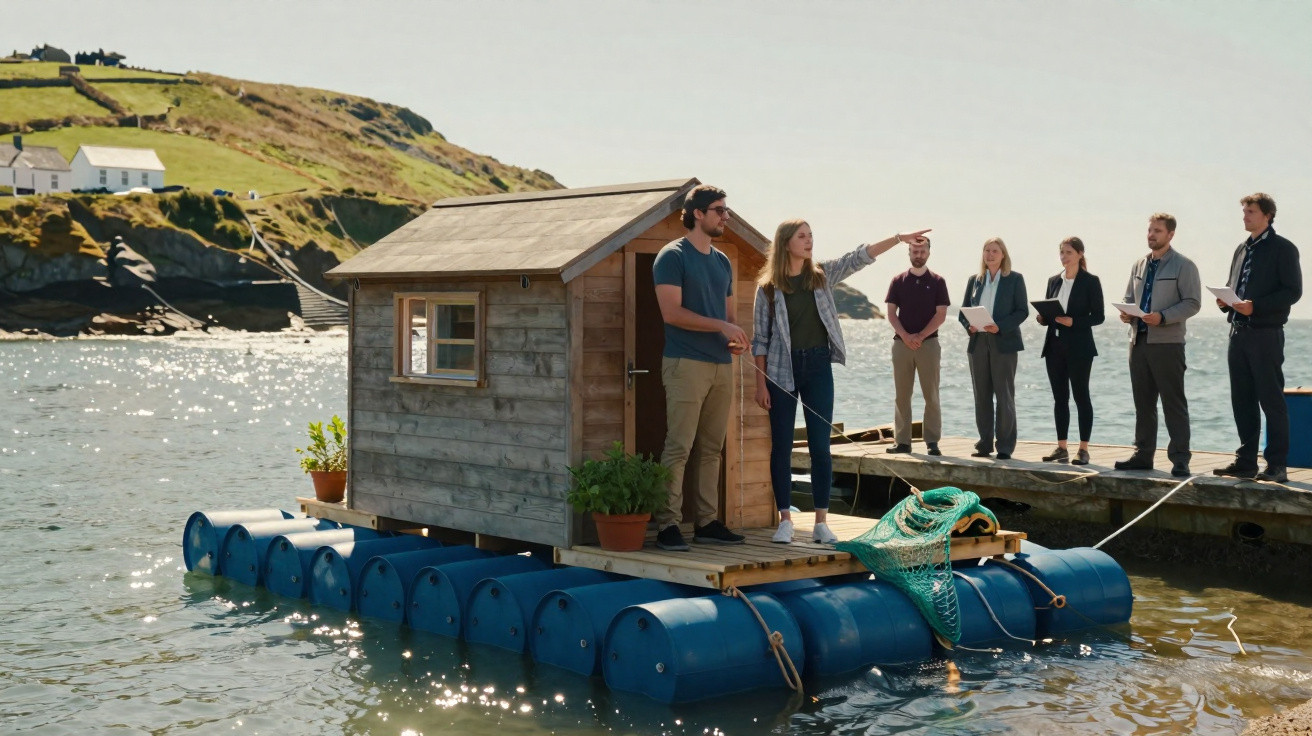
A floating home took shape on a peaceful Cornish creek through a mix of grassroots ingenuity, engineering and sheer determination. Now local councils are monitoring tidal marks and making notes, considering a question once dismissed as “eccentric”: might this offer a genuine response to high rents, coastal flooding and waste?
When I first climb on to the deck, the tide is halfway in and the gulls are already making a racket. Beneath my feet, the boards give with a slow, springy steadiness, as though I am standing on the chest of a sleeping giant. Isla passes me a chipped coffee mug, Tom pulls a strap tight, and mist lifts from the reeds in silvery strands. Listen for long enough and you can hear the water speaking to the barrels: an airy glugging sound that never quite follows the same pattern. The couple laugh as I automatically look towards the horizon for a sway. This home does not sway. Then the tide changed.
The raft that turned into a home
At its core, the home is straightforward: a timber grid rests on a flotilla of recycled food-grade plastic barrels, secured with ratchet straps and finished with a deck warmed by the sun and a compact cabin. There are no showy curves or billionaire-yacht bravado. It is simply functional geometry, with affordable materials quietly and reliably doing their job. The creek holds it between the tides, while the wind divides each day into conditions that work and those that do not. Birds venture nearer because nothing clatters, and after dark the lights on the far bank seem closer, as though the village is breathing in time with the home.
Their project began with 120 barrels collected from fisheries, breweries and a nearby car wash. Each was cleaned, capped and pressure-tested. Tom made a 6-by-10-metre timber frame: a giant-pallet-style lattice in which every compartment cradled a barrel. The couple estimate that the entire build, from the initial ratchet strap to the solar panels, cost about £28,000. That is not insignificant, but it is not a mortgage either. One spring evening, several neighbours helped them ease the completed raft down a slippery slipway. It sat high and clean on the water. Someone uncorked a bottle, while someone else claimed to have spotted an otter.
The appeal for councils goes beyond its charm. This approach connects three pressing concerns at once: low-cost housing, flood resilience and the circular economy. Cornwall is all too familiar with the figures: increasing rents, pressure from second homes and more flooding during storm surges. A home that rises with the water replaces sandbag thinking with a natural rhythm. Giving barrels a second use, rather than leaving them in a yard or sending them to landfill, addresses another issue. Combine that with off-grid electricity and a composting toilet, and the result is a small-scale blueprint that feels less like a “vision board” and more like something people can genuinely make.
How they built the floating home - and what they would alter
Remove the romance and the process resembles a carefully planned weekend job extended across a dozen weekends. It starts with 200-litre food-grade HDPE barrels with undamaged caps. Each barrel is pressure-tested using soapy water and a bicycle pump, revealing any faulty seals. A frame of 2×6 treated timber is then constructed, with supports positioned so that every barrel carries an equal proportion of the weight. The barrels are fastened in pairs using stainless-steel ratchet straps, before the lattice is cross-strapped to make the entire raft behave as a single platform. Marine plywood goes on top, followed by a breathable membrane and decking boards. Anchors are screwed into the creek bed, with bow and stern attached to a fore-and-aft mooring. The lines are given enough give to move with swell rather than resist it.
They are quick to list the most frequent errors because they made some themselves, then corrected them in poor weather. Insufficient cross-bracing can cause a banana-like curve when the tide pulls unevenly for the first time. Cheap straps will deteriorate. Loading one corner with batteries creates a permanent list, which disrupts sleep and rather ruins the coffee routine. Honestly, nobody wants that every day. Keep the cabin compact and lightweight, choose larch or cedar cladding, and locate heavy equipment amidships. If the system is off-grid, install 20 per cent more solar capacity than you think you need. Storms have no interest in your spreadsheets.
There is a human element too: routines that only become clear once you live on the water. They note spring tides in the diary, exchange boots for socks at the door, and speak to the harbour master more often than many people speak to their postie.
“We didn’t set out to prove anything,” Isla says, turning a mug in her hands. “We just wanted a home we could pay for, that didn’t fight the sea. It turns out that’s a bigger idea than us.”
- Climate resilience: Rather than being battered by floodwater, the home rises with it.
- Circular build: Reused barrels gain years of extra use rather than merely months.
- Local fit: Its lightweight footprint suits sensitive banks and bird habitats.
- Cost control: Materials are sourced from trade-waste streams and builders’ merchants rather than luxury catalogues.
Why councils are examining the model
For years, Cornish officials have discreetly charted low-energy, low-cost concepts, testing which could expand without overstretching budgets or damaging landscapes. A floating home that converts a waste stream into flotation has the feel of policy kismet. It is not only housing stock but adaptable infrastructure. Groups of these homes on unused moorings could provide key-worker accommodation close to harbours, or ease pressure during seasonal rent peaks, without concreting over floodplains. The attraction is easy to understand: it has a practical poetry.
Most of us know the sensation of a rent increase making the floor feel as if it has shifted beneath us. This model reverses that feeling: the movement becomes part of the solution. Councils are commissioning feasibility reports on barrel-based pontoons, assessing environmental effects and testing potential licensing routes. They are considering mooring rights, navigation safety and wastewater requirements. Initial findings favour trials in sheltered waters, where the distinction between “boat” and “home” becomes flexible enough for common sense to prevail. The paperwork may be complicated; the physics is not.
There are genuine constraints. Unprotected barrels deteriorate in sunlight, although UV wrapping and skirting lengthen their life and reduce the risk of microplastics. Mooring spaces are limited, and communities change when water becomes a neighbourhood. Insurance is available, but underwriters want detail: load calculations, fire breaks and access plans. Councils are also considering fairness: if floating homes appear, who will receive them, and at what rent? The couple’s home has become a case study rather than a universal template. Even so, interest keeps rising with the tide. When a solution resembles a raft yet functions as a home, it is difficult to overlook for long.
What this could make possible next
This is the understated revolution: it does not demand heroic efforts. A phone call to find salvaged materials, a community workshop, a sensible harbour policy and a few trial pontoons could create a new route within British housing. Many schools of thought disappear into memos; this one stays afloat. It is possible to picture apprentices learning buoyancy calculations alongside carpentry, a council planner walking through a reed bed with a resident to chart greywater flow, or a night storm passing as a cluster of homes rises, waits and settles once more. No one claps. No one needs to evacuate. Daily life continues with the tide.
| Key point | Detail | Why it matters to the reader |
|---|---|---|
| - | Food-grade barrels and a timber grid provide stable, low-cost flotation | Replicate or adapt the approach for affordable-living projects |
| - | Off-grid package: solar power, battery, rainwater collection and composting toilet | Reduce bills and strengthen resilience during storms or power cuts |
| - | Councils are exploring trials in sheltered waters and for key workers | Indicates practical routes from DIY construction to policy-supported housing |









Comments
No comments yet. Be the first to comment!
Leave a Comment