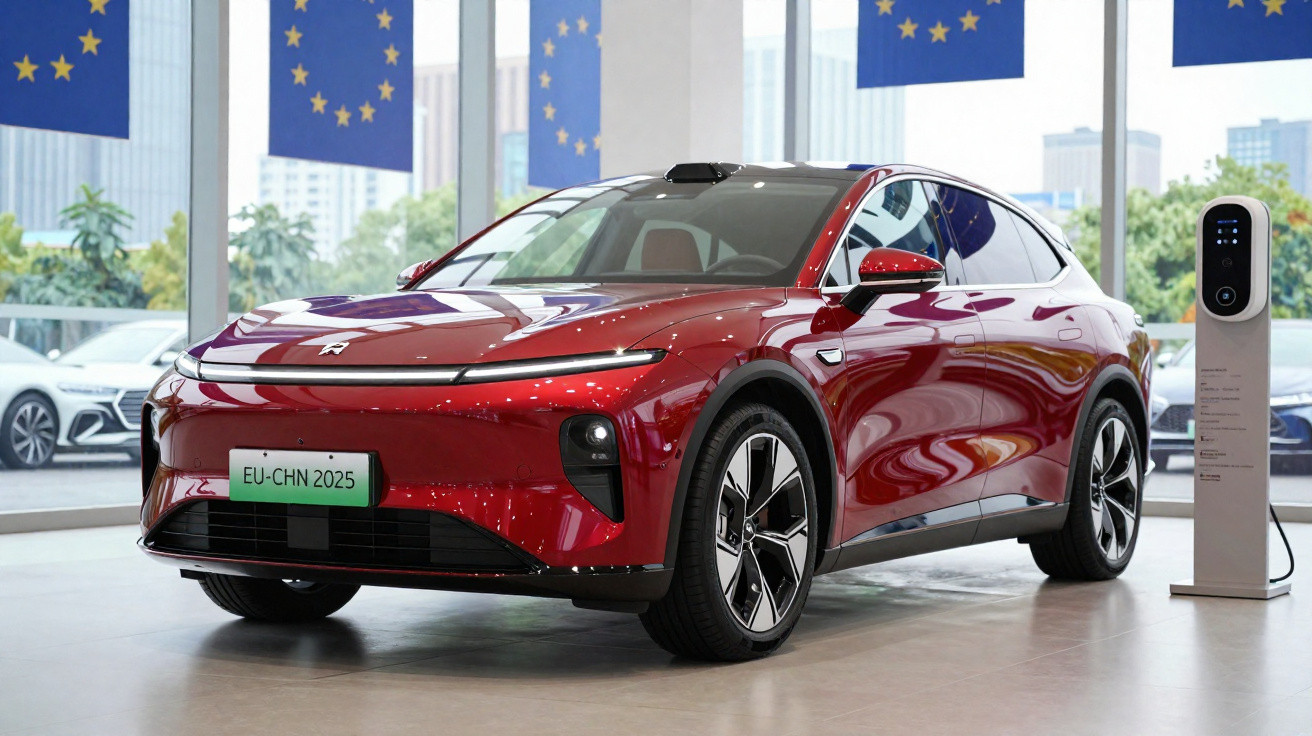
Chinese carmakers have invested heavily in the European market in recent years, and the results are already clear. While their market share was almost negligible in 2021, at 0.5%, it had risen above 9% by this spring, with no indication of a slowdown.
Although some Chinese brands, including BYD, have already begun investing in European production sites, most manufacturers still import the majority of their cars directly from China despite their increasing success. As a result, they face customs duties of up to 45.3%.
The European Union does not intend to stop at tariffs, either. Chinese carmakers are still regarded as a threat to Europe’s automotive industry, prompting the bloc to announce tougher protectionist measures.
One of the European Union’s main proposals is the Industrial Accelerator Act. This legislative proposal is intended to safeguard European industry and jobs by applying stricter rules to foreign investment. Experts believe the law could come into force as early as the middle of next year.
Why Chinese carmakers are concerned
It is this proposal that has put Chinese carmakers on alert. If the law proceeds, any manufacturer planning to build a factory in Europe will have to meet a strict set of requirements:
- Establish joint ventures in which the European partner holds majority control, meaning Chinese brands cannot own more than 49%;
- Share and license intellectual property, including technology and patents, with the European entity;
- Employ at least 50% European workers; this is the only non-negotiable rule;
- Use local suppliers and components.
Faced with these conditions, Chinese manufacturers are now racing to establish themselves in Europe before the new requirements take effect.
Buying rather than building
Constructing a factory from scratch takes too long, and Chinese carmakers do not have that time. The strategy gaining the greatest traction is therefore to buy, or partner with, existing industrial facilities that are underused or have ceased operating.
Several manufacturers are already pursuing this route. BYD, which has built a greenfield factory in Hungary and is building another in Turkey, is now actively seeking underutilised facilities in Italy and Spain.
Chery has purchased Nissan’s former factory in Barcelona and is in talks with the Japanese manufacturer over production in Sunderland, United Kingdom, where the Leaf and Qashqai are currently built. Leapmotor will build its models in partnership with Stellantis in Madrid and Zaragoza, while Dongfeng is preparing to manufacture its premium range at Stellantis’s plant in Rennes. Geely, meanwhile, is negotiating to acquire part of a Ford facility in Valencia.
Chinese carmakers target European factories
SAIC, MG’s owner, will open the group’s first European Union factory in Galicia, with capacity for 120,000 vehicles a year. XPeng is reportedly holding discussions with Volkswagen and other manufacturers to acquire a European factory, although it already builds models at Magna Steyr’s facilities in Austria.
Quoted by Automotive News Europe, Jefferies analyst Philippe Houchois summed up the situation: “Chinese carmakers have always aspired to manufacture in Europe, but they are now beginning to realise that this opportunity may be becoming more limited”.
According to the same consultancy, based on Chinese carmakers’ known plans, if these projects come to fruition they could result in more than two million cars being produced on the European continent.








Comments
No comments yet. Be the first to comment!
Leave a Comment