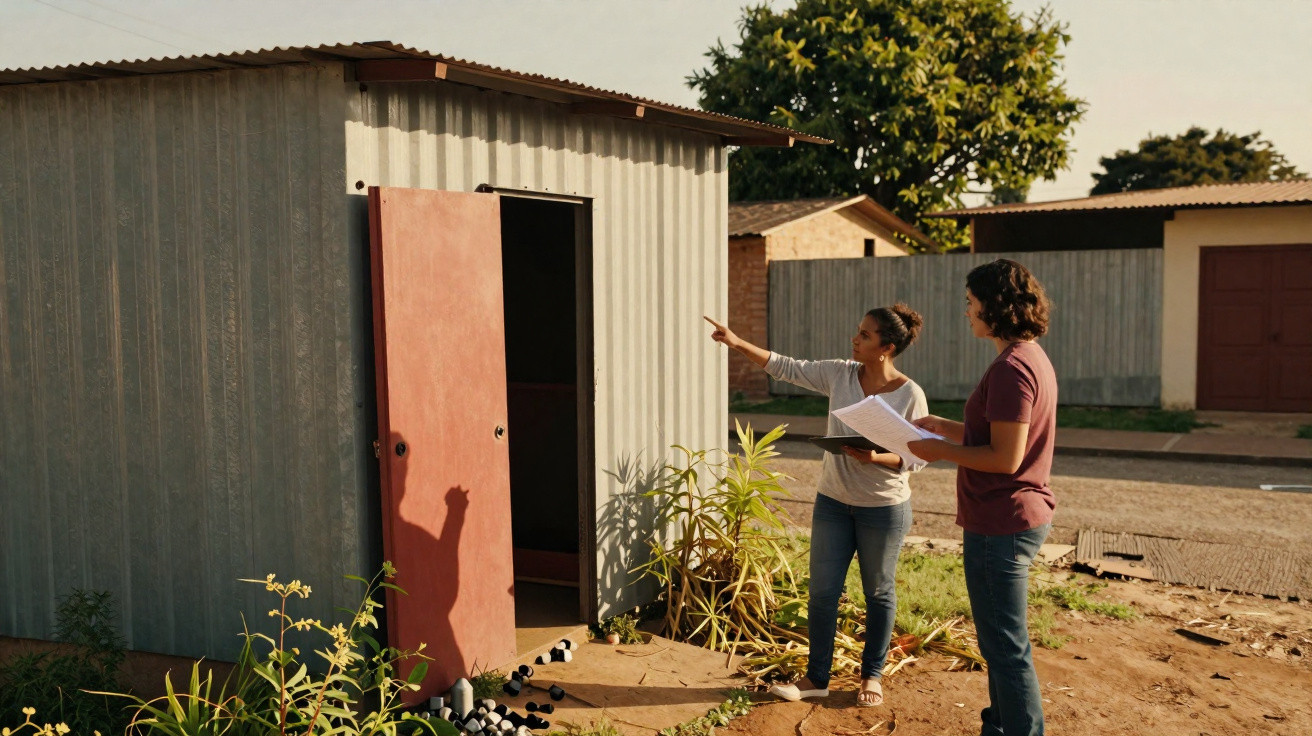
People were putting it into their trolleys as casually as a packet of kitchen roll. It seemed like a straightforward weekend job: some extra storage, nothing more. Then complaints began appearing in local Facebook groups, followed by discussions at town halls. In several French and Belgian municipalities, this inexpensive shed has unexpectedly become a political problem. Officials are now considering what once seemed unthinkable: banning a €199 shed.
How a cheap Action shed became a local controversy
The issue began on a quiet suburban road on the outskirts of Lille, where a succession of matching sheds appeared. They had the same colour, the same pitched roof and the same small plastic window. Initially, it resembled a Pinterest idea that had gone slightly wrong, and neighbours laughed about it. But then came the shadows cast across windows, the obstructed views and the first arguments about property boundaries.
One resident says that he woke one Saturday morning to find a three-metre wall of beige panels facing his living room. Another says that half the daylight in her kitchen disappeared after her neighbour placed the shed directly beside the fence. In a small Walloon town, the mayor received nine complaints in a fortnight concerning the same item: the low-cost shed sold by Action.
Municipal technical teams began examining the matter more carefully. The shed is marketed as “easy to assemble, no permit required, under 5 m²”. On paper, it falls below many administrative limits. In practice, however, buyers sometimes build a base, lengthen the roof or connect two kits together, unknowingly passing legal thresholds. A product presented as a “mini structure” can suddenly look remarkably like a genuine outbuilding once it is installed.
Planning departments are raising concerns. They are seeing the same model emerge repeatedly, often positioned too near boundaries, on protected sites or in areas vulnerable to flooding. Fire services are not especially pleased either. Constructed mainly from thin panels and lightweight materials, the shed may become a rapidly burning unit if someone stores fuel, paint or a lawnmower with a leaking tank inside. That is not something shoppers tend to consider at the checkout.
Why some towns want Action sheds removed
In a number of small towns across northern France and Belgium, councillors are preparing local regulations aimed not at a particular brand, but at this category of structure. The push comes from a combination of safety warnings, visual clutter and neighbour disputes. Action’s shed has simply become the emblem of the problem: affordable, readily available and easy to buy on impulse.
An urban planner in a town near Charleroi recounts a telling example. During a promotion, one resident bought three sheds, placed them side by side at the end of his plot and turned them into a makeshift workshop. The difficulty was that the entire construction leaned towards a stream classified as a risk zone. Following heavy rainfall, water eroded the ground beneath one corner and the whole group of sheds began to lean. Photographs eventually reached the mayor’s desk. There was no planning permission, no declaration and no paperwork at all.
Elsewhere, the dispute became more personal. A couple who had recently moved in put the well-known Action shed in the only green gap among a tightly packed row of homes. Their elderly, isolated neighbour had spent his afternoons watching birds in that direction. To him, the beige block felt like a barrier shutting off his final view of nature. The account reached the local press, and the cheap garden shed swiftly became the week’s villain.
Municipalities are caught between competing needs. People want low-cost places to keep bicycles, tools and children’s belongings without hiring a bricklayer or architect. Yet the unchecked spread of ready-to-install sheds can turn small gardens into crowded labyrinths. Some communes are considering bans in protected areas, caps on the number of sheds permitted on each plot, or minimum distances from boundaries. Their aim is not really to fight Action; it is to regain some control over how their neighbourhoods will look in five years’ time.
Legal specialists are following the situation closely. As the shed is sold as a “temporary” or lightweight structure, conventional building rules have not kept pace with these newer consumer products. The law was written for brick walls, not self-service plastic panels. The resulting gap creates a grey area: residents believe they have done nothing wrong, while authorities see a gradual alteration of the landscape. That uncertainty is precisely where the dispute sits.
What to do if you have bought, or plan to buy, an Action shed
Before taking the flat-pack into the garden and reaching for the drill, pause for a moment. The most sensible approach is very simple: measure first, then speak to someone. Check the size of your garden, the distance to boundaries, the total height of the shed including any planned base or slab, and where its shadow will fall late in the day. Then telephone or visit your local town hall to ask how this type of structure is classified.
It may seem excessive for a €199 shed. The packaging may also imply that it belongs in “no permit” territory. Even so, half an hour spent asking dull questions can prevent months of arguments, fines or even an order to remove it. Take a photograph of the product label, bring the dimensions and ask directly: “Can I put this in my garden, here, at this distance from the fence?” It may not be glamorous, but it stops a simple storage plan becoming a legal saga.
It is also worth considering the longer term. Will you use the shed over the next ten years, or is it mainly a way of delaying a major clear-out? Sometimes a shed becomes a tangible excuse for avoiding sorting through what is already in the house. After a thorough declutter, you may find that you do not need an entire extra structure in the garden after all. Or you may decide that you do need one, but will put it in the proper place and involve your neighbours in the decision.
Certain familiar mistakes occur from one town to the next. Placing the shed directly against a shared fence is one. Converting it into a hidden workshop containing power tools and flammable materials is another. So is overlooking drainage, allowing rain from the roof to pour directly into a neighbour’s vegetable patch. These may seem like minor errors, but they are exactly the kind of issues that make people contact the town hall rather than knock on your door.
On a personal level, communication is the key. Tell neighbours what you intend to do, show them where the shed will go and listen if they say, “That will block my only bit of sun at 5 p.m.”. That conversation may feel uncomfortable, but ten minutes of honest discussion now can often prevent years of passive-aggressive glances over the hedge. At its worst, a shed can become a symbol of everything left unsaid in a street.
Let’s be honest: nobody really reads the full planning rules before buying a garden shed.
“The shed is not the problem,” says a local councillor from the Nord region. “The problem is the speed at which we can now transform a garden without anyone talking to anyone. That’s what hurts the most.”
Behind this small beige box lies a broader question about sharing space when private life is visible through a neighbour’s window. On social media, users queue up to ridicule “ugly sheds” and “plastic carbuncles”. In everyday life, those same people are dealing with too many bikes, too many tools and too little indoor space. We want tidiness, privacy and storage, while still holding on to the idea of green, open neighbourhoods. That tension is unlikely to disappear.
- Check local regulations before installing any shed, including models described as requiring “no permit”.
- Speak to neighbours early if the shed could affect their light or view.
- Consider safety: what is stored inside determines the true level of risk.
- Plan drainage and leave space from fences to prevent disputes.
- Keep receipts and photographs in case authorities request details later.
What this small Action shed reveals about modern life
What may appear to be a minor local issue actually points to something more profound. A shed is seldom only a shed. It is physical evidence that houses are overfull, garages are overloaded and daily life leaves too little time to organise everything properly. On a Saturday afternoon, standing in the queue at Action, buying storage can feel like buying calm: a simple box that will absorb the clutter.
Then reality intervenes. The shed alters the shape of the garden, the view from a bedroom window and the way a street feels. Local elected representatives must suddenly balance two deeply personal needs: one person’s wish for order against another’s need for light and beauty. Nobody truly comes out ahead in that debate. On a quiet evening, stories like this can make you see the back gardens passing by a train in a different way, with their small structures lined up like silent confessions.
Most of us have experienced the point at which a home feels too small for the life we are trying to fit into it. The dispute surrounding the Action shed merely magnifies that sensation. Perhaps the real question is not “Should towns ban this shed?” but “How far do we want consumer products to shape our landscapes before we even talk to one another?” Next time you pass a garden scattered with identical beige boxes, you may wonder what is actually stored inside: bikes and tools, or fragments of a lifestyle that no longer fits indoors.
| Key point | Detail | Why it matters to readers |
|---|---|---|
| Local rules | Some communes are considering restrictions or bans aimed at this type of shed | Know what to expect before or after buying |
| Neighbour disputes | Proximity to fences, loss of light and blocked views fuel tensions | Avoid long, exhausting disputes |
| Use and safety | Storing flammable products and unauthorised installations increases risks | Protect your family and home every day |














Comments
No comments yet. Be the first to comment!
Leave a Comment