Every step across the landing coaxes a faint, aggrieved squeal from the boards, like an elderly relative grumbling quietly to themselves. Try creeping into the kitchen at night, and the entire house seems to turn into a ghost ship. First-time visitors offer a polite smile. People who have stayed longer begin taking peculiar zigzag routes, hunting for the one silent passage that will not give them away.
People discuss double glazing, insulation and smart heating. Almost nobody considers how a home sounds. But few things make a house feel older more quickly than a floor that objects whenever you walk across it. It may seem insignificant, yet it alters the way you live: where you tread, when you risk getting up, and how carefully you move around your own bedroom.
Those boards squeak for a reason – and the remedy can be so straightforward that it sounds almost laughable.
What causes squeaky floorboards?
Walk along the hallway of an older British home and it can feel as though you are hearing its past: shoes, school bags and late-night arrivals. That squeak beneath your left foot outside the bedroom? It may have outlasted some relationships. Far from being a random sound, it is a small recurring drama involving timber, nails and air, performed whenever you walk past.
Beneath your feet, floorboards shift by tiny amounts. A nail may have worked loose by half a millimetre. A board may have bowed just enough to scrape against the one beside it. A gap can widen during dry weather and close again when it becomes damp. The sound is simply friction, although it can feel strangely judgemental. Once you notice it, it is impossible to stop hearing it.
During one quiet evening in a semi-detached house in Leeds, a couple carried out a small test. They put tiny sticky notes on every squeaking point across their landing. Within ten minutes, the carpet resembled a crime scene: fifteen squeaks between the bedroom and bathroom, three sharp pops near the top step, and one dreadful patch by the airing cupboard that groaned like a sitcom sound effect. They kept track, too: simply walking that route woke the baby in the next room 4 nights out of 7.
They are far from unusual. Some surveyors estimate that, in older UK homes, nearly 7 out of 10 timber floors they examine contain at least one ongoing squeak. It is not a structural catastrophe, nor the sort of issue that reaches the news. Still, it quietly influences everyday routines. One father gave up late-night gaming sessions so he would not wake the children during the “squeak run” to the kitchen. A nurse working night shifts developed an odd hopping routine to reach bed after 3am without rousing everyone in the flat. These are the small compromises people make with their floors.
Remove the human element and the explanation is rather dull. Timber contracts and expands as humidity changes. Years of slight movement loosen nails. A board may lack proper support from the joist beneath it, causing it to flex more than the boards around it. Movement creates rubbing, and rubbing creates noise. Sometimes it is timber against timber; sometimes nails move inside their holes with a soft metallic chirp. You step down, the board flexes, something shifts when it should not, and the sound gets out. There are no ghosts or mysteries involved – only physics at ankle level.
The dry lubricant trick for squeaky floorboards
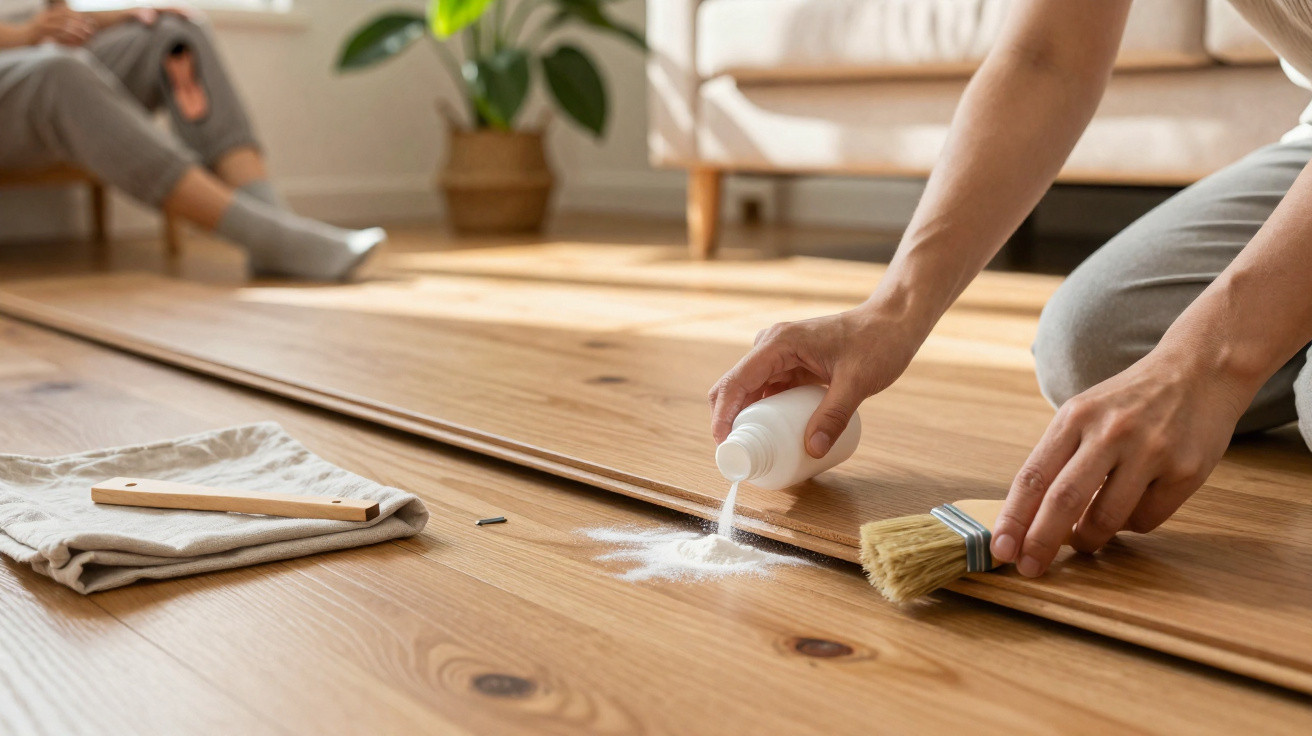
This is the part that catches most people out: dry lubricant is one of the most effective ways to quieten squeaky floorboards. There is no need for a full refit or for tearing up half the home. Instead, sprinkle a fine powder into the gaps between the boards – a process that is simple, a little messy and immensely satisfying. Graphite powder, talc, or a good powdered lubricant made for locks can all have surprisingly effective results.
The principle could not be more straightforward. When boards squeak because they rub together, reducing that friction can stop the noise. The powder works its way into hairline gaps, coats the edges and forms a smooth barrier. When the boards shift again, they slide against each other rather than protesting. It feels almost too simple, like one of those “nan’s tricks” you side-eye… right up until you try it. Many people begin with one especially noisy spot and, impressed by the result, end up treating the whole landing on a Sunday afternoon.
There are a few details to get right. First, locate the precise source of the squeak rather than treating the general vicinity. You may need to move slowly, going heel first and then toe, while listening closely. Sprinkle the powder directly into the narrow gaps between the boards, then work it in using a soft brush or an old credit card. Carpet makes the task more difficult, though not impossible: some people carefully lift a strip near the worst area, treat the boards and put it back afterwards. Let us be honest: nobody really does that every day.
The main error is assuming that one half-hearted shake of talc will silence a floor that has complained for twenty years. Often, you must repeat the treatment, walking over the area to help the powder settle before adding more. Another frequent mistake is using oil. It may sound sensible, but it stains, collects dust and does not age well. Use dry products instead. Think of this as softening the loudest noises, not giving the floor a complete personality transplant in five minutes. You are teaching it to whisper instead of shout.
There is a subtle satisfaction in that change. One homeowner in Bristol described the point at which her upstairs landing finally became quiet:
“It was like someone had turned off a noise I’d been ignoring for years. I walked to the bathroom at night and… nothing. No squeak, no complaint. I honestly felt a bit emotional, which sounds ridiculous for a floor.”
After trying the powder method, this quick checklist may help:
- Check every noisy spot slowly until you identify the precise board.
- Choose a fine, dry powder: graphite, talc or a purpose-made dry lubricant.
- Brush it well into the gaps, then walk over it to help it settle.
- Return to stubborn areas after a day or two and repeat the treatment.
- If the squeaks continue, consider loose nails or screws as the next possible cause.
Living in a quieter home
After treating a squeaky floor, there can be an odd moment when your brain does not quite believe the silence. You step carefully, expecting the familiar sound and almost preparing for it. Yet nothing happens. There is only the gentle sound of your own weight moving through the room. The home feels… calmer. It becomes clear just how much those small complaints had shaped the soundscape of your evenings.
Practically speaking, this method will not resolve every issue. If the joists below are warped, or the boards were poorly laid from the outset, deeper problems will still need attention eventually. Even so, this modest fix can bring time, calm and sanity. Parents who once dreaded the “post-story bedroom escape” can suddenly slip out like stage magicians. Flatmates no longer wince whenever someone crosses the landing for a glass of water at 2am. It is one small domestic battle, quietly won.
More personally, this is about having some control. So many sounds in life feel beyond reach: traffic, neighbours and boilers with a sense of humour. A squeaky floorboard is different. It is a minor, fixable issue sitting in plain sight. Repairing it will not change the world, but it can change how you occupy your own four walls. That change is unexpectedly powerful. Instead of tiptoeing around the house, you begin walking as though you belong there.
| Key point | Detail | Benefit for the reader |
|---|---|---|
| Identify the source | Test each area gently to find the precise point of the squeak | Prevents treating the wrong place and wasting time |
| Use a dry lubricant | Apply graphite, talc or a specialist dry product to the gaps | Reduces friction effectively without staining or attracting grime |
| Repeat if needed | Revisit persistent areas after a few days | Helps achieve a genuinely quieter floor over the long term |












Comments
No comments yet. Be the first to comment!
Leave a Comment