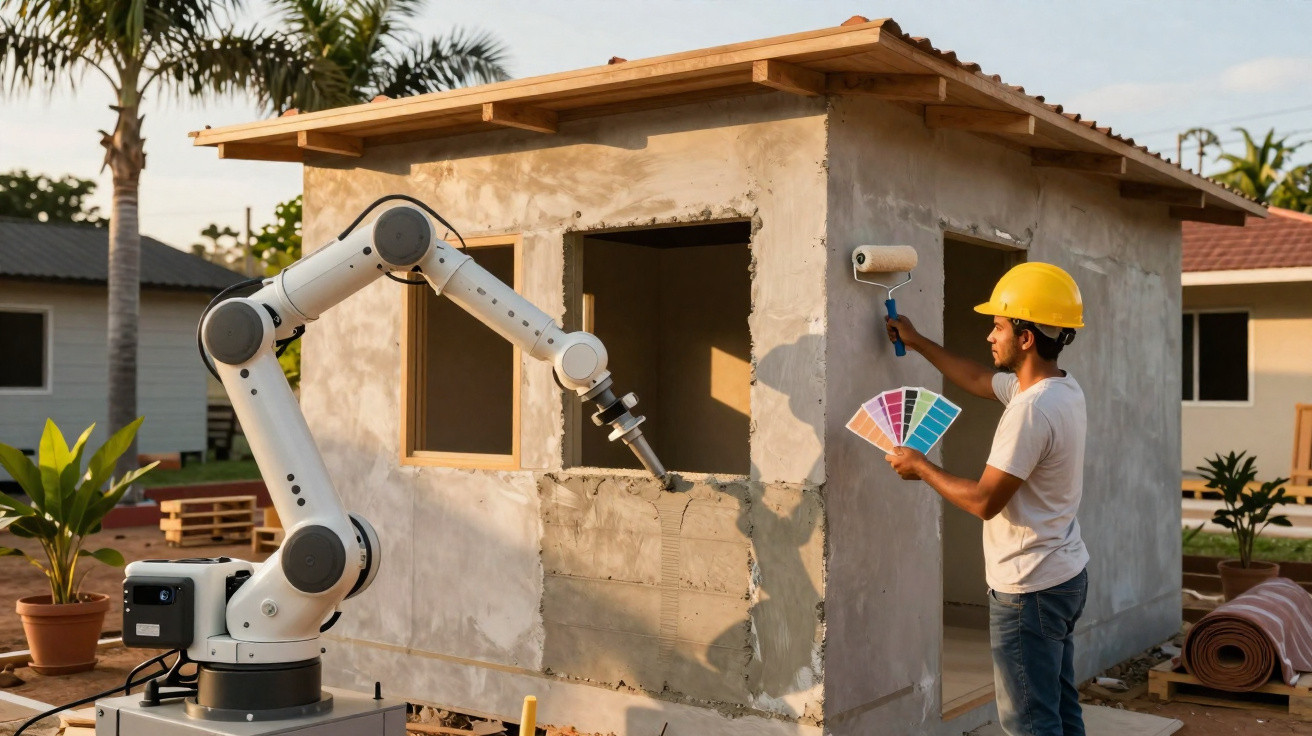
At the edge of a new-build development near Munich, a robotic arm stands in the morning mist as though it has accidentally ended up on a building site. There is no shouting or deafening hammer drilling-just a quiet whirr and the rhythmic movement of its steel joints. Layer by layer, the arm extrudes a grey compound from its nozzle, tracing lines and turning with millimetre precision like an intensely focused pastry chef icing a cream cake. Nearby, two bricklayers lean against a site cabin with coffee cups in hand, silently watching. Eventually, one remarks: “It is fast, you have to give it that.” The other snorts, nodding towards a window opening: “But inside there, that will be our job again.”
The future of construction is unfolding precisely in this gap between speed and sensitivity.
And it is less seamless than the glossy videos suggest.
When robots build walls and people create a home
Anyone visiting a modern site using a 3D-printing robot immediately notices the contrast. Where pallets of bricks once stood, there is now a container with hoses, cables and a dust-covered laptop emerging from it. A robot can print the external walls of a detached house within days, whereas people once needed weeks to do the same work. The sheer pace is hypnotic.
Yet the site still feels oddly incomplete-almost like a skeleton waiting for its soul.
One of Germany’s first 3D-printed homes was built in Beckum, North Rhine-Westphalia, back in 2021. Its images spread through the media: curved walls, a futuristic appearance and a house that looked as if it had come from a computer game. On site, however, tradespeople told a different story. The robot had printed 100 square metres of living space in around 100 hours. But once the machine had been removed, the work that never appeared in the photographs began: running cables, fitting sockets, filling, sanding, laying floors and installing doors.
The rapid shell construction made the headlines. The slower finishing work made the house liveable.
This is where fascination gives way to reality. Construction robots can now perform bricklaying tasks at remarkable speed, apply materials precisely in layers and reduce error rates. What they cannot do is make the countless small choices that turn an enclosure into a home. Where will a light strip feel too harsh? Where is another socket needed? How does a handle feel in the hand when it is used every morning? These decisions reflect biography, taste and instinct rather than algorithms.
The machine builds the house. People create the life inside it.
How human hands and sensors work together-and where the limit lies
Watching architects and site managers today makes one thing clear: using robots is no longer a science-fiction experiment, but part of a practical toolkit. On site, a 3D-printing robot primarily takes over repetitive and physically demanding tasks. Heavy formwork components are no longer required, while dust and back problems are reduced. Site teams shift their attention away from carrying and towards thinking, measuring and checking.
On a robotic building site, the most important gesture is no longer a hammer blow, but a scrutinising look.
A practical example comes from Baden-Württemberg, where a medium-sized property developer introduced its first automated concrete-formwork robots. Initial pride was high, but disillusionment arrived quickly. The robot followed the plans flawlessly, yet during the second project the installers realised that a planned bathroom felt claustrophobic in real life. The reason was simple: a wall opening was formally correct but positioned in a way that did not suit people. Only after several walk-throughs with future residents was the geometry adjusted slightly.
The robot could implement that correction effortlessly. Only people had recognised that it was needed.
That is the fundamental limit. Robots excel at repetition, precise execution and 24/7 speed. Living spaces, however, emerge from subtleties, deviations and last-minute compromises. A window is moved 30 centimetres because otherwise the view of the garden would just miss the old oak tree. A door opens the other way because a child’s bed would otherwise be in the way. Let us be honest: no client plans their life entirely according to standards.
Fine-tuning works like a conversation between a house and its residents-and that conversation needs a human voice.
Using construction robots without losing a home’s soul
The most intelligent approach to construction robots starts not on site, but at the kitchen table with a pen in hand. Anyone planning a house can deliberately build on the strengths of machines: clear geometries for load-bearing walls and repeating modules that are easy to print or build. At the same time, it makes sense to identify certain areas from the outset as “human spaces for flexibility”: the kitchen, bathroom and living area. Here, the shell can be standardised while details such as niches, light sources and material transitions are decided calmly on site.
Robots provide the pace; people decide where the pauses belong.
Many clients underestimate one point: the real magic of a house only reveals itself when you walk through unfinished rooms. That is when you notice whether a ceiling height feels oppressive, whether a corridor resembles a tunnel or whether a window causes unexpected glare. Anyone who hands everything blindly to the digital model and the robot misses out on this experience. Another common mistake is cutting every “special request” under cost pressure because it supposedly disrupts automated construction.
Yet these very deviations are often what make later life in a home tolerable-and sometimes even joyful.
Architect Sarah K., who has supported several partly automated projects, puts it this way:
“The robot gives us a basic pace that we have to fill with human attention. If we only focus on output, we end up with houses that may be efficient, but are emotionally empty.”
Anyone wishing to combine both in their project can follow a few straightforward principles:
- Robots for the rough work, people for the finer points: Automate the load-bearing structure, but plan touchpoints such as handles, light switches and seating edges consciously by hand.
- Do not idolise digital models-walk through them: Schedule at least one “shell construction tour” while changes can still be made.
- Allow for materials with character: Include timber, plaster and textiles that accommodate minor imperfections and can even make them feel alive.
- Involve tradespeople early: Ask those who will later sand, install and fit components-they spot problems before they are set in concrete.
- Take everyday users seriously: Consider circulation routes, pushchairs, pets and hobbies, not just square metres and floor-plan lines.
Between steel arm and human hand: living remains a feeling
When people see a house erected by robots in record time, it is easy to focus solely on the spectacle. YouTube clips concentrate on the moment when concrete flows from the nozzle like icing, drones circle overhead and everything looks like a perfect choreography. What the camera rarely captures are the quiet afternoons afterwards, when an electrician considers in dusty silence where one additional socket might make everyday life easier. Or the moment when a family stands in an unfinished living room and suddenly realises that a window is too high to look out at the garden while seated.
Robots accelerate the shell; people slow the process down again to make it liveable.
The coming decade will probably be interesting not because machines take over everything, but because we will be forced to decide again what human time should be reserved for. On site, that means less muscle power and more judgement. Fewer accidental errors and more deliberate deviations. The honest question is not whether robots build “better”, but: where do I trust precision without compromise, and where do I want to see my own fingerprint?
Whether in a beloved crooked niche, a hand-laid tile or a window aligned exactly with a favourite tree.
Perhaps, in a few years, people will walk through new-build neighbourhoods without being able to tell whether the shell was created by a person or a machine. What will remain unchanged is what they can feel: whether a house seems cool and neutral, or feels like a calm breath as soon as they enter. Because beyond sensors, actuators and software, living remains a physical, sometimes stubborn and always personal feeling. And that feeling will still require someone standing in the dust, taking a breath, looking around and saying at the right moment: “However quickly this is going, we need to change something here.”
| Core message | Detail | Value for the reader |
|---|---|---|
| Robots speed up shell construction | Fast 3D printing and automated bricklaying create the building shell in days rather than weeks | An understanding of how construction times can genuinely be shortened-and where costs can actually be reduced |
| Fine-tuning remains human work | A sense of space, lighting design and everyday usability emerge from decisions made on site | Awareness of which aspects should not be handed over blindly to technology |
| The best outcome comes through collaboration | A clear division of tasks: machines for repetition, people for variation and comfort | A practical approach to planning personal building projects more intelligently and avoiding mistakes |





Comments
No comments yet. Be the first to comment!
Leave a Comment