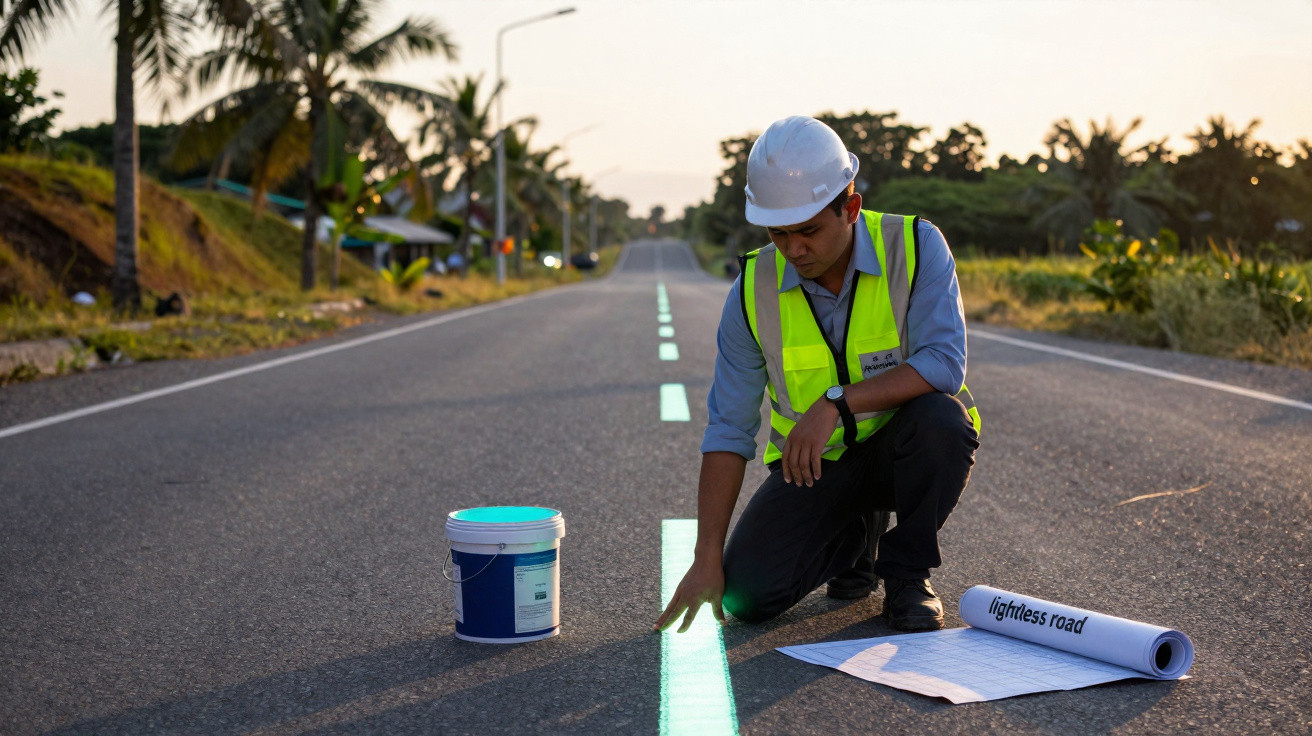
In Malaysia, the future of road lighting briefly appeared to have arrived: rather than relying on conventional street lamps, self-illuminating road markings were intended to make dark rural roads safer. The trial made international headlines – but just a year later, the government abruptly applied the brakes. The reason lay less with the technology than with the budget.
How a glimpse of the future lit up in Semenyih
The trial took place on a two-lane road near Semenyih in the state of Selangor. At the end of October 2023, the public works department installed special road markings along a 245-metre stretch that absorb sunlight during the day and glow after dark.
The concept was practical. There was no street lighting in the area, while the road was winding and difficult to see in wet conditions. From the outset, the authority stressed that this was not a visual gimmick, but a measure to improve road safety and promote “innovation in road construction”.
The road itself was meant to become the source of light – without electricity, without lamp posts, integrated directly into the asphalt.
In daylight, the markings looked almost entirely ordinary. Their effect only became apparent after nightfall: the lines emitted a greenish glow, giving drivers clear guidance even in rain. The minister responsible, Alexander Nanta Linggi, said they could remain visible for up to ten hours after sunset.
Why glowing roads suddenly became the subject of discussion
The pilot project delivered a simple, easily understood promise: improved visibility on dark roads without electricity costs. That was enough to generate considerable attention, both in Malaysia and beyond.
The figures for the test section showed how seriously the authorities approached the issue. A total of 490 metres of glowing markings were used across the 245-metre stretch, including on bends and at hazardous points. The aim was partly to replace conventional road reflectors, known as “cat’s eyes”.
The approach was not entirely new. In the Netherlands, designers and construction firms had already tested so-called “Glowing Lines”, which collect energy during the day and shine for several hours at night. However, that remained a time-limited experiment and was never rolled out on a wider scale.
In Malaysia, the scheme seemed much more down to earth: not an art installation or a publicity project, but a road-safety trial for everyday use on rural routes.
From pilot scheme to vision: sudden expansion plans
As many motorists praised the glowing strip of asphalt, those responsible began thinking much bigger just a few months later. In February 2024, the state of Selangor announced plans to test the technology at 15 further locations across all nine districts.
Around 15 kilometres of road were planned, including sections in Sepang, Kuala Langat and Petaling. The estimated cost was about 900,000 Malaysian ringgit. The experiment therefore appeared to be developing into a strategic infrastructure project.
At the same time, other states signalled interest. Johor identified 31 roads for similar trials, including a 300-metre section near Batu Pahat. Suddenly, glowing road markings looked like a potential standard solution for dark rural roads throughout the country.
The catch emerges in the figures
While interest continued to grow, a problem was emerging in the background that eventually catches up with every infrastructure project: cost. The government published a straightforward but stark comparison.
- Price per square metre of standard road paint: around 40 ringgit
- Price per square metre of photoluminescent specialist paint: around 749 ringgit
- Cost factor: almost 20 times more expensive
And that figure covered initial installation alone, without long-term evidence on durability, weather resistance or repair cycles. This is normally where the critical stage of an assessment begins for transport experts.
A statement in Parliament ends the dream
The reversal came in November 2024, and it was unexpectedly clear-cut. Deputy Works Minister Ahmad Maslan told Parliament that the cost of the glowing markings was “too high”, meaning that continuing with the luminous lanes would “probably” not be considered.
His second point was at least as significant: internal tests had not convinced the ministry’s specialists. The issue was therefore not solely financial, but also concerned technical assessment and standards.
What looked like a convincing safety benefit to many drivers did not pass the more stringent assessment of the specialists.
The success story had therefore turned into a familiar infrastructure reality: a technology can look impressive, prove useful in practice and still fail if it costs too much or is too demanding to maintain. In the end, photographs on social media matter less than service life, maintenance intervals, standards and a limited public budget.
Why the visibility question remains
Even without a major glowing roads programme, the original issue remains unresolved: how can road markings be designed to stay clearly visible at night and in poor weather, especially in areas without street lighting?
Transport authorities around the world are addressing precisely this question. In Japan, for example, the National Institute for Land and Infrastructure Management is examining which indicators are suitable for maintaining and assessing the quality of motorway road markings. There, the condition of markings is regarded as a separate road-safety factor rather than a minor detail.
From an engineering perspective, several elements must work together:
| Aspect | Importance for safety |
|---|---|
| Reflectivity | Determines how effectively vehicle headlights make the marking visible. |
| Contrast with the road surface | Important in rain, darkness and when the road is dirty. |
| Durability | Determines how quickly markings need to be renewed. |
| Maintenance costs | Affects whether a solution remains affordable across an entire network. |
| Technical standards | Ensure consistency and minimum quality across the country. |
What glowing roads have nevertheless taught us
Even though Semenyih remained only a test site, the project still offers several lessons. First, it demonstrates how strongly innovation in road construction can shape public perception: a 245-metre section was enough to trigger a nationwide debate.
It also highlights how narrow the gap can be between an “exciting pilot project” and an “expensive misinvestment”. Such trials must clear several hurdles:
- a noticeable safety improvement in real traffic conditions
- proven durability over several years
- clear maintenance plans for local authorities
- a cost framework that can compete with established alternatives
It was the final point in particular that troubled the glowing markings. A technology must not merely work in day-to-day use; it must also remain financially viable across thousands of kilometres of road network. Local authorities often face a choice between one spectacular flagship scheme and straightforward improvements at many problem locations.
Where photoluminescent markings could still make sense
Malaysia’s rejection does not remove such solutions from consideration altogether. Highly targeted uses remain conceivable:
- short, poorly visible danger spots without an electricity connection
- tunnel sections where protection against power cuts is required
- test areas for combined systems using reflectors and LED technology
- specialist zones, such as those around industrial facilities or ports
Hybrid approaches are also possible: conventional highly reflective markings could remain the standard, supplemented by limited glowing sections at especially critical locations. This would allow the benefits to be tested without coating long stretches of road.
What motorists can take from the debate
For road users in Europe, the story from Malaysia may initially seem distant. Yet it raises questions that are relevant here too: how safe are rural roads at night? Are markings and roadside delineator posts sufficient? When is a new technology worth the additional cost?
Several basic principles can be applied more widely:
- Clearly visible markings are not a luxury, but part of active safety.
- Road construction innovations need clear evidence, not simply attractive images.
- Cost per kilometre often has more influence than technical feasibility.
- Pilot projects should produce data that enables an honest assessment, even when the result is negative.
For now, glowing roads remain a symbol of the tension between high-tech ambition and budget reality. The brief episode in Malaysia shows how quickly futuristic ideas can move into the spotlight – and how demanding the conditions are for them to reach the road permanently.











Comments
No comments yet. Be the first to comment!
Leave a Comment