It began with a bright whirr, followed by a noise like a coin tumbling in a spin dryer: harsh, unmistakably wrong.
The sink filled quickly as the scent of onion skins and washing-up liquid rose into the air, while the small green light on the switch seemed to glare at me like a self-satisfied witness. My garbage disposal had jammed, thoroughly and without question, halfway through Tuesday’s dinner. Rice was clinging to every surface, my glass of wine was warming up, and I felt that familiar dread of ringing a repair service for something that sounded minor but probably was not. I stood looking at the drain, debating whether to act as though it might repair itself while I searched YouTube. Then I remembered the small Allen wrench in the junk drawer and lowered myself to the floor. It is strange how much a tiny tool can alter your mood, isn’t it?
The clunk that stopped my kitchen
Even if you have never given your appliances names, you soon learn their personalities. Mine normally purrs like a happy cat. That evening, though, it spluttered, shook and then fell completely silent. I switched it off, looked into the drain’s dark opening and did the very human thing: grabbed a torch and peered inside, as though insight might float up like a message in a bottle.
Everything appeared harmless at first: dull metal and a handful of defiant noodles. I pulled out a small strip that may have been lime peel, noticed a slight snag around where the blades sit, and understood that it was gripping something hidden from view. My shoulders sank. The water in the sink was heavy and motionless, showing my reflection like a disappointed pond. We have all faced that point where we know the responsible thing is to sort it out… yet would much rather avoid it.
In my head, I calculated the cost of a call-out: a weekday evening, an emergency appointment, perhaps £90 simply for someone to arrive, before labour was added. The wine immediately tasted less enjoyable. Then I remembered a friend talking about kitchen mishaps: “There’s a hex socket under the disposal. You can hand-crank it.” That memory was enough to replace dread with determination.
The little hex hero
My junk drawer is a monument to good intentions: tape that adheres to nothing, an extra remote control I do not recall connecting, and a collection of Allen keys left over from flat-pack furniture. One of them was precisely the right size. It felt like a small miracle, the sort that makes you have faith in your own home again.
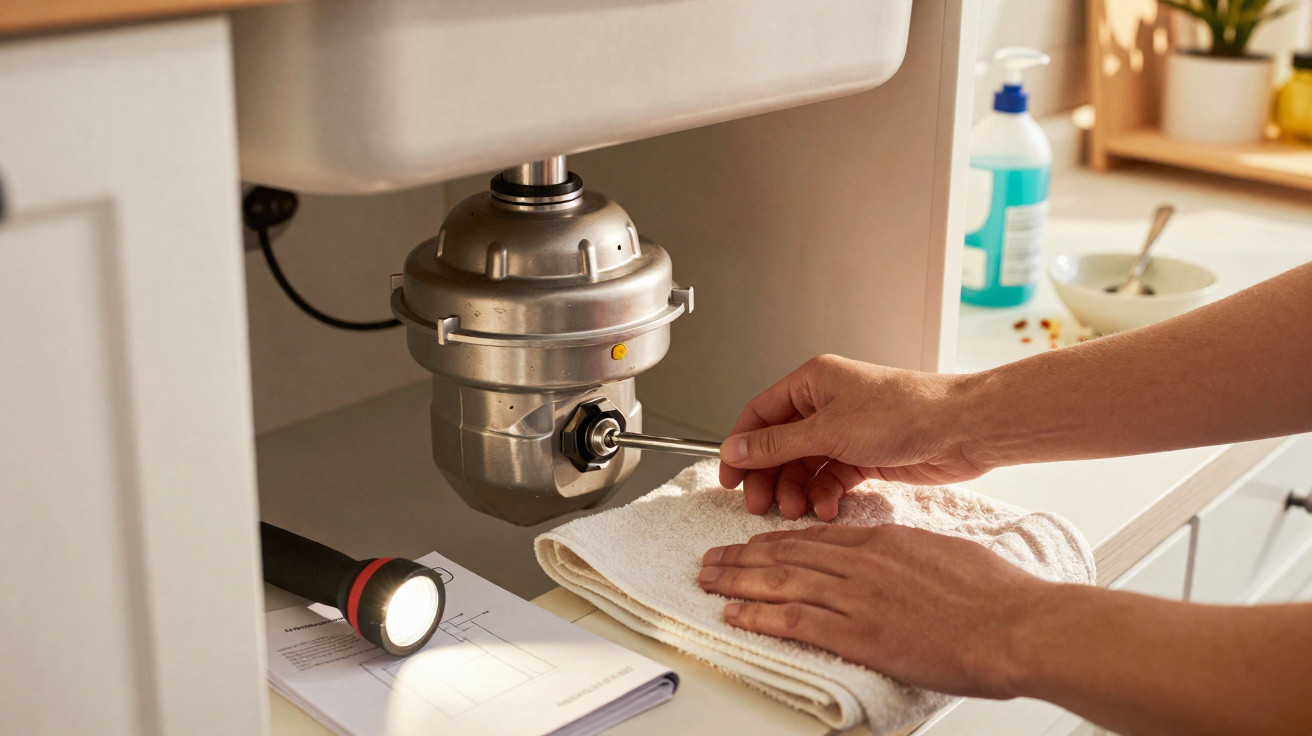
Armed with a tea towel and torch, I slid onto the floor. The cupboard beneath the sink has its own atmosphere: damp timber, a faint note of lemon cleaner, and old shopping bags that seem to reproduce when ignored. I shifted the bin, made room for myself and found the beast’s underside: the garbage disposal’s base, a short metal cylinder with a small hexagonal socket exactly in its centre.
Under the sink: safety and preparation
Here is the one sentence that will earn you invitations to future dinner parties. Always cut the power to the disposal before you put your hands anywhere near it. Mine plugs in beneath the sink, so I unplugged it. If yours is hardwired, turn off the circuit breaker instead. The aim is simply to eliminate the chance of a nasty surprise.
I tidied the space and placed a shallow tray below the unit, in case water chose that moment to escape. The reset button, a small red dot, sat tight against the base. I pressed it hopefully, without expecting much, then dried my hands and searched again for the hex socket. It is tiny and easily overlooked, rather like a keyhole in a storybook door.
Locating the socket
With most units, the socket is positioned directly in the centre of the underside. Insert the short end of the Allen key and it lets you rotate the shaft that moves the internal plate and blades. This is not about wrenching it round as if it were a bolt; it is about coaxing it. Imagine gently nudging a jammed drawer until it starts to slide.
The Allen wrench method that freed the blades
The first movement felt unnatural, as if I were pressing against a locked door. Holding my breath, I tried the opposite direction - left, then right, in a careful little dance. A faint scrape replied, followed by the slightest movement. I imagined something soft yet stubborn lodged in the darkness: one piece of dinner determined to turn itself into a lesson.
I continued rocking the wrench backwards and forwards: a quarter turn, then half a turn, then back again. There were no grand gestures, only patient encouragement. I even whispered please to a machine. There is something reassuring about metal gradually remembering what it is supposed to do after stopping for a while. The sensation shifted from gritty resistance to smooth movement, and through my hands I felt the entire unit seem to exhale.
By then, I was smiling to myself beneath the sink, not remotely how I had expected the evening to unfold. There’s a tiny hex socket on the bottom of most disposals that can set you free. You do not have to be a plumber to use it; you need only patience and a key that likely arrived with your most recent bookcase. Once the movement felt steady and effortless, I gave it several more turns, removed the wrench and wriggled back into the light.
When the jam released
Relief has a sound all of its own. It is not a cheer or a ping, but simply the disappearance of that anxious little crunch. I pressed the reset button once more for good measure, picked up some tongs and extracted the culprit from the drain: a curl of onion skin tightly wrapped around part of a wooden cocktail stick from the weekend. Together, they had created a troublesome little wreath.
Aftercare and the debris I removed
After a success like this, I always run cold water for a full minute. The disposal deserves a thorough rinse, the pipes need a decent flush, and I frankly needed the sound to carry away the drama. I plugged the unit in again, flicked the switch and heard the familiar hum return, almost apologetically. There was no rattle or vibration, only that reassuring purr.
While the water continued to run, I added a few small ice cubes and a slice of lemon to freshen it up. Ice does not sharpen the blades - that is a myth - but it can help dislodge small pieces stuck inside the chamber, while lemon makes you feel as though the kitchen belongs to you again. The citrus smell cleared away the final trace of onion, and I could breathe properly.
What I will not put down there again
Let us identify the villains. Stringy ingredients are Enemy Number One: celery fibres, onion skins and sweetcorn husks. They wind around the impeller like cling film, and suddenly your Tuesday becomes an incident report. From now on, I will compost them with the conviction of someone who has learned an awkward lesson firsthand.
Then there are the dense, misleading offenders: fruit stones, bones, hard clumps of pasta and wooden cocktail sticks. Coffee grounds remain a matter of debate, but my pipes are old, so I have decided to keep them out. The same goes for eggshells. I know some people swear by them, but to me they seemed like tiny pieces of shrapnel waiting to cause trouble. Honestly, nobody gets this right every day.
We have all been there while rinsing plates, telling ourselves it will “probably be fine.” That was exactly the thought that jammed my blades. Now, I scrape dishes with the attentiveness of someone who has spent time close up with the underside of their sink. One minute of care is better than an hour spent on your knees, every time.
What if the garbage disposal remains stuck or smells burnt?
Sometimes, you do the dance and it simply is not your day. If the wrench will not move, or if it turns but the motor still groans and stalls, stop there. Check whether the base of the unit feels warm. A hot casing may mean that the motor has tripped, or something worse has happened. Leave it for ten minutes, press the reset button, try the hand-crank again and only then restore the power.
If it hums loudly but does not spin, disconnect the power and return underneath with the wrench for longer, rotating it in both directions to break the blockage up bit by bit. Here is the rule I keep for true emergencies. If you smell burning or see leaks, stop and call a professional. Pride costs less than replacing a kitchen floor. Some faults are not jams at all; they are failures, which means a different problem and a different bill.
The small rules I now follow
I allow the cold tap to run for 20 to 30 seconds both before and after using the disposal. That keeps waste moving and helps prevent the sticky blockages that occur when fats and starches settle together. I add scraps gradually rather than giving it an entire feast at once. The unit is not a hungry hippo; it is more of a careful nibbler.
Every few weeks, I put in several ice cubes and a slice of citrus. That ritual is more for my benefit than the machine’s. The noise of ice being crushed feels like a modest reset, as if the kitchen is clearing its throat. It also helps to clean the rubber splash guard; it is the little black umbrella that catches every kind of mess, and it can smell like yesterday’s secrets.
Why the wrench trick works - and why it is so satisfying
A disposal’s impellers do not cut food as knives do. Instead, they throw it against a grinding ring until the pieces are small enough to wash through. When something firm or fibrous wedges itself in the wrong spot, the mechanism becomes like a locked carousel. The hex socket links to the shaft, giving you enough leverage to rock that carousel past the obstruction without using brute force.
There is a pleasing humility in the process. You are not defeating the machine; you are simply giving it enough encouragement to work as itself again. That is why the motion needs to be gentle and go in both directions. You are loosening a knot, not smashing through a door. It is the kind of repair that leaves you feeling both very human and surprisingly capable.
The money I saved and the confidence I found
I did not make the evening news or receive a medal. However, I probably avoided a £90 call-out charge, as well as the strange guilt of summoning a professional to rescue a cocktail stick. More importantly, I kept my evening and my good mood. I poured another glass of wine and watched the water disappear through the drain like a perfectly polite guest.
There is a quiet confidence in resolving a small household crisis with your own hands. It changes how you see the cupboard beneath the sink. Instead of viewing it as the kitchen’s haunted corner, you begin to see it as somewhere you have already been and somewhere you can manage. What looks mysterious is often just unfamiliar. That is a sentence I would happily put on a tea towel.
A quick recap to keep handy
Turn the unit off, then unplug it or switch off the circuit breaker. Remove anything from the drain using tongs rather than your fingers, and press the reset button underneath. Put an Allen key into the hex socket at the bottom, rocking it left and right until it moves smoothly. Reconnect the power, run cold water and test the switch.
If the motor is still protesting, use the hand-crank for a few more minutes and search for concealed offenders with your tongs. Avoid putting fibrous or hard items in the unit from now on, and occasionally treat it to a little citrus-and-ice spa. It is uncomplicated, a bit scruffy and effective: the finest sort of home magic.
The part where I state the obvious
Of course, it would have been easier to ignore the noise and hope the sink somehow resolved the problem on its own. Yes, I briefly thought about posting a sad kitchen photograph and asking the internet for a solution. Yet crawling under the sink with a hex key gave me more than a clear drain. It gave me that warm click of competence: the sense that everyday life can be gently pushed back into place with a small amount of courage and a simple tool.
The next time the kitchen has a mood, I will still grumble, roll my eyes and contemplate handing the drama to somebody else. Then I will reach for the wrench. The best knowledge is not always grand or complicated. Sometimes it is the sort you can hold in your hand: hex-shaped, quietly waiting in a drawer and ready to surprise you all over again.
















Comments
No comments yet. Be the first to comment!
Leave a Comment