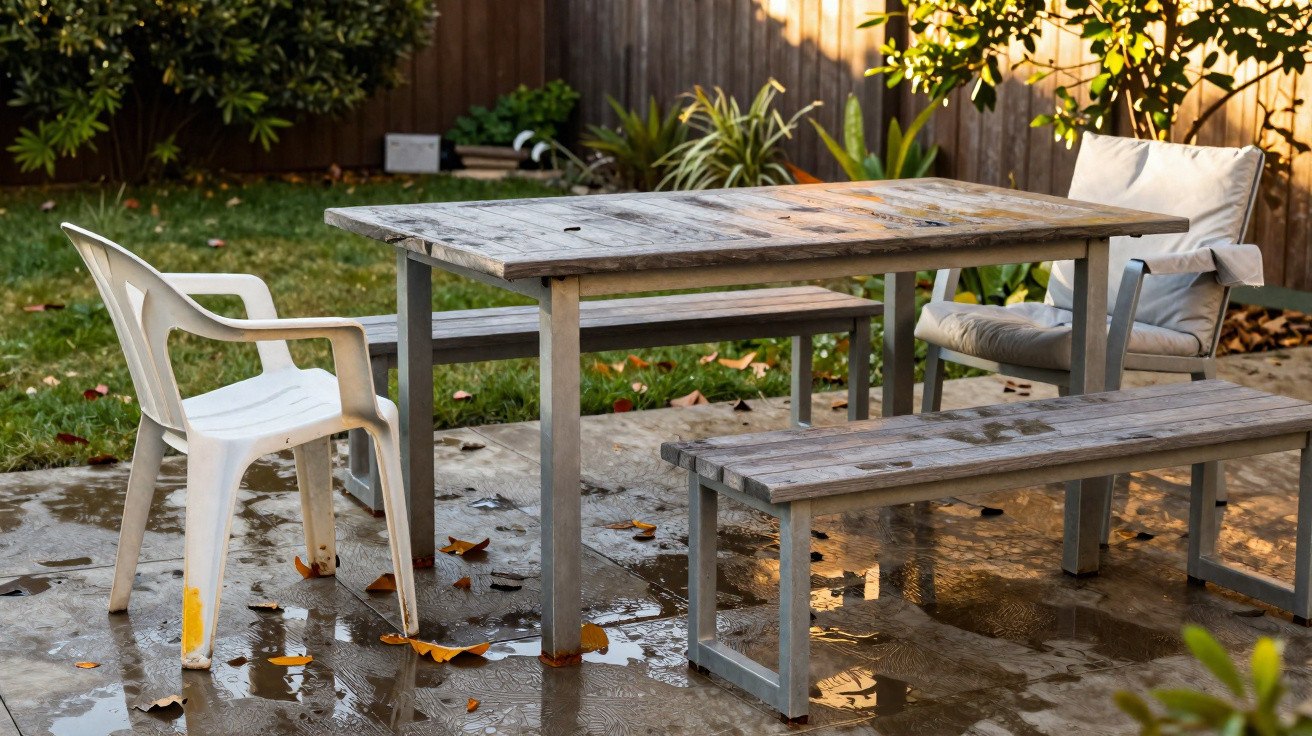
Freshly brewed coffee in hand, the garden beckoning outside… then the perfect moment is spoiled by furniture damaged over winter.
Anyone with a balcony, patio or garden knows the situation: all it takes is the first serious cold spell to expose cracked chairs, warped benches and stained tables. It is not always a matter of “poor care”; often, the real issue is choosing materials that simply cannot cope with rain, sun, wind and abrupt temperature changes.
The silent enemy: why winter ruins outdoor areas
When planning an outdoor area, most people worry about intense sunshine. Yet in many cases, damp winter weather is the greater threat. Rain, mist, dew, frost and fluctuating temperatures create a destructive combination when the wrong material has been selected.
Water penetrates tiny cracks and the natural pores of vulnerable surfaces. If temperatures fall sufficiently, that water freezes, expands and creates internal pressure that opens cracks, strips varnish and loosens joints. Even in parts of Brazil where snow does not fall, the wet-dry-hot-cold cycle causes similar wear, albeit more gradually and deceptively.
“The issue is not one ‘very harsh’ winter, but several winters repeated over the years on fragile, poorly specified materials.”
The outcome is often familiar: swollen timber, flaking paint, rusted metal and dull, brittle plastics. In most instances, there is no lasting repair, because the structural damage has already taken hold.
Cheap timber and ordinary plastic: the bargain that quickly becomes waste
Untreated timber: outdoor sponges
The biggest source of regret outdoors is the combination of “pale timber + low price + spring sale”. In many cases, it is pine or another softwood that has not been properly treated for exposure.
These timbers behave like sponges, taking in rainwater, moisture from the air and even splashes from garden irrigation. In humid conditions, fungi and bacteria establish themselves quickly. In warmer regions, termites and wood-boring insects finish the job.
- Timber swells, warps and splits;
- Screws begin to loosen, leaving structures unsteady;
- Dark stains can emerge within a few months;
- The furniture loses strength and can become a falling hazard.
The situation worsens when the timber has received only a thin factory-applied varnish, which looks attractive on the day of purchase but cracks during the first particularly wet season.
Ordinary plastics and cheap resins: when cold meets sun
Basic plastic chairs, lightweight resin benches and very inexpensive colourful sets also belong on the list of items likely to be discarded early. They may stand up reasonably well to water, but they fare badly against the combined effects of sun and time.
UV rays gradually break down polymer chains. The item becomes dull, yellowed and rough. Once the material has weakened, any sharp temperature drop makes it stiffer and causes micro-cracks. A simple knock, or an adult sitting down quickly, may then be enough to break it.
“Ordinary plastic outdoors tends to follow the same pattern: colourful in the summer it is bought, cracked two winters later.”
Metals and modern composites: where investment pays off
Aluminium: lightweight, durable and low-maintenance
Aluminium is among the strongest material choices for outdoor areas. It does not rust, is lightweight and copes well with rain, sunshine and temperature variation, provided it has a good finish.
The recommended option is aluminium with powder coating, often called a “thermolacquered” finish. This treatment forms an even protective layer that resists peeling and shields the metal from moisture and sea air.
In practical terms, this means:
- furniture that can remain outside throughout the year;
- straightforward cleaning with only water and mild soap;
- low weight, making it easier to rearrange the garden layout;
- good compatibility with timber, fabric and synthetic fibre.
Composite timber: a warm look with polymer durability
For those who like the appearance of timber but do not want to deal with sanding, varnishing and stains, composite timber, or “composite decking”, is a robust alternative. It combines wood fibres with high-density plastic resins.
This blend limits water absorption, reduces splitting, prevents rot and makes pest attack more difficult. It is therefore widely used for:
- decking around swimming pools;
- balcony flooring;
- fixed benches and planters;
- façade cladding.
“Composite timber provides the ‘feel of wood’ while behaving far more consistently in rain, sun and thermal shocks.”
When real timber is the preference: the role of autoclave treatment
Not everyone wants to forgo natural timber. In that case, treatment is the key consideration. The most widespread system for outdoor use today is autoclave treatment, in which the material undergoes vacuum and pressure processing so that preservatives penetrate right to the core.
This timber is generally classified by intended use. For outdoor settings, categories 3 or 4 are the most suitable, as they are designed for frequent contact with moisture and even contact with soil.
Over the years, these pieces tend to develop a greyish tone. This “grey” does not automatically mean rot; rather, it is natural surface oxidation, which can either be left in place or softened with specialist oils.
| Material | Typical lifespan outdoors | Maintenance |
|---|---|---|
| Cheap untreated timber | 1 to 3 years | High, with a risk that it is not worthwhile |
| Ordinary plastic | 2 to 4 years | Low, but it ages poorly |
| Autoclave-treated timber (cat. 3/4) | 10 to 15 years | Medium, with occasional oil reapplication |
| Thermolacquered aluminium | 10 years or more | Low, simple cleaning |
| Composite timber | More than 15 years | Low, with no sanding or varnishing |
When a “sale” becomes a trap for your wallet and the planet
The habit of “buying again next summer” is directly connected to selecting disposable materials for outdoor spaces. Very cheap furniture can ease the immediate budget, but it creates a cycle of purchasing and disposal every two or three years.
This pattern affects both waste volumes and household spending. Producing low-quality plastic and disposable timber consumes resources, creates emissions and fills landfill sites. Replacing items regularly means paying several times for something that could have lasted a decade.
“Investing in a good material reduces waste, maintenance effort and cumulative spending over the years.”
How to assess a material before taking it home
Quick checks in the shop
A few signs can reveal whether a piece of furniture is likely to age badly:
- Very lightweight timber with no treatment information and a “raw” appearance;
- A strong solvent smell, suggesting a fragile surface finish;
- Thin plastic that bends too much when pressed by hand;
- Metals with no mention of anti-corrosion treatment;
- Exposed ordinary steel screws, already showing rust spots in the shop.
Labels can help too. Looking for terms such as “outdoor use”, “weather-treated”, “autoclave-treated timber category 3 or 4” or “aluminium with powder coating” is a good starting point.
A practical scenario: two purchases, two outcomes
Imagine two families. One equips its outdoor area with a basic plastic set, a flimsy parasol and an untreated timber bench. The other chooses an aluminium table, chairs with a robust metal frame and an autoclave-treated timber bench.
After three rainy winters, the first family is likely to have broken items, whitened plastic and swollen timber, requiring the replacement of almost everything. The second may have only minor signs of use and, at most, need to reapply oil to the timber – while the set remains sturdy and safe.
Terms worth understanding before renovating the garden
Two concepts are becoming increasingly common in discussions of outdoor areas: “weathering” and “service life”. Weathering is the combined impact of the climate on a material: sun, rain, wind, sea air, pollution and temperature changes. Service life, meanwhile, is the period during which a product performs its function safely and retains an acceptable appearance without major renovation.
In practice, understanding these terms makes it easier to see the real cost of a piece of furniture. A more expensive item with a service life of 10 to 15 years may cost less than three or four cheap pieces replaced during the same period, even before considering the time spent maintaining, painting or disposing of them.
Anyone intending to update an outdoor area in the coming months can model some simple scenarios: how long they expect to use the space, how much sun and rain it receives, whether there are children or pets, and whether the area is coastal. Matching these answers to the chosen material greatly improves the chances of avoiding expensive furniture that ages badly and becomes a headache in its first few seasons.













Comments
No comments yet. Be the first to comment!
Leave a Comment