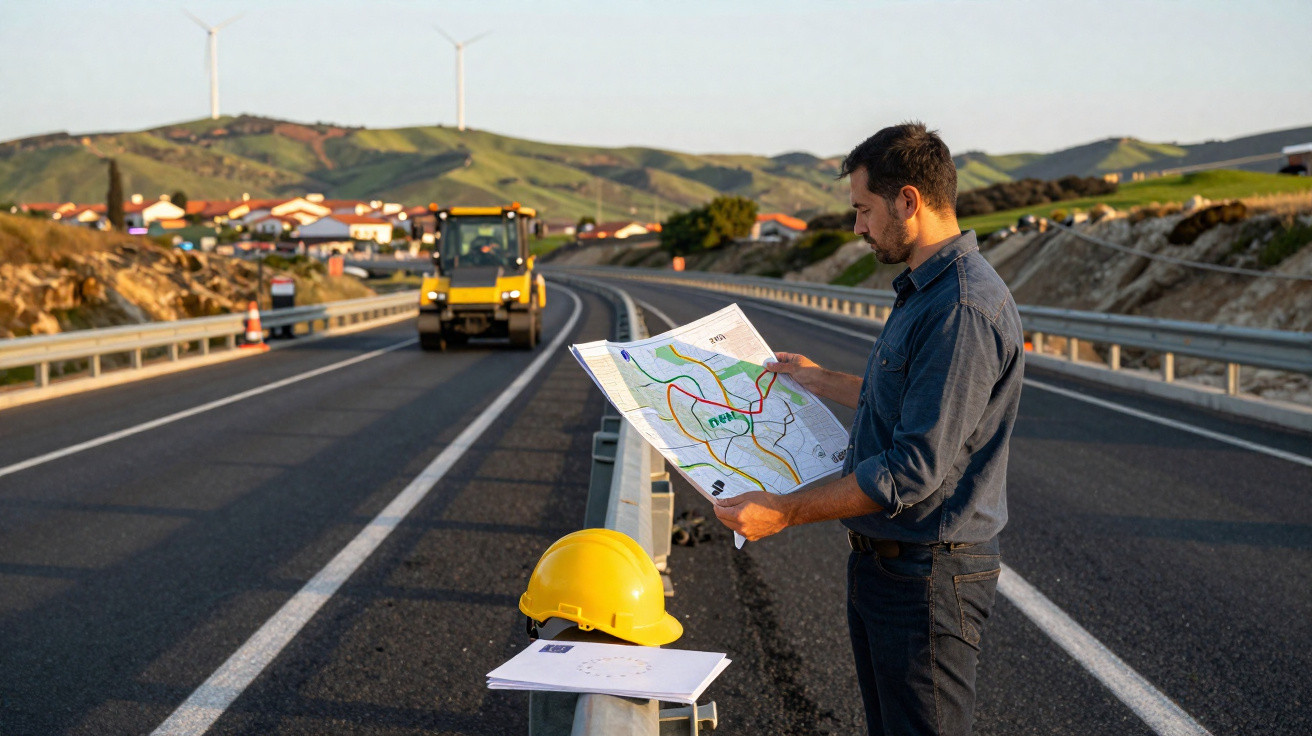
PRR infrastructure funding and delivery deadline
At the Infraestruturas de Portugal headquarters in Pragal, Almada, Prime Minister António Costa and the Minister for Infrastructure and Housing, Pedro Nuno Santos, unveiled the Recovery and Resilience Plan (PRR) for infrastructure. The plan will result in the construction of new roads and the upgrading of existing routes.
Of the €45 billion Portugal will receive from the “European bazooka” - the name given to the EU Recovery Fund - €520 million has been earmarked for infrastructure. This funding must translate into completed works by 2026, a tight implementation deadline set by Brussels.
In the Prime Minister’s own words: “We have less time than usual. We have financial commitments in place until 2023 and all the work must be completed by 2026, otherwise we will not receive those resources.”
Focus on tarmac
Despite resistance from the European Commission, which wants national plans to place particular emphasis on environmental issues and the energy transition, Portugal’s PRR shows a strong commitment to tarmac, through the construction of roads and the upgrading of others. However, António Costa said that rail will be the country’s principal focus within the European funding framework.
According to António Costa, the newly announced road schemes are intended to “decarbonise urban centres”. Most interventions cover only a few kilometres, “but radically transform the territory”. The sole major project will be the route linking Beja and Sines, improving connections to the terminal, port and railway.
Pedro Nuno Santos also stressed that the main aim is to remove “vehicles from urban areas or direct them to high-capacity corridors”, thereby “increasing the capacity and safety of road sections with high levels of congestion and a degraded level of service - such as the EN14, where average daily traffic is close to 22,000 vehicles a day, or the connection to Sines, where 11% of traffic volume consists of heavy goods vehicles”.
António Laranjo, president of Infraestruturas de Portugal (IP), outlined how IP’s work is organised across three investment programmes, shared with local authorities:
- Missing Links and Increased Network Capacity, with planned investment of €313 million;
- Cross-border connections, with investment of approximately €65 million;
- Road access to Business Reception Areas, with investment of around €142 million.
New roads: where?
The construction of new roads and the upgrading of existing ones have been allocated across the three investment programmes mentioned above: Missing Links and Increased Network Capacity, Cross-border Connections, and Road Access to Business Reception Areas.
PRR road investment programmes
Missing Links and Increased Network Capacity - CONSTRUCTION:
- EN14: Maia (Via Diagonal) / Trofa Road-Rail Interchange, promoting modal shift to rail transport via the Minho Line;
- EN14: Trofa Road-Rail Interchange / Santana, including a new bridge over the River Ave;
- EN4: Atalaia bypass, allowing through-traffic to be removed from this urban area;
- IC35: Penafiel (EN15) / Rans;
- IC35: Rans / Entre-os-Rios;
- IP2: eastern Évora bypass6;
- Aveiro–Águeda Road Axis, providing a direct link between Águeda and Aveiro and encouraging modal shift to maritime and rail transport;
- EN125: Olhão bypass, allowing through-traffic to be removed from this urban area;
- EN211 bypass: Quintã / Mesquinhata, promoting modal shift to rail transport via the Douro Line.
Missing Links and Increased Network Capacity - UPGRADING:
- EN344: km 67+800 to km 75+520 – Pampilhosa da Serra;
- IC2 (EN1): Meirinhas (km 136.700) / Pombal (km 148.500);
- IP8 (A26): increased capacity on the connection between Sines and the A2.
Missing Links and Increased Network Capacity - CONSTRUCTION AND UPGRADING:
- Baião connection to Ponte de Ermida (approximately 50% new-road construction) [13];
- IP8 (EN121): Ferreira do Alentejo / Beja, including the Beringel bypass (only the Beringel bypass, representing 16% of the route, involves construction of a new section);
- IP8 (EN259): Santa Margarida do Sado / Ferreira do Alentejo, including the Figueira de Cavaleiros bypass (only the Figueira de Cavaleiros bypass, representing 18% of the route, involves construction of a new section).
Cross-border Connections - CONSTRUCTION:
- International bridge over the River Sever;
- Alcoutim–Saluncar de Guadiana Bridge (Spain).
Cross-border Connections - CONSTRUCTION AND UPGRADING:
- EN103: Vinhais / Bragança (bypasses), in which the bypasses, as newly built sections, account for only 16% of the route to be improved;
- Bragança connection to Puebla de Sanabria (Spain), with only 0.5% comprising new-road construction.
Road Access to Business Reception Areas - CONSTRUCTION:
- A8 connection to the Palhagueiras Business Area in Torres Vedras;
- Connection from the Cabeça de Porca Industrial Zone (Felgueiras) to the A11;
- Improved access to the Lavagueiras Business Location Area (Castelo de Paiva);
- Improved access to the Campo Maior Industrial Zone;
- EN248 bypass (Arruda dos Vinhos);
- Aljustrel bypass – improved access to the mining extraction zone and the Business Location Area;
- Tâmega Road – EN210 bypass (Celorico de Basto);
- Casarão Business Park connection to the IC2;
- New River Lima crossing between EN203-Deocriste and EN202-Nogueira;
- Access to Avepark – Taipas Science and Technology Park (Guimarães);
- Road access from the Vale do Neiva industrial zone to the A28 junction.
Road Access to Business Reception Areas - UPGRADING:
- Connection to Mundão Industrial Park – removal of constraints on the EN229 between Viseu and Sátão;
- Access to the Riachos Industrial Zone;
- Access from Camporês Business Park to the IC8 (Ansião);
- EN10-4: Setúbal / Mitrena;
- Connection to the Fontiscos Industrial Area and redesign of the Ermida junction (Santo Tirso);
- Connection from the Rio Maior Industrial Zone to the EN114;
- Roundabout on the EN246 providing access to the Portalegre industrial zone.
Road Access to Business Reception Areas - CONSTRUCTION AND UPGRADING:
- Connection to Mundão Industrial Park: EN229 – former IP5 / Mundão Industrial Park (approximately 47% new-road construction).
Source: Observador and Infraestruturas de Portugal.















Comments
No comments yet. Be the first to comment!
Leave a Comment