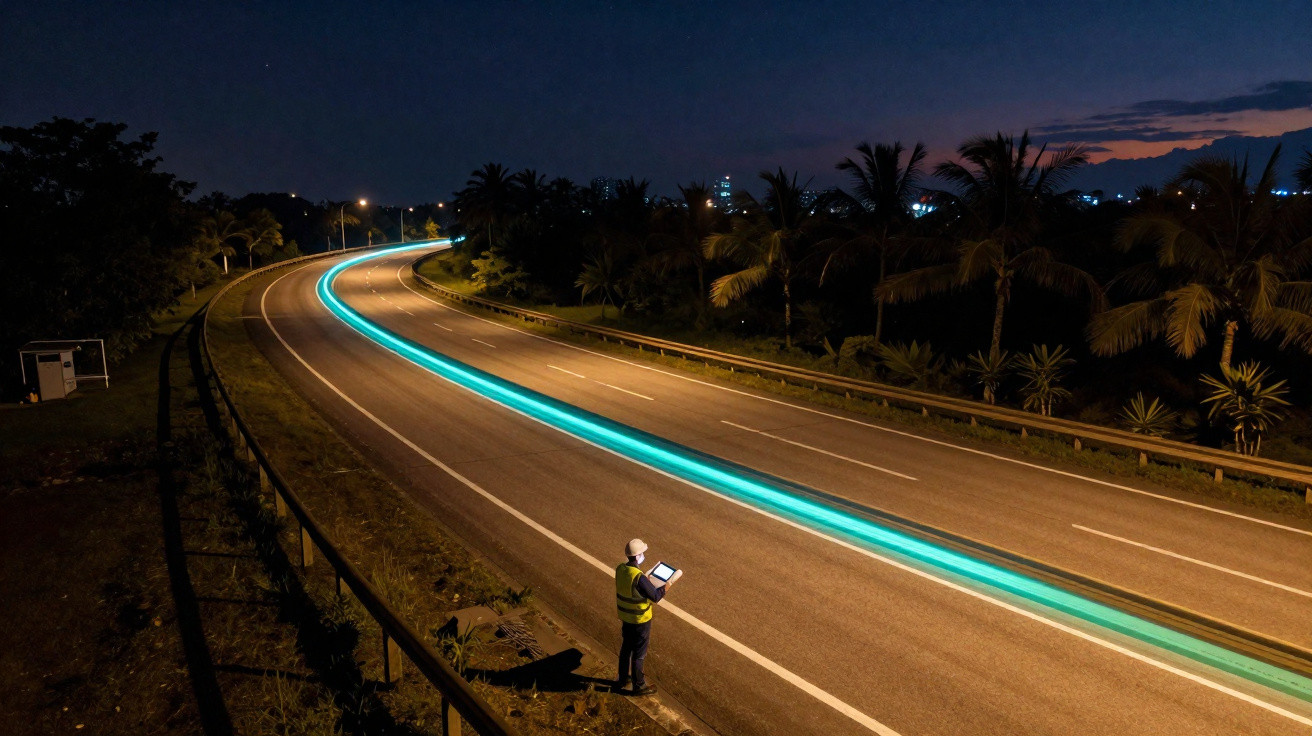
A provincial project near Kuala Lumpur was intended to demonstrate how dark rural roads could be made safer without conventional streetlights. Glow-in-the-dark paint rather than lamp posts, high-tech instead of traditional infrastructure: the concept impressed motorists, made international headlines – yet ultimately foundered on hard figures and exacting engineers.
How a 245-metre stretch suddenly looked like the future
The experiment took place on a two-lane road near Semenyih in the Malaysian state of Selangor. There is no road lighting along extended parts of the route, leaving it completely dark at night. At the end of October 2023, Malaysia’s Ministry of Transport applied photoluminescent paint to the road markings along a 245-metre section.
This specialist coating stores sunlight during the day before releasing it again for hours after nightfall. As a result, the edge and centre lines emit a greenish glow, as though subtle neon lighting had been painted directly onto the tarmac.
“The road was meant to light itself, with no cables, no electricity connection, and daylight alone in the paint’s ‘battery’.”
The state’s public works department explicitly presented the scheme not as a publicity stunt, but as a serious contribution to road safety. In poorly lit rural areas, drivers can easily drift towards the road edge, while faded markings make it harder to maintain their bearings.
Minister Alexander Nanta Linggi said the markings could remain visible for up to ten hours after sunset. The glow was still clearly apparent even in rain, according to the statement. During the first few weeks, local media outlets and social-media users reported that the experiment was well received and that the road felt safer.
Glowing roads as a global trend
The idea itself was not entirely new. In the Netherlands, the “Smart Highway” project had already experimented with luminous lane markings at an early stage. Construction firm Heijmans developed the so-called “Glowing Lines” with design studio Roosegaarde.
- specially coated lines that charge during daylight
- up to eight hours of illumination each night
- use on motorway sections alongside conventional lighting
In Europe, the emphasis was clearly on design – a futuristic calling card for “intelligent” infrastructure. Malaysia, by contrast, focused much more strongly on practical benefits: less glare, better guidance for drivers and reduced reliance on electricity, particularly in areas where maintaining lamp posts is expensive.
From pilot scheme to expansion plans – and a cost barrier
The encouraging start prompted further ambitions. As early as February 2024, Selangor announced plans to introduce the luminous markings at 15 additional locations across all nine districts. The proposal covered around 15 kilometres of glowing roads in areas including Sepang, Kuala Langat and Petaling.
The estimated cost of this expansion was around 900,000 Malaysian ringgit. Other states did not want to be left behind. In Johor, authorities assessed 31 routes, including a 300-metre section in Batu Pahat. What began as an unusual trial was rapidly in danger of becoming a nationwide strategy.
At precisely this point, attention turned to a detail that had been largely overlooked amid the glow of the initial images: the cost per square metre. Standard road-marking paint costs about 40 ringgit per square metre, whereas the luminous alternative costs a substantial 749 ringgit, according to the government.
“Nearly 20 times the cost per square metre – with no final data yet on durability and maintenance.”
That brought the project face to face with the realities of budgets, procurement processes and finance ministries. A multiple of the usual cost may be acceptable for pilot schemes, but not for widespread deployment.
The parliamentary statement that changed everything
The turning point came in November 2024. Deputy Works Minister Ahmad Maslan told parliament that the luminous strips were “probably” not a future solution for the country. The main reason was their excessive cost – and the ministry’s internal tests had failed to persuade experts.
This altered perceptions of the project. The futuristic, glowing showcase road became a classic infrastructure case: a technology may appear exciting and practical, but still fail because of standards, testing criteria and long-term costs.
Notably, the government said little officially about visual impact or spectacle. Instead, it concentrated on pragmatic issues such as:
- long-term cost-effectiveness
- resistance to heat, rain and wear
- compatibility with existing guidelines
- the expense of repairs and renewal
The 245 metres near Semenyih will therefore remain a trial section. There is no longer any question of a new standard for dark rural roads.
What the Semenyih trial still demonstrated
Even without further rollout, the underlying problem remains: how can road markings be kept sufficiently visible at night and in poor weather? Clearly visible lines matter greatly on high-speed roads and in rural areas in particular.
Japan’s National Institute for Land and Infrastructure Management has spent years examining when markings need renewing, what level of brightness remains safe in different conditions, and how their condition can be measured efficiently. Such findings are systematically incorporated into standards and maintenance plans there.
The Malaysian test road shows that innovation can quickly attract attention and sometimes deliver noticeable improvements. But before an idea enters official regulations, it must be assessed against:
- day-to-day performance in wet conditions, heat, dirt and wear
- scalability across many kilometres
- cost per year of service life rather than simply per square metre
- acceptance among authorities and specialist engineers
Why seemingly simple road markings deserve attention
Road markings may appear inconspicuous, but they are among the most effective road-safety measures. At night, they guide drivers’ eyes, create an invisible safety barrier and help vehicles stay in lane during rain. Poor or worn markings increase the risk of leaving the carriageway and of lane-change collisions.
Many countries therefore invest in reflective beads within the paint, raised markings or so-called “cat’s eyes” – small elements embedded in the road surface that direct headlight beams back towards drivers. Photoluminescent paint is simply another option in the continuing effort to improve visibility.
Malaysia faces additional challenges: high humidity, heavy rainfall, heat and intense sunlight. All of these place substantial strain on road-marking materials. A luminous paint that shines for ten hours on paper may wear out much more rapidly in tropical day-to-day conditions. When that happens, any calculation of cost-effectiveness changes completely.
Lessons other countries can draw from Malaysia
For transport planners in Europe or German-speaking countries, the Malaysian trial has a certain appeal. It illustrates how new technology can be tested within clearly defined limits, communicated publicly and then abandoned on the basis of data – despite positive feedback from motorists.
Anyone considering similar solutions should address demanding questions at an early stage:
- How does the brightness perform after five rainy seasons, rather than only five weeks?
- Can the paint be applied and removed mechanically?
- Are there environmental consequences from wear particles and micro-components?
- Which combination with conventional lighting provides the best balance of safety and cost?
Hybrid approaches could be particularly interesting: hazardous locations, bends or slip roads might receive especially prominent luminous paint, while conventional solutions continue to dominate on long straight sections. This would allow the technology’s advantages to be used without consuming expensive specialist paint over kilometre after kilometre.
Why failure does not mean the end of the idea
The story of the glowing road near Semenyih follows a familiar technology cycle: initial enthusiasm, then disillusionment, and finally a pragmatic halt. That does not mean photoluminescent markings will never have a role in road construction.
If material prices fall, coatings become more durable or combined systems using reflectors and luminous pigments emerge, the calculation could look entirely different in a few years. At the same time, pressure is growing to save energy while continuing to provide safe roads – an environment in which any light source requiring no electricity remains inherently attractive.
For now, however, Malaysia demonstrates just how harshly technical innovations can collide with the realities of public budgets. On paper, the future often shines more brightly than government finances permit. The road at Semenyih is brief, green-glowing proof of that.









Comments
No comments yet. Be the first to comment!
Leave a Comment