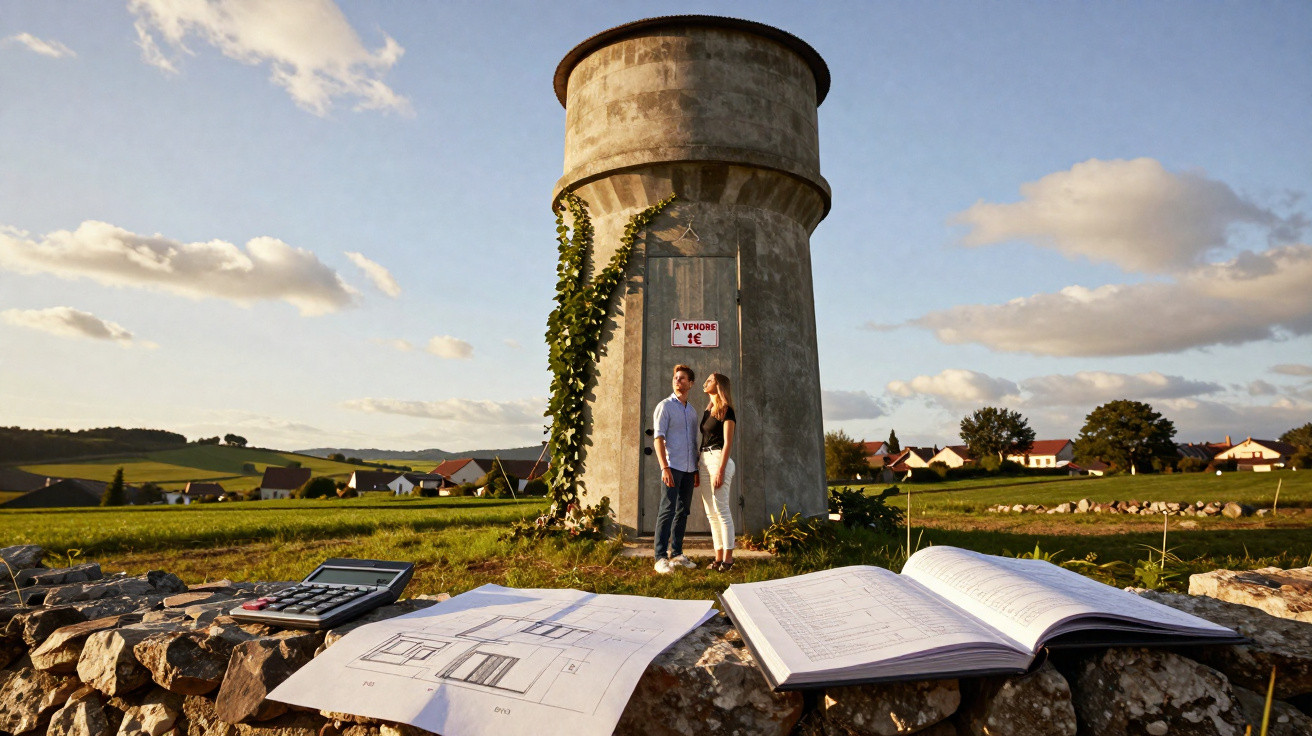
A tiny village in central France is currently making headlines: the local authority is virtually giving away its old water tower – but it expects a bold idea in return.
In La Chapelle-Baloue, in the Creuse department, a grey post-war concrete giant is available for a token price. Anyone prepared to give the redundant water tower a new purpose can take ownership for just 1 euro – with no notary fees, but with substantial obligations and a few potential pitfalls.
A water tower for the price of a baguette
It may sound like an internet joke, but the story is genuine: the council is selling its former water tower, which stands around 15 metres high, for the symbolic sum of 1 euro. Built in the period after the Second World War, the structure is now unused and no longer required for the drinking-water supply.
The offer includes both the tower and its plot of roughly 79 square metres. The building is sold “as seen”, with no renovation work, technical upgrades or guarantees provided.
“Anyone who buys the tower takes on a piece of village history – and a substantial building project.”
The deadline is firmly set: interested parties have until 31 March to submit their project and apply to acquire it. Pure speculators who simply want to own the tower without doing anything with it are unlikely to succeed.
Why the council is virtually giving away the water tower
This is not an outlandish publicity stunt but the result of a fairly pragmatic calculation. The local authority wants to modernise its drinking-water network. As the old tower is no longer needed, retaining it would only create ongoing costs.
A technical assessment found that demolishing the concrete giant would cost around 100,000 euros. For a small rural council, that is a considerable amount that would put pressure on its budget for years.
“Rather than spending 100,000 euros on demolition, the council is opting for a symbolic sale and hoping to find creative minds.”
Those responsible make it clear that the aim is less about raising money than preserving part of the local heritage and giving someone the opportunity to undertake an unusual project. Instead of falling into disrepair or disappearing at the public’s expense, the tower is intended to begin a second life.
Who is most likely to win the bid
The competition is not entirely open-ended: immediate neighbours of the site will be given priority. They could extend their own property with the tower, perhaps using it as an unusual garden pavilion, studio or guest house. Its position in the centre of the village is particularly important here.
Even so, the council has not ruled out applicants from outside the area. Every serious application with a coherent proposal will be considered. The key requirements are that the project suits the village, is legally viable and does not create safety risks.
- Priority for residents in the immediate vicinity
- A concept is required: a simple storage area with no proposed use is unlikely to be approved
- The municipal council will assess submitted projects and make the decision
- The council will cover the notary fees – a genuinely attractive offer
An expensive dream? The costs behind the 1-euro bargain
It is hardly surprising that interest has so far been limited. The purchase price represents only a small part of the reality. Turning an old water tower into a safe, usable building requires funds, patience and enthusiasm for building sites.
Several cost areas could arise:
- Structural integrity and safety: assessment of the concrete, possible reinforcement, railings, stairs and escape routes.
- Utility connections: electricity, water, sewerage and internet, depending on the intended use.
- Interior fit-out: flooring, insulation, windows, doors, heating and potentially a lift or a safe staircase.
- Permissions: planning consent, possible listed-building requirements and a fire-safety plan.
France has around 16,000 water towers, yet only a small fraction – fewer than one hundred – can realistically be converted into homes. Many are purely functional structures with no windows, little floor space and no straightforward access. That makes conversions complicated and costly.
What a water tower can become
Despite all the obstacles, the idea invites imagination. In other parts of Europe, owners have already successfully transformed similar structures into:
- Design lofts with panoramic views
- Holiday accommodation and unusual bed-and-breakfast projects
- Artists’ studios or rehearsal spaces
- Viewing points with a small café
- Offices for start-ups or agencies seeking to project a deliberately different image
Especially in the age of Instagram and Airbnb, such conversions can be commercially appealing. A distinctive location with a story can be rented out for considerably more than a standard characterless flat.
An opportunity for visionaries – and a warning for dreamers
Anyone considering the tower should calculate realistically whether their budget can support the project. The purchase price may feel like a lottery win, but restoration costs can quickly reach six figures. Fire-safety and accessibility requirements become especially expensive if public use is planned.
At the same time, the offer provides a rare chance for creative freedom. The buyer would not be taking on an ordinary terraced house, but a striking landmark visible from afar and one that often defines the appearance of a village.
| Aspect | Advantage | Risk |
|---|---|---|
| Purchase price | Just 1 euro, with no notary fees | Subsequent costs can easily be underestimated |
| Architecture | A distinctive, eye-catching structure | Conversion is technically demanding |
| Location | Quiet village, rural surroundings | Limited catchment area for commercial use |
| Image | Strong media and social-media appeal | Public attention if problems arise |
Why schemes like this could become more common
The case in Creuse represents a wider issue: many councils own obsolete infrastructure, including waterworks, station buildings, silos and barracks. Demolition is costly, while vacant buildings pose a safety risk and are not particularly attractive visually.
Councils are increasingly using symbolic sales for 1 euro or similarly low sums to transfer responsibility and creativity to residents, businesses or associations. Whoever takes over becomes liable, invests and, ideally, creates something interesting.
In return, projects repeatedly emerge that attract attention far beyond their region: cultural centres in former factories, co-working spaces in station buildings, holiday flats in lighthouses and even climbing centres in old gas holders.
What prospective buyers should consider
Anyone seriously considering the tower in La Chapelle-Baloue or similar offers needs more than enthusiasm. Three steps provide an initial guide:
- Technical assessment: involve a structural engineer and architect before making a commitment.
- Talk to the council: which uses are realistic, which conditions apply and what does the local development plan allow?
- Funding plan: establish a clear spending limit, include a contingency and check potential grants for culture, heritage protection and rural development.
Terms such as “water tower” or “municipal heritage” may sound dry, but in this case they carry huge potential: with intelligent planning, a purely technical ruin could become an emotional project that attracts tourists, creates jobs or simply fulfils a deeply personal dream.
At the same time, the scheme is a realistic illustration of the challenges currently facing many rural areas: ageing infrastructure, tight budgets and a need for fresh ideas. Whether the tower in La Chapelle-Baloue ultimately becomes a stylish loft, a peaceful retreat or perhaps merely a neighbour’s enlarged garage will be decided in the coming weeks – the symbolic euro is almost the least important figure.










Comments
No comments yet. Be the first to comment!
Leave a Comment