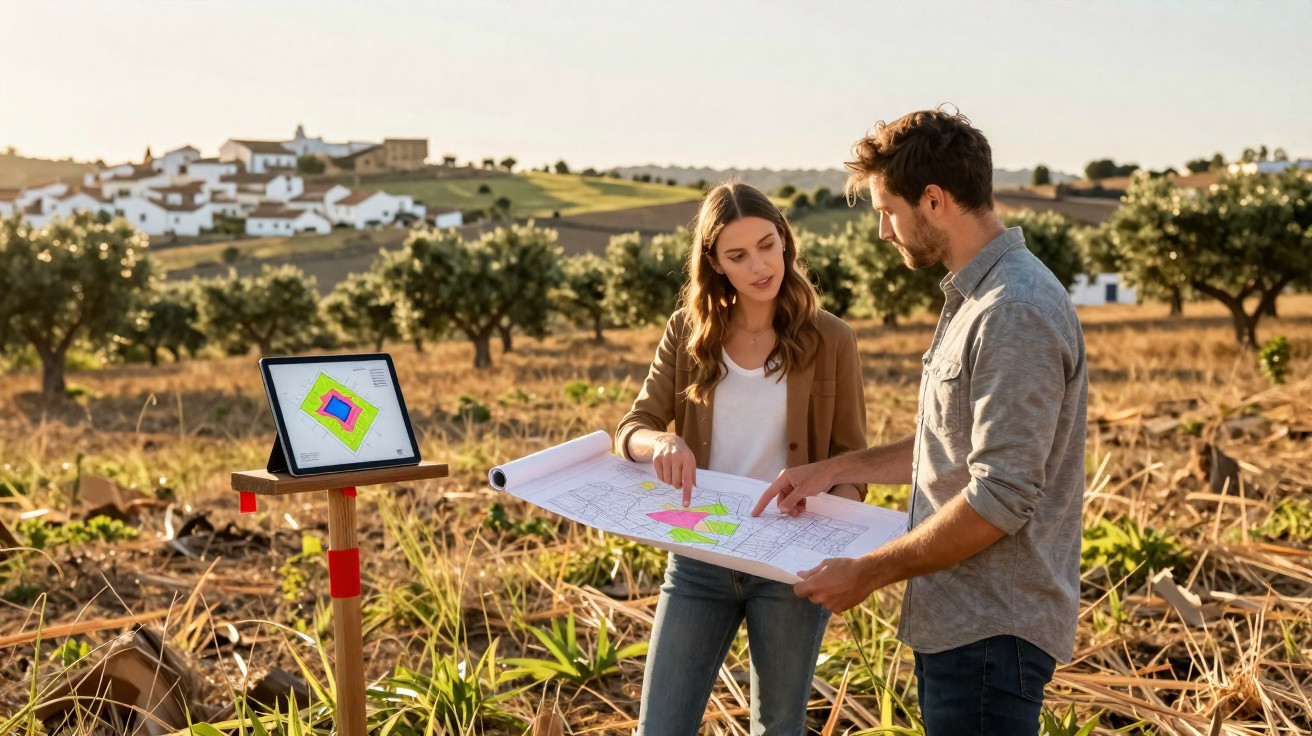
“In recent years, calls and emails asking the same question have become increasingly common: ‘I own a rural plot; what am I allowed to build on it?’” says Clélia Brás, a solicitor specialising in property law. Behind that question, she sees a familiar pattern: “almost always the same dream: leaving the city, building a country home, perhaps investing in rural tourism, and the often mistaken belief that rural is merely a temporary label pending urban development”.
“The bad news is that the law does not view it that way; the good news is that there is an orderly way to answer the question, and it begins well before the first set of plans is drawn,” the solicitor stresses.
What can be built on rural land?
Under the legal framework, rural land is intended for agricultural, livestock and forestry use, the conservation of natural resources and risk protection. It is not land held in reserve for future urban development. “The law does not regard rural land as urban land in waiting, but as a productive and environmental resource that must be safeguarded,” Clélia Brás explains.
In this setting, the solicitor adds, “owners are entitled to use the land in line with its designated purpose, but they do not have an automatic right to build a home”.
An assessment of several Municipal Master Plans (PDMs) “in municipalities such as Sintra, Seia and Sousel reveals a shared pattern: development on rural land is exceptional and confined to what is essential,” says Clélia Brás. Among the most common cases, she identifies “the farmer’s dwelling, generally linked to holdings with a relevant minimum area, buildings supporting agricultural activity, and rural tourism projects, the latter subject to very low building-density limits”.
Luís Mendes, a researcher at the Centre for Geographical Studies at the University of Lisbon, refers to “18 changes, across the country, from rural to urban use”.
He notes that, despite the restrictions, recent legislative amendments have introduced greater administrative flexibility. Redundant permits have been removed, the prior-notification regime has been strengthened and the scope for municipal regulations to impose procedural requirements has been curtailed. He also highlights the repeal of the General Regulations for Urban Buildings, effective from 2026, along with simpler procedures for reclassifying rural land as urban land in certain cases.
Even so, Clélia Brás warns: “these changes do not amount to a liberalisation of building on rural land. The decision still depends on municipal planning and compliance with the principles designed to contain urban expansion”.
The PDM determines building viability
Another common misconception concerns the phrase “rural land with building potential”, which “has no legal value”, according to the solicitor. What determines whether a project is viable is “the classification in the Municipal Master Plan and the associated constraints, such as inclusion in National Ecological Reserve areas, Natura Network areas, floodplains or natural parks, which may prevent or severely restrict any construction”.
What can be built on a rural plot will always depend on the PDM
Building on rural land also frequently brings additional costs. “Municipalities are not required to provide infrastructure such as water, drainage or electricity in scattered areas, so these costs fall to the owner, who will need to rely on independent solutions,” Clélia Brás adds.
The planning history of the plot is another decisive consideration. “Processes such as requests for prior information, permits or notifications may establish or constrain the applicable regime, particularly in a context in which these instruments have gained greater relevance,” the solicitor notes. She points to a legal framework with “less formal bureaucracy, but greater responsibility for technical professionals and developers”.
Technical assessment before any rural land project
From a market perspective, André Casaca, property analyst and director of estate agency Laplace, identifies a structural weakness in decision-making. “I own land, a rural property that needs to be enhanced; what do I need to do to unlock its value?” is, he says, the central question for many owners.
According to André Casaca, “there are many rural properties within the PDM with no approved construction whatsoever, but their use needs to be unlocked”. The first step, Casaca argues, “should always be to submit a request for prior information to the local authority, to establish the land’s viability, not least because land with such a request has greater value than land with no planning framework at all”.
Casaca emphasises that crucial decisions are at stake: “a plot’s building capacity, the definition of the property product, the number of dwellings, types and floor areas and, consequently, the asset’s value”. These choices “cannot be made blindly or based on market perceptions”, he advises, but must rest on “rigorous technical studies”.
The new Land Law has brought greater flexibility to the reclassification of rural plots as urban land, particularly for controlled-cost housing, giving municipal councils more autonomy where land is not part of the National Agricultural Reserve or the National Ecological Reserve.
The first step should be to establish the land’s viability with the local authority
Nevertheless, André Casaca recalls that “the new regime does not remove the need for a rigorous technical approach. A project’s viability must be based on concrete data, from planning constraints to market studies, rather than expectations”. The risk, Casaca adds, is that “greater legal openness may be interpreted as an incentive for speculation or for excessively simplistic decision-making”.
Luís Mendes also accepts that “bureaucratic procedures have been simplified”, but observes resistance in practice: “Many local authorities fear legal problems when they lose planning control, which then becomes based on the responsibility of technical professionals,” he says.
Furthermore, Luís Mendes stresses, “not all land has infrastructure, and building under this regime becomes very expensive”. He also points to constraints including the lack of a land register and the need for territorial continuity. “A rural property is not land waiting to be built on,” the researcher reiterates.
Even so, he sees merit in simplification, “provided that developers and local authorities are willing to ensure the necessary infrastructure”.
Fundamentally, the answer remains unchanged: what can be built always depends on the PDM. “It is the PDM that classifies and qualifies land and sets the use regime through planning indices, building limits and the number of storeys,” Clélia Brás reminds readers.
“None of this means that it is impossible to build a home,” the solicitor says, arguing that “it simply means that the agricultural or forestry purpose carries more weight than the wish for an isolated house”. She leaves a warning: “the notion that something can always be built on rural land is more than a myth; it is a serious asset risk”.














Comments
No comments yet. Be the first to comment!
Leave a Comment