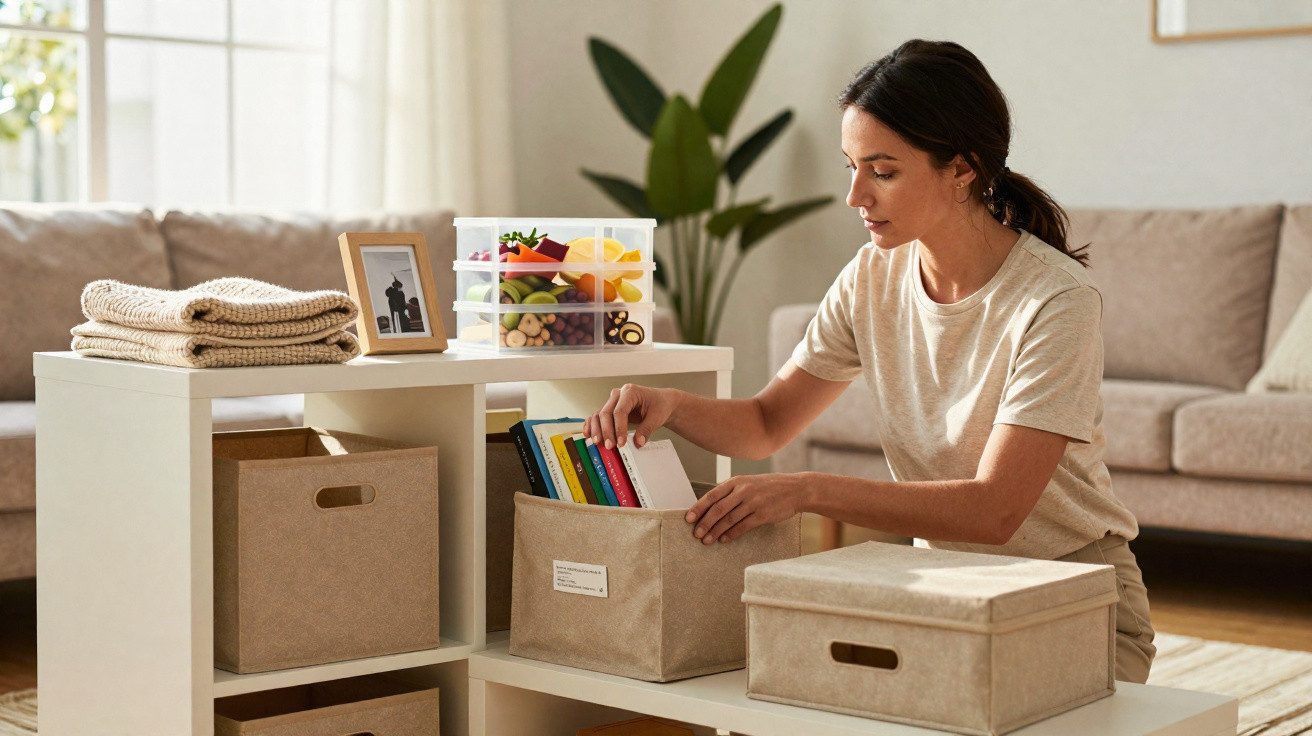
Five minutes before visitors are due, you are kneeling in front of a cupboard door that refuses to shut. A tote bag dangles from the handle by one thread, a yoga mat is creeping out as though it wants to flee, and a winter scarf drops onto your head in July. You push, shove, promise yourself you will “sort this out this weekend”, then slam the door as if doing it quickly might squash everything inside.
The room itself is not especially small. It is simply that the belongings never move.
That is the odd part: the more storage we own, the more packed, overwhelmed and blocked it seems to become with possessions that appear to have settled in permanently. It is not because every item is necessary, but because none of them ever changes position.
There is a simple, almost childlike approach that can transform this.
Why your storage always feels full even when it isn’t
Spend a moment looking at any crammed shelf and one thing becomes clear: most of its contents have not shifted for months. The same heap of jumpers. The same pile of plates. The same basket labelled “random stuff” that has effectively become part of the decoration. We do not merely put possessions away; we leave them fixed in place.
Our minds soon stop registering anything that stays still. Those shoes you have not worn since 2019? They disappear into the scenery. Storage can feel not only full but weighty, rather like an inbox that is never emptied.
A mother I spoke to recently said a plastic dinosaur was her tipping point. Her son had ignored it for more than a year, yet it remained permanently on the top shelf “just in case”. One evening, as she searched for a missing puzzle piece, she took down the dinosaur box and triggered an avalanche of long-forgotten toys. Underneath, she discovered three birthday presents that had remained unopened for months.
That was when she changed her approach. Rather than vowing to tackle an enormous declutter “one day”, she began rotating possessions: half the toys went into a box in the cellar, some books returned to the shelf while others were put away, and clothes were turned around on the rail. A fortnight later, her son was thrilled to “rediscover” the toys she had brought back into use. Her shelves also looked noticeably, almost startlingly, lighter.
The reason is straightforward: when a space never changes, it can feel overcrowded because nothing has room to breathe. If every item is permanently in view, the eye interprets it as “too much”, even when the actual amount is not huge. Rotating objects gives possessions a seasonal pattern, much like swapping over a wardrobe but across the entire home. It encourages small, manageable choices instead of demanding that you organise your whole life in one draining weekend.
The effect is surprisingly powerful: identical storage can suddenly seem roomier than it did when every centimetre was stuffed. One modest routine can alter how you experience your space.
The object rotation method that quietly frees your shelves
Object rotation is just what the name suggests: your belongings do not remain in one place throughout the year. They take turns. Some are “on stage”, while others stay “backstage”. Instead of having every mug, toy or jumper visible at once, you intentionally remove part of your belongings from regular use.
Begin on a small scale. Choose the category that frustrates you most: T-shirts, children’s toys, kitchen utensils or beauty products. Empty it all out, then return only what you genuinely want to use and see over the following 2–3 months. Put the remainder in a clearly labelled box, storage tub or suitcase. You are not getting rid of it; you are simply pressing pause.
The main risk is that rotation becomes a hidden hoarding system, made up of countless mystery boxes that you never open again. That is not the intention. The aim is a gentle cycle, not a second, unseen loft.
Create rules that are realistic rather than flawless. One reader told me she sticks a note on every box showing a “rotation date” three months ahead. If that date arrives and she has no wish to bring anything back out, she treats it as a signal to donate at least one third of the contents. Honestly, nobody manages this perfectly every day. A flexible, forgiving routine lasts far better than rigid spreadsheets you give up on in the second week.
“The rotation changed everything,” admits Pierre, 42, who lives in a two‑bedroom apartment with two children. “We didn’t get a bigger place. We just stopped pretending we needed to see everything all the time. Now the kids get ‘new’ toys without us buying anything, and I can actually find my drill.”
Keep the process straightforward with a short checklist:
- Choose one area each month, such as a toy shelf, bathroom cabinet or a single wardrobe shelf.
- Divide items into: keep visible, rotate out, and obvious donate/trash.
- Restrict each area to one rotation box, so that storage does not steadily spread.
- Note today’s date on the box along with a month to “revisit” it.
- When that month arrives, open the box and choose whether to bring items back, leave them stored or let them go.
Object rotation is not a storage trick; it is a decision-making habit in disguise.
A quieter home where space finally feels like space
What this approach truly changes is not the size of your cupboards, but the amount of mental noise you carry. A visually crowded room continually demands your attention. As soon as half the visible belongings are removed, your mind gains a little quiet. It is easier to breathe when a shelf displays only this season’s favourites.
Some people find that rotating possessions reveals a shift in their personal style. One woman I spoke with noticed that she had worn only the same six tops from her “current” rail for three consecutive months. When she opened her rotation box again, half the clothes seemed to belong to somebody else. Giving them away then felt less difficult and almost self-evident. Rotation gives your preferences time to make themselves known.
We have all had that feeling of looking at an overflowing drawer and becoming oddly exhausted before touching a single item. This is why small cycles work better than major projects. You are not remaking your entire life; you are merely allowing certain things to rest backstage.
| Key point | Detail | Value for the reader |
|---|---|---|
| Rotate visible objects regularly | Keep only a portion of items “on stage” for 2–3 months | Lighter cupboards, less visual overload, easier daily choices |
| Use labelled rotation boxes | Mark categories and revisit dates on each box | Prevents hidden hoarding and supports painless decluttering over time |
| Decide at each rotation | Bring back, keep stored, or donate a portion of items | Gradually reduces clutter without a massive, overwhelming clean-out |




Comments
No comments yet. Be the first to comment!
Leave a Comment