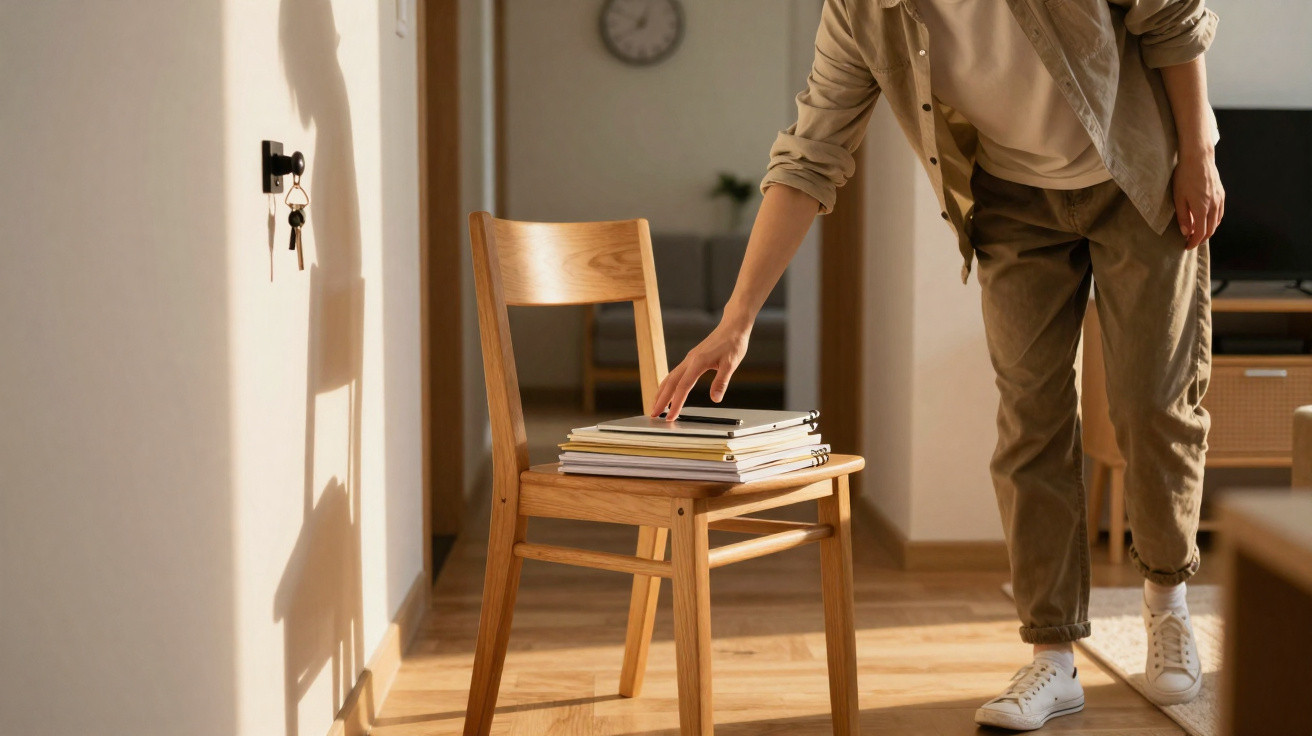
Placed not against a wall but firmly in the centre of the hallway, it looked as though it were making a statement. Getting around it meant turning sideways, and that made the post on its seat, the partly folded washing on its back and the bag waiting to go to the car impossible to miss.
At first, it was unintentional. Somebody put the chair there “just for a minute.” But then, almost unnoticed, its role changed. Jobs that had previously drifted around your mind began to land on that chair. The hallway stopped being merely a passageway and became a checkpoint.
One deliberately misplaced object had started to alter the pattern of procrastination at home.
The hallway chair as a silent nudge
A chair positioned somewhere it does not “belong” has a surprisingly strong effect. In an orderly hallway, a single chair obstructing the route feels a little off. Your body responds before your thoughts catch up: you slow down, spot it and take in whatever has been left there.
That brief pause is where procrastination begins to weaken. Rather than hurrying between rooms while only vaguely aware of the jobs you are putting off, you meet a small, gentle obstacle. The chair acts as a stage for just the next task: post to send, shoes to polish or a jacket needing repair.
This is not about making clutter. It is about creating one purposeful interruption in a space you pass through ten times a day.
Sarah, a woman I interviewed, insists that her worn wooden chair “saved her from drowning in later.” She used to leave bags on the floor, pile unopened post on the kitchen worktop and tell herself she would “deal with it tonight.” The weeks passed, and nothing changed.
She eventually pulled an old dining chair into the hallway, placing it close to the front door. It had a single purpose: to hold only items requiring action within 24 hours. It seemed strange during the first week, and her partner made fun of it. Before long, though, he was using it as well: library books to take back, a parcel to send and the tape measure for the handyman. Items no longer vanished into assorted rooms.
By the end of the month, they had not become magically ultra-organised. Yet the small jobs that had been nagging at them were no longer accumulating in their minds. They were gathering on the chair - and actually getting done.
Psychologists describe this sort of technique as a “cue” or a “prompt.” The brain is designed to conserve effort, so it does not go looking for chores. Instead, it responds to something visible, specific and a little too difficult to overlook. A chair positioned right in the hallway meets all three conditions.
Putting it there intentionally lets you use the way attention operates at home. Rather than hiding tasks in drawers, apps or mental lists, you give them a physical waiting area. The hallway works particularly well: it is neutral ground, less private than a bedroom and less chaotic than a kitchen.
The chair becomes a boundary object - neither ordinary furniture nor decoration, but a silent message: “This goes somewhere else. Soon.” That mild pressure can be enough to remove the support that keeps procrastination alive for minor but irritating jobs.
How to turn a simple chair into a procrastination trap
For this to work, the chair must be purposeful rather than incidental. Pick one that is solid, easy to see and slightly too large to overlook when it is out of position. Give it a firm rule: it belongs in the hallway and should sit far enough into the route that you notice it whenever you walk past.
Then define its role. It is not somewhere to dump possessions; it is a transfer point for jobs that need to leave the house or be moved to another room. Think outgoing post, returns or clothes that need taking upstairs. A glance should make the next step immediately clear.
There is no need for labels or an elaborate method: simply use one object for one category of unfinished task.
The system usually fails when the hallway chair turns into “that place we put stuff.” At that point, procrastination has simply taken another form. Washing you never folded becomes a heap on the seat, while the bag you intended to sort remains there for three weeks, silently reproaching you every time you cross the hall.
To prevent that, keep the focus short term. The chair is for jobs that can be progressed within a day or two, not for “someday/maybe.” If an item remains there for longer than 48 hours, either return it to its proper place or schedule the task properly. Nothing should stay in permanent limbo.
Practically speaking, your future self will benefit if the rule remains forgiving. Missed a day? That is fine. The chair is meant to support you, not make you feel ashamed. We all have evenings when the only task we can manage is shutting the door and acting as if the world does not exist.
“The chair doesn’t magically make me productive,” one reader told me, laughing. “It just stops me from lying to myself about what I’m avoiding.”
There is a quiet emotional change when the hallway chair is treated as an ally rather than a pest. It does not demand that you “do more.” It simply keeps the things you have already decided matter in a place where they cannot be entirely ignored.
- Choose a chair you enjoy seeing, so it looks deliberate rather than like discarded junk.
- Keep its purpose limited: it is for active tasks only, not storage.
- Empty it completely once or twice weekly, even if that only means relocating things to a more truthful place.
- Recognise that it will look messy in some weeks. That is feedback, not failure.
- Make it a household conversation starter: “What’s on the chair today that we can move?”
What that hallway chair quietly changes in your mind
When the hallway chair becomes part of everyday life, you begin to spot recurring patterns. That parcel appearing on the seat again and again may show that online returns always drain your energy. The gym bag you never pick up as you leave may suggest that the 6 a.m. class is a story you are telling yourself.
The chair becomes a mirror for the distance between intention and action. It does not do this in the harsh style of a motivational poster, but in a practical, mildly irritating way that is difficult to dismiss. You begin asking yourself: “Do I really want this chore in my life, if it’s back on the chair every week?”
Once you start asking that, procrastination finds it much harder to shelter behind “I’m too busy.”
There is a modest yet meaningful physical benefit as well. Each time you pick something up from the chair and take it nearer to its destination, you receive a small sense of completion: an envelope posted, a book returned to the bedroom or a bag taken to the car. These are not grand achievements, but they connect the parts of your day in a different way.
Many of us imagine major productivity transformations. In reality, the change is usually smaller. A hallway chair used with purpose produces modest, regular successes precisely in the places where daily life tends to drain energy. Let’s be honest: nobody really lives as that idealised version of themselves we see on Instagram every day.
Even so, one carefully positioned chair in the hallway can quietly show that the distance between intention and action is sometimes only one step.
The more profound result emerges after several weeks. You start expecting the chair. Before reaching the hallway, your brain already notes, “There’s that thing I left for myself.” The reminder becomes less irritating and more comforting, like a friend who remembers what you said yesterday.
At that point, the hallway shifts from a space you simply move through to a gentle checkpoint. It is not a place for guilt or conflict, but a straightforward physical question you encounter every day: What am I prepared to carry one more time, and what am I finally ready to move?
| Key point | Detail | Benefit for the reader |
|---|---|---|
| Hallway chair as a cue | A conspicuous chair breaks autopilot and draws attention to small chores | Turns vague “I should” jobs into clear next actions |
| Clear rules for use | The chair holds only short-term, active items that need moving | Avoids clutter and makes the system manageable and sustainable |
| Emotional feedback | Items repeatedly left on the chair expose genuine procrastination patterns | Helps you change habits and let go of tasks that do not truly matter |





Comments
No comments yet. Be the first to comment!
Leave a Comment