The first thing that hits you is the noise.
Not only the actual sounds - the kettle boiling, notifications pinging, children talking, the neighbour’s drill - but the visual noise too. Shoes crowd the hallway, washing sits on the chair nobody has ever actually used, and unopened post watches you like a to-do list with eyes.
You put your bag on the table, notice your shoulders tense and have that familiar thought: “I need to change everything.” Different furniture, a new arrangement, a different life. Then you open Instagram, see a peaceful beige sitting room with no cables anywhere, and immediately feel worn out.
But what if you do not need a new sofa or a complete overhaul? What if a handful of small changes could alter the way your home feels, rather than the way it appears in a social media post?
The calm you need may already be in the room
Take a look at the room around you. Nothing is moving, but your mind is still racing. Each item makes a quiet request: put me away, file me, repair me, charge me, clean me. It is hardly surprising that a calm home can seem like something only people with cleaners, stylists and quiet children can achieve.
Most homes feel disorderly not because they are unattractive or poorly decorated, but because they are always “speaking” to us. A stack of documents says “sort me out”, while a chair covered in clothes murmurs “you failed at washing again”. Peace does not begin with buying more things. It starts by quietening that constant background noise.
One rainy Tuesday in London, I spent time with a family in an entirely ordinary flat, complete with toys, cables and mismatched mugs. We did not shift one item of furniture or purchase any storage boxes. Instead, we did one thing: selected a “quiet zone”.
They chose the corner beside the window. The side table was cleared, a blanket was folded into a basket, a lamp was set on a timer, and stray items were no longer allowed to land there. No keys, post or chargers. That was all it took: ten minutes. Two weeks later, they told me something unexpected: the whole flat seemed calmer. It did not look noticeably different. It simply felt less loud.
Our minds respond to “islands of order”. One small peaceful spot can become an anchor during a storm. Your whole home does not have to resemble a spa. You only need one or two reliable places where your nervous system can rest. Once your brain recognises those islands, the remaining mess feels less like a personal shortcoming and more like simply… life.
Small habits that shift a room’s emotional temperature
Begin with a single doorway ritual. It is not a full tidy-up, but a soft “transition moment” between the outside world and home. Put up a hook for your bag instead of letting it land on the table. Keep a shallow bowl or tray for the keys and headphones that always end up there. Sort post immediately into two piles: “deal with this week” and “probably recycling”.
The goal is not flawless organisation. It is about giving your mind a different message: when I cross this threshold, I move from alertness into something gentler. That small, familiar pattern - hook, bowl, two piles - tells your body that home differs from the street, even when trainers fill the hallway and washing-up is waiting in the sink.
The most common mistake is attempting to adopt ten new habits at once, then deciding you have “failed” three days later. Another is setting the bar far too high: a 45-minute evening reset, towels folded by colour and not one cup left in the sink.
Let us be honest: nobody really does that every day.
Choose one calming action that remains possible even on your worst day. It could mean clearing only the coffee table each evening, or making the bed every morning, even when the rest of the bedroom resembles a washing tornado. Treat it as your “bare minimum calm”, rather than the routine you aspire to. When everything goes wrong - poorly children, deadlines or break-ups - that small action reminds you that disorder is not the entire picture.
“Your home doesn’t have to be calm to look calm. It has to be calm to you.”
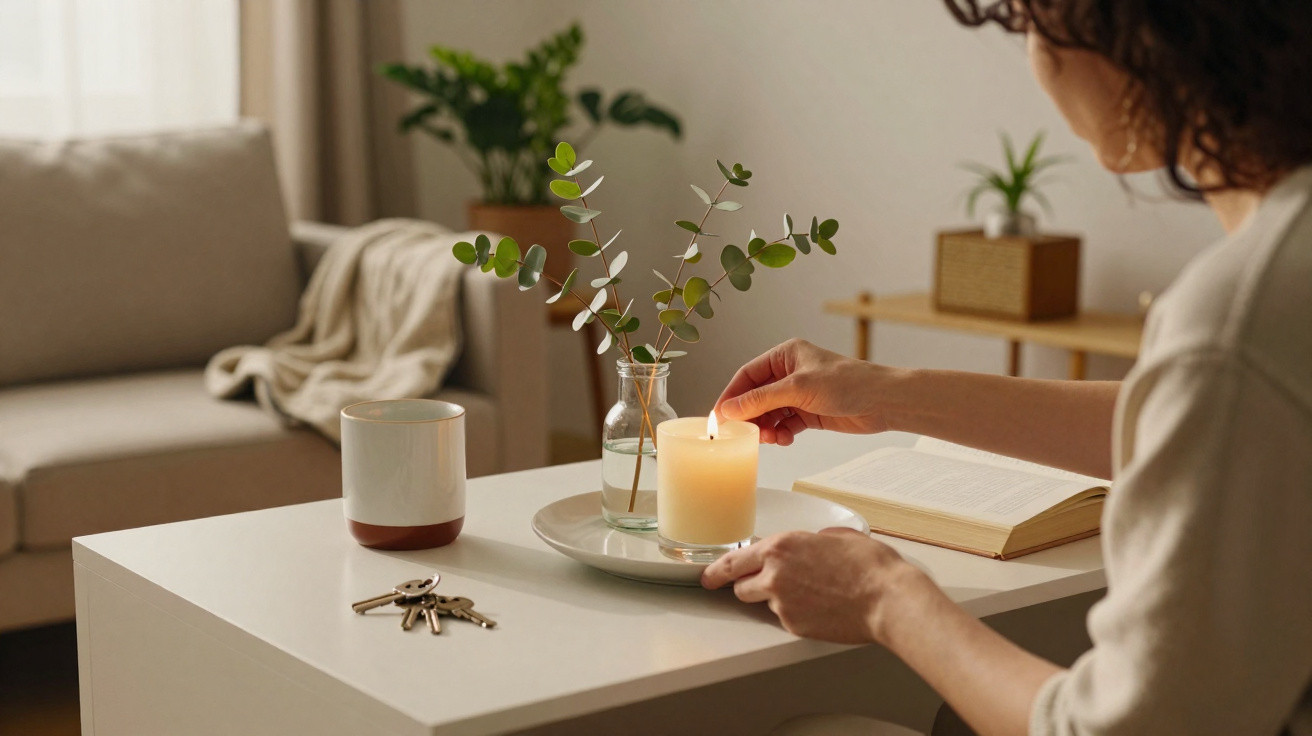
For some people, calm comes from lighting a candle at 9 pm; for others, it is an empty kitchen sink or dimmed lights after dinner. No single ritual is universally sacred. It is simply whatever makes your shoulders lower by two centimetres.
- Pick one “always calm” surface, such as a desk, bedside table or coffee table.
- Attach it to a daily cue you already follow, such as brushing your teeth or sending your last email.
- Give it one firm rule: the surface can hold 3 things max.
- Guard it from random clutter as though it were a table in a hotel lobby.
Your home begins to seem quieter not when it reaches perfection, but when a few things are fixed and simple enough to maintain even on untidy days.
Light, sound and the mess that can genuinely soothe you
Before purchasing organisers, consider the lighting. Strong blue-white ceiling lights keep your nervous system in a state of high alert. Create layers instead: a warm lamp close to where you sit, a lower light in a corner and perhaps a small spotlight aimed at a picture or plant. You are not creating a showroom. You are setting a frame for calm.
Test one straightforward evening rule for a week: after 8 pm, use lamps only and avoid the “big light”. You may find that voices become quieter, screens seem less harsh and your thoughts begin to slow. The same unhoovered floor can suddenly look less like a failure and more like ordinary life between loads of washing.
Sound also influences how secure we feel at home. With the television constantly on, phone alerts sounding and YouTube autoplaying at random, your mind never has a clear backdrop. This does not mean you need silence. It means choosing sound intentionally: a podcast as you cook, music while you eat, then 20 minutes of quiet afterwards.
Late one Sunday afternoon, I saw a couple transform their tiny kitchen from a stress factory into something close to a sanctuary with that one adjustment. They silenced notifications, switched off the television and played the same slow playlist whenever they cooked. The kitchen remained small, the fridge was still too noisy and the worktop was still cluttered. Yet the room became softer somehow. They argued less often, and their dinners lasted longer.
Not every type of visual mess has the same effect. Paperwork piled up is “hot” clutter - it hums with choices and consequences. A basket of blankets or a pile of much-loved books is “soft” mess - it communicates comfort rather than threat.
Once you understand that distinction, you can make changes without redesigning anything. Keep “hot” clutter out of sight in rooms where you relax: place paperwork in a closed box elsewhere, devices in a drawer and your to-do list in the hallway rather than beside the bed. Let “soft” mess remain where you unwind: cushions, plants, a partly completed puzzle or a jumper draped over a chair. You are not removing your life; you are lowering the volume of the parts that shout.
A calmer home is never a completed project
A calm home is not one that stays tidy forever. It is one where mess does not immediately become self-criticism. When you stop pursuing the photo-ready version of your sitting room, you can design for something more peaceful: how you genuinely feel when you walk through the door at the end of the day.
In practical terms, it may not look impressive to anyone else. One uncluttered corner rather than five. One dependable entrance ritual. One calm surface you protect like a small patch of territory. Lamps in place of the big light after dark. A playlist you put on whenever you cook or fold clothes. Nothing dramatic and nothing suited to a magazine spread.
Emotionally, though, it can be significant. On a difficult Thursday, you can enter a visually noisy home and still know that the corner by the window is there. The bed has been made. The coffee table is clear. A blanket waits in its place on the sofa and the lamp is on, even while the rest of the room is in the middle of life.
We have all had the moment of looking around our home and thinking, “If I can’t get this together, maybe I’ll never get anything together.” A calmer home will not solve your life. It simply declines to join the attack. When your space stops yelling at you, other parts of you finally have room to be heard - the part that wants to read three pages, reply to a friend, breathe quietly for 30 seconds or just sit and do absolutely nothing without guilt.
| Key point | Detail | Benefit for the reader |
|---|---|---|
| Create a “quiet zone” | One corner that remains tidy, even while the rest of the home is lived in | Provides a quick visual refuge without reorganising the whole flat |
| One entrance ritual | Hook for the bag, bowl for keys and simple post sorting | Turns arriving home into a calming transition |
| Chosen light and sound | Warm lights, a regular playlist and muted notifications | Reduces inner tension without major work or a large budget |







Comments
No comments yet. Be the first to comment!
Leave a Comment