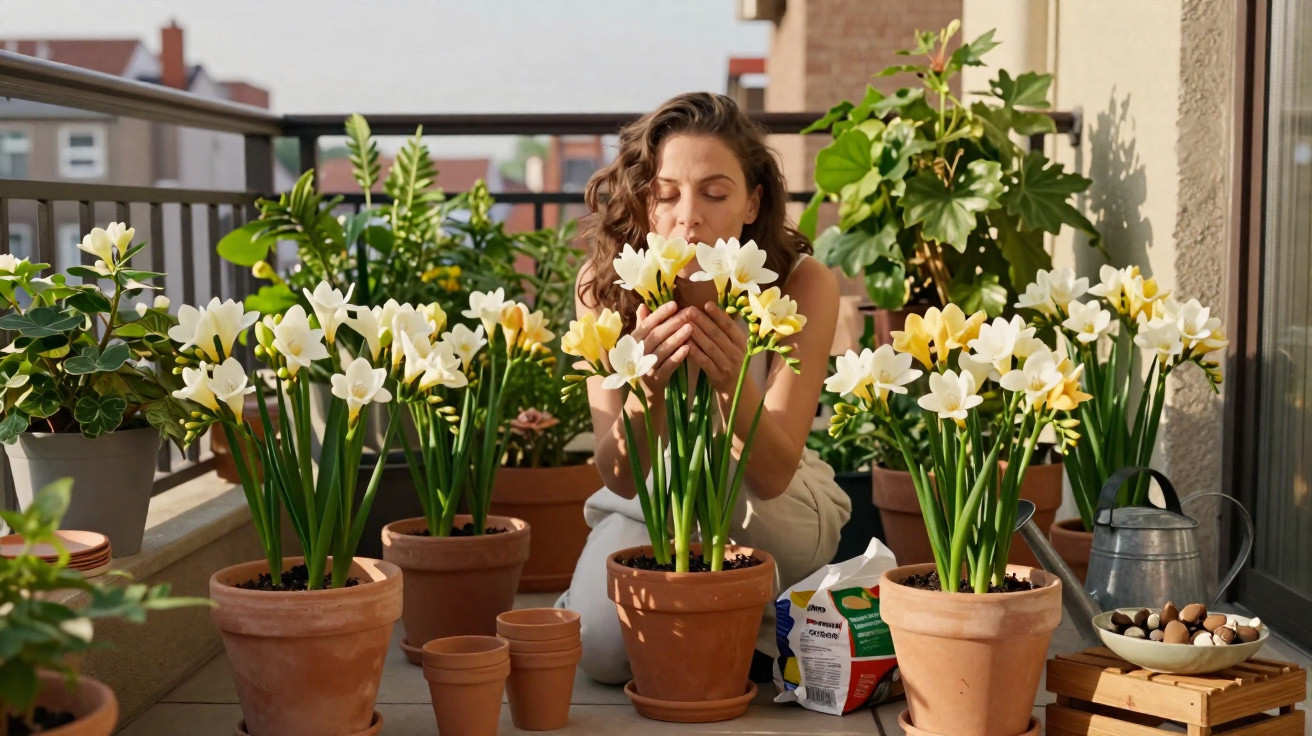
A small city balcony, barely enough room for pots – yet a delicate floral fragrance drifts into the flat from first thing in the morning.
Many balcony owners know the problem: they want a welcoming scented retreat, but it often ends with tubs, planters and struggling plants scattered everywhere. The upkeep is demanding, while the result is underwhelming. In truth, even a confined space needs only one type of flower to provide an intense yet unobtrusive fragrance throughout summer.
Why your balcony does not need to be crammed with pots
The usual response to a balcony that lacks fragrance is to add another pot of lavender, another jasmine and perhaps a mix of scented pelargoniums too. Before long, it looks chaotic. The plants compete for light, water and space, and often none of them flowers particularly well.
City balconies are generally compact, exposed to wind and prone to overheating. The more pots they hold, the more quickly everything dries out. Anyone who cannot constantly be out with a watering can will lose that battle in the height of summer.
Rather than ten ‘lightly scented plants’, one genuine fragrance powerhouse is enough – if it is positioned cleverly and cared for well.
This is where a flower that many people know from bouquets, but few deliberately grow in a balcony pot, really excels: freesias.
Freesias: the overlooked scented star for balconies and patios
Originally from southern Africa, freesias grow from corms, which are bulb-like storage organs. They are a perennial favourite in the perfume industry because their fragrance is crisp and fresh while also carrying warmth.
Their scent brings together hints of honey and citrus fruit, with a gentle floral quality that never becomes too heavy. That makes freesias particularly suitable for small settings such as balconies and patios: their fragrance is clearly noticeable without becoming overpowering.
Visually, they offer long, gently curved stems and flower-filled spikes, with every bloom arranged on one side. Available in white, yellow, pink, red and violet – often in two colours – they bring both scent and colour to a balcony.
How few pots do you really need?
On a typical city balcony, just a few thoughtfully positioned containers can create a noticeable cloud of fragrance. In many cases, three medium-sized pots planted densely with freesias are enough to scent the entire seating area.
- Tiny balcony (1–2 m²): 1–2 pots, each around 15–20 cm in diameter
- Standard balcony: 2–3 pots arranged around the seating area
- Small patio: 3–5 pots, distributed along the wall and railing
The planting density matters more than the number of containers: lots of corms in one pot create a ‘fragrant bouquet’ with a far stronger effect than several isolated stems.
How to plant freesias properly in pots
Freesias thrive in free-draining, loose compost that never stays permanently wet. In areas with mild winters, the corms can remain in the soil; where frost is expected, balcony gardeners are better off lifting them from their pots after the season.
The right pot size and compost
For a balcony, choose a container at least 20 to 30 centimetres across. Depth is the key consideration, as it gives the roots enough space to spread. A simple plastic or terracotta pot will do – provided it has a drainage hole.
A mix that allows water to drain away quickly works well as growing medium:
- around 50% good-quality potting compost
- around 25% sand or fine grit for drainage
- around 25% light organic material, such as mature compost or coir fibre
A pot around 15 centimetres in diameter will hold 5 to 7 corms. Plant them 3 to 5 centimetres deep, with the pointed end facing upwards. Leave only about 5 to 6 centimetres between each corm – this close spacing creates the characteristic bouquet-like effect later on.
The best planting time for your location
Freesias are sensitive to frost. The following rule of thumb works well:
- Areas with very mild winters: autumn planting is possible if the balcony is well protected.
- All other locations: plant in spring, once night frosts are no longer expected.
Flowering begins around ten to twelve weeks after planting. Anyone planting in April can therefore usually enjoy the full fragrance in high summer.
Location, care and flowering: getting the most from freesia corms
Freesias love light. A sunny balcony is ideal, though they also cope well with light partial shade provided they receive six hours of sunshine per day. Wind can damage the delicate stems, so a spot close to a wall or balcony railing is a good choice.
Watering and feeding without the fuss
Water thoroughly after planting. Afterwards, keep the compost evenly moist but never soaking wet. Allow the top layer to dry slightly between waterings. Waterlogging quickly causes rot, especially in containers without drainage.
A fertiliser high in potassium, such as one intended for flowering plants, supports abundant blooms. Feeding every two weeks while buds are forming and during flowering is usually entirely sufficient.
Anyone who waters freesias regularly without overdoing it and feeds them moderately will be rewarded with a remarkably reliable firework display of fragrance in a pot.
The long flowering stems can sometimes lean forwards. A slim cane or small circular plant support will keep them upright without becoming visually intrusive.
What happens after flowering?
Once flowering has finished, do not cut everything back immediately. Leave the foliage in place until it turns yellow naturally. During this period, the corms store energy for the following season. Gradually reduce watering.
In areas with harsher winters, it is worth lifting the corms from the pot. After the first light frosts, carefully remove them, allow them to dry and store them somewhere cool and dry at around 4 to 10 degrees – for example, in a paper bag in a cellar. They can be replanted the following spring for another season of fragrance.
How to combine freesias cleverly on a balcony
Although freesias make an impression on their own, they also pair well with other balcony plants. The most practical companions offer plenty of structure or colour rather than competing fragrance.
- With ornamental grasses in the same container for a lighter look
- In front of a low box or privet planter as a scented accent
- Near the balcony table, while tougher container plants are placed closer to the edge
Anyone wanting colour on their balcony both early and late in the year can choose seasonal companions. Spring flowers such as horned violets fill the gaps before the freesias get going. In autumn, subtly coloured heucheras or small chrysanthemums can take over while the freesia corms are already in storage.
Who benefits most from freesias on a balcony or patio
Freesias are ideal for people with limited space and little time who still value atmosphere. Rather than managing lots of different temperamental plants in pots, one dependable scented plant is enough, reliably delivering once it has found the right position.
They are especially useful for working people: after arriving home in the evening, nobody wants to water and tend 15 pots. Three well-planted freesia containers along the balcony railing or beside the patio door require far less work, yet still create the impression of a carefully planned scented retreat.
Freesias are also excellent cut flowers. A few stems can go into a vase on the kitchen table while the rest remain outdoors. This lets the scent of summer travel not only across the balcony but through the whole flat too – using minimal floor space and without pot chaos.














Comments
No comments yet. Be the first to comment!
Leave a Comment