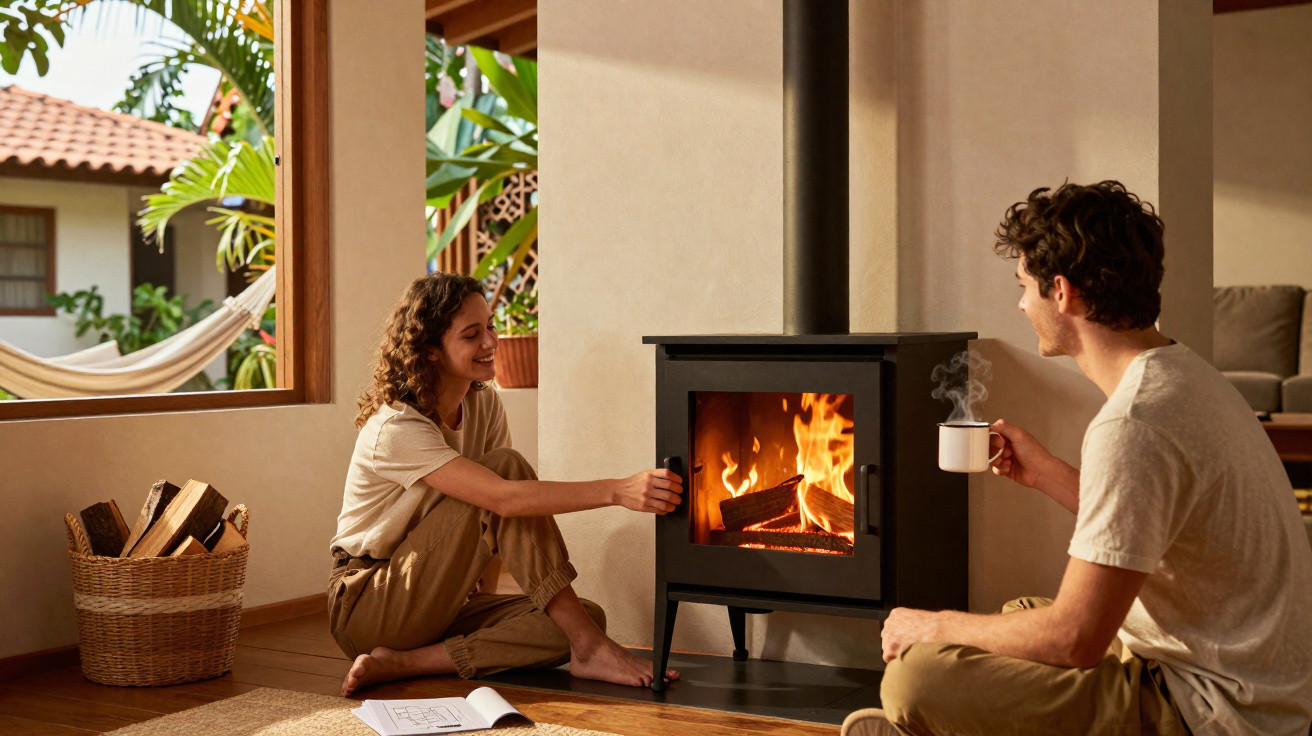
The first time I watched a wood stove burning in the centre of a living-room wall, with no chimney visible above it, my eyes immediately went upwards in search of the flue. There was nothing there: only an uncluttered wall, a broad window and a calm, mesmerising flame behind glass.
The owners, a young couple whose two children were darting between Lego bricks and blankets, laughed when they saw my puzzled expression. “It’s a wood stove,” they said. “Without a flue. We just plug it in and feed it pellets.”
The room had an unexpectedly peaceful feel. There was no smoky smell or sooty staining on the walls, only a gentle warmth enveloping the space like a large woollen jumper.
That image stayed with me.
A wood fire… without a chimney?
How a wood stove without a flue actually works
A flue-less wood stove resembles a compact, contemporary fireplace, typically featuring generous glass panels and a sleek, minimalist form.
Rather than a conventional chimney extending through the roof, it generally requires only a discreet outlet or, in some cases, a straightforward air-circulation system. Its apparent “magic” lies in the way it combusts fuel: at a high temperature, cleanly and under careful control.
The combustion chamber is designed to burn the gases almost entirely before they exit the appliance. The result is less smoke, fewer particulates and more heat that can actually be used.
You are not simply looking at flames; you are seeing a small thermodynamics laboratory at work in your living room.
Imagine entering a small block of flats in a densely built neighbourhood on a cold November evening. There are no new chimneys piercing the roofs, no scaffolding and no holes drilled through concrete floors. Still, several residents are heating their homes with compact wood or pellet stoves… without a conventional flue.
Consider Léa and Julien, who live on the 4th floor of a 1970s building. They fitted a pellet stove with a horizontal outlet running straight through an external wall. Before leaving the appliance, the fumes are filtered and cooled, meeting strict local requirements.
Their heating costs fell by nearly 40% compared with electric radiators. They also avoided having to seek agreement from the entire co-ownership to install a chimney up to the roof. For them, this flue-less arrangement was the only realistic route to having genuine flames at home.
Technically, many appliances described as “wood stoves without a flue” are in fact highly efficient pellet stoves or sealed units with a short, narrow-diameter vent. Electronic controls, sensors and fans are used to optimise combustion. Air is supplied in a controlled flow, pellets are delivered in precise quantities, and exhaust gases are treated before being expelled with far lower emissions than an old open fireplace.
Some models are even room-sealed, drawing air from outdoors and sending fumes outside with almost no contact with the indoor air. This is what makes them safer and more suitable for airtight, well-insulated homes.
When people say there’s no flue at all, they often mean “no big, classic masonry chimney” rather than zero evacuation system.
Why these stoves are attracting more and more households
Selecting a flue-less or low-flue wood stove often begins with a practical question while looking at a wall: “Where could this possibly go?” In many houses and flats, the former answer was nowhere. The need for a chimney put an end to the idea.
These newer systems reverse that assumption. An installer may be able to use a simple opening in an external wall, a small coaxial pipe or a short vertical outlet. There is no major building work and no weeks of dust or disruption.
As a result, real flames become possible again for tenants, flat owners and people renovating to a tight timetable. The mental obstacle - “I don’t have a chimney, so I can’t” - begins to disappear.
There is also an emotional appeal. We all know the feeling: rain tapping on the windows, a flat seeming slightly lifeless, and a wish for a fire to watch rather than merely a thermostat figure on a display.
Take Damien, 34, who works from home in a small town. Last winter, he bought a compact pellet stove without a traditional flue. He presses a button on his phone in the morning, and by the time his first video call begins, the stove is quietly crackling beside his desk.
It creates no smell, does not blacken the ceiling, and his two cats have already taken possession of the warmest place on the rug. The flame is more than a source of heat: it becomes part of the household’s daily routine.
From a practical perspective, the trend also reflects rising energy costs and a wish for greater independence. Wood and pellets can cost less per kilowatt-hour than electricity or gas, particularly in older properties with poor insulation.
Many households no longer want to feel caught between unpredictable bills and dependence on fossil fuels. A modern, efficient wood stove without a substantial flue system can provide a compromise: lower carbon than heating oil, more personal control than central heating and, often, greater comfort than small electric heaters.
Let’s be honest: no one checks their radiators every day with much pleasure. Even behind glass, a flame creates a small ritual that gives a sense of meaning to the ordinary task of heating a home.
How to choose and live well with a wood stove without a flue
The first useful step is not picking the most attractive stove on Instagram, but assessing your space. Walk around your home and identify an external wall, an electrical socket nearby for a pellet stove, and an unobstructed area where furniture will not be too close.
Next, speak to a certified installer. A competent professional will calculate your home’s actual heating requirements, assess its ventilation and recommend either a horizontally vented pellet stove, a sealed appliance with a coaxial pipe, or another compliant option.
Always ask three questions: “Where does the air come from? Where do the fumes go? What happens in a power cut?” Those answers reveal almost everything about the safety, comfort and independence your future stove can offer.
The most frequent error is viewing a flue-less stove as a decorative accessory rather than a serious heating appliance. Some people position one too near curtains, neglect its maintenance, or fill it with poor-quality pellets purchased cheaply at the last minute.
Failing to consider noise is another common mistake. Many pellet stoves use fans. Some produce a subtle hum, while others buzz loudly enough to spoil a film night. Ask to hear the stove operating before committing to a purchase.
If you have children or pets, arrange the area with their needs in mind. A safety guard, a non-slip mat and a dedicated corner for logs or pellets can turn possible worries into daily comfort.
“Since we installed our flue‑less pellet stove, evenings have changed,” says Sonia, 42, who lives in a semi‑detached house on the edge of a city. “We used to huddle under blankets and watch the thermostat, afraid of the bill. Now the kids sit in front of the fire to read. We still watch our energy use, but we don’t feel cold and guilty at the same time anymore.”
- Check local rules
Certain towns, cities or regions restrict wood-burning appliances or impose strict emissions standards. Always verify what is permitted at your address. - Arrange an annual maintenance visit
Professional cleaning of the combustion chamber, fans and exhaust route helps maintain high efficiency and lowers the chance of a breakdown in the middle of winter. - Store quality pellets or wood correctly
Keeping fuel dry and ventilated protects both your fuel and the stove. Damp pellets or logs produce more smoke, less heat and more frustration. - Plan for the long term, rather than just “winter panic mode”
Choosing a stove also means choosing a supplier, a maintenance routine and a particular lifestyle rhythm around the flame.
A new relationship with heat, space and everyday life
Look more closely and the growing popularity of wood stoves without a flue reveals something broader about the way people want to live. We want warmth, but not at any environmental or financial price. We want authentic flames, without turning our homes into building sites hidden behind scaffolding.
These hybrid systems - part traditional fire, part high-tech appliance - suit the in-between space that many of us now occupy. They reflect a desire for comfort that does not seem wasteful, discreet technology and energy choices that feel slightly more within our own control.
Some people will always favour a large stone chimney and the scent of burning logs. Others will continue to prefer underfloor heating and systems that remain out of sight. Between these options, the flue-less or low-flue stove creates another possibility: a flame returning to the heart of the home without taking over the architecture or the budget.
It prompts a straightforward question on every winter evening: what sort of warmth do we truly want around us - and what are we willing, or unwilling, to change in order to have it?
| Key point | Detail | Value for the reader |
|---|---|---|
| Flexible installation | Short vents, wall outlets and sealed systems remove the need for major chimney work | Access to real flames even in flats or existing buildings without flues |
| Controlled, cleaner combustion | Pellet and modern wood stoves burn efficiently using sensors and fans | Lower emissions, improved comfort and often lower heating costs |
| Everyday comfort and ritual | Programmable, simple-to-use stoves that still provide a visible flame | A more enjoyable heating experience, rather than simply a number on a thermostat |










Comments
No comments yet. Be the first to comment!
Leave a Comment