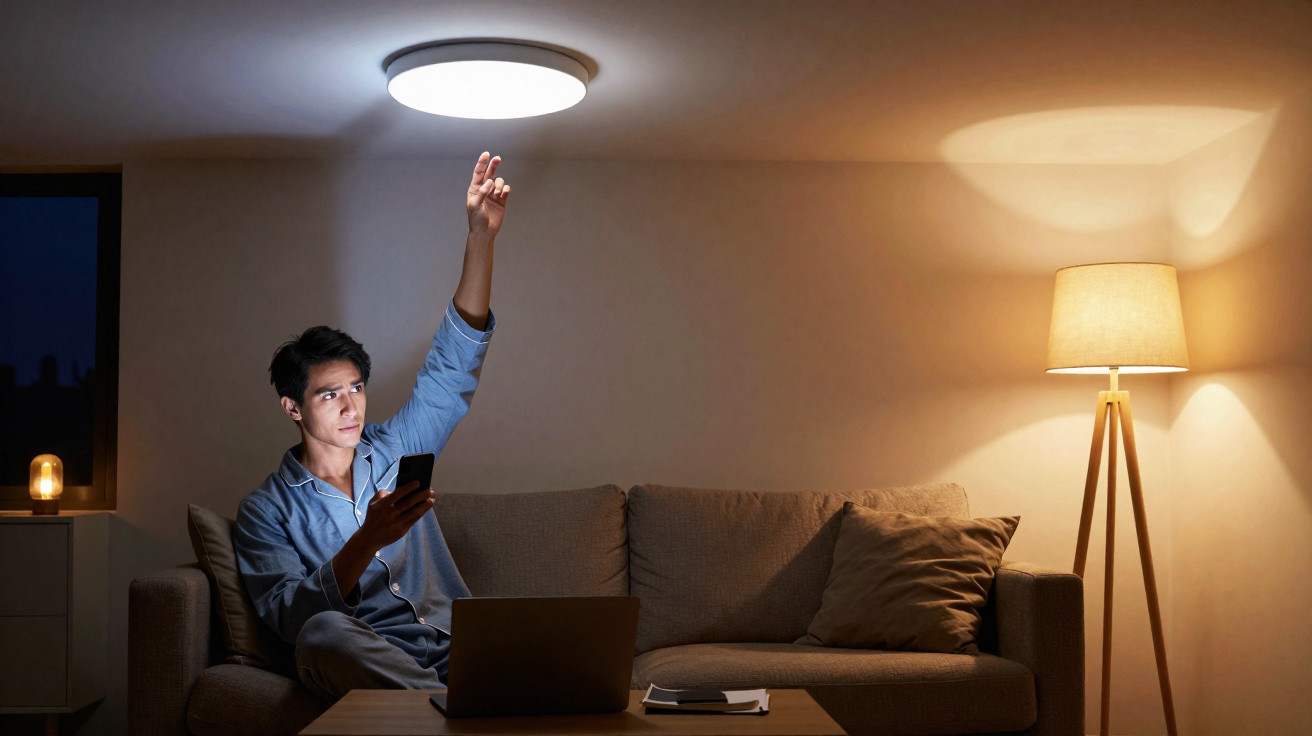
It may begin for you much as it began for me.
It is late in the evening, and a “quick” look at your phone somehow becomes half an hour. Your laptop is still lit up on the coffee table, while the kitchen lights glare as brightly as a supermarket at 10pm. You feel physically weary, your eyes are slightly sore, but your mind simply will not switch off. Then you lie awake looking at the ceiling, strangely alert and a little robbed, as though somebody slipped caffeine into your chamomile tea.
The following morning dissolves into repeatedly snoozed alarms, a heavy body and that peculiar cotton-wool sensation behind your eyes. You assume you went to bed too late, have been under pressure, or are simply having “one of those weeks”. But the pattern keeps returning, even when you have technically spent enough time in bed. Something is disrupting the cues that tell your body when to rest and when to wake. Most unsettling of all, it feels entirely ordinary while it is happening.
The quiet villain in your living room
Let us identify the culprit immediately: bright, cool artificial light indoors during the evening, particularly from LED ceiling fittings, screens and “daylight” bulbs. This is not about every kind of light, or a gentle lamp in the corner. It is the particular blue-tinged, clinically clean brightness that now fills so many homes and workplaces - the sort shops use to keep you alert enough to carry on browsing. You know the one: the light that makes your kitchen look brilliant on Instagram while making your brain forget that midnight is approaching.
We tend to regard lighting as either decorative or practical. You brighten it while cooking and lower it when you want things to feel “cosy”. To your brain, though, light is not decoration; it is information. When powerful, cool light reaches your eyes in the evening, it signals to the internal clock deep in your brain that it is nearer lunchtime than bedtime. Your body quietly puts aside the sleep routine it was about to begin and changes to “day mode”, because its most trusted signal has been overridden.
Your internal clock, or circadian system, is both particular and dependable. It once took nearly all its direction from the sun: intense, blue-rich light in the morning and warm darkness at night. Today, it has to interpret a muddled flow of indoor lighting choices: kitchen spotlights at 10pm, a phone in bed, bathroom mirror lighting at 1am. Gradually, its sense of timing starts to shift. You do not notice the precise point at which it drifts; one day, you simply realise that you are permanently out of step with yourself.
The light you feel vs the light your brain sees
There is an odd mismatch at work. You may be exhausted on the sofa, yawning into your sleeve, while your brain still interprets the moment as daytime because of the light entering your eyes. That is because your circadian system is not especially concerned with whether you feel sleepy. It pays close attention to a set of light-sensitive cells in your eyes that do not help you see colours or shapes; their job is simply to assess brightness and send time-of-day signals to the brain’s master clock.
Known as intrinsically photosensitive retinal ganglion cells (IPRGCs if you like acronyms), these cells are particularly responsive to bluish light - the type emitted by crisp white LEDs, laptops, televisions and smartphones. Their response is far from subtle. When bright, cool light activates them at 9 or 10pm, they deliver the message: “It’s still daytime, keep the melatonin low.” Melatonin is the hormone that quietly tells your body: “Night now. Power down. Start the maintenance shift.” If that message never properly arrives, you may still get to sleep, but the entire night can feel slightly off-script.
This explains why so many people describe themselves as “tired but wired” in bed. Your mind and muscles may feel finished, but your hormonal signals are not aligned. You wake more regularly through the night, sleep feels light, and dreams can become vivid or jumpy. The next day, you force your way through work while caffeine handles the job your biology was trying to do for nothing. It is not severe enough to make you book a doctor’s appointment straight away. Instead, it quietly and gradually wears down your resilience.
The invisible jet lag of staying home
Jet lag is usually discussed as something that follows a long-haul flight. Yet strong indoor lighting in the evening can produce a small, self-created form of jet lag without you ever leaving the sofa. Each night, your lighting habits push your internal clock a little later, only for an early alarm and a dark commute to punish it again the next morning. Your body is effectively trying to exist in two time zones simultaneously: the natural one and the LED one.
There is a term for this: social jet lag. It commonly results from late evenings and early mornings, but exposure to light in the evening quietly widens the divide. You may go to bed at a sensible time, while your circadian clock believes bedtime is one or two hours later because it was receiving “daytime” cues at 10pm. When the alarm goes off at 7, your biology hears it as 5. It is hardly surprising that you feel as though you have been pulled from sleep halfway through a dream.
The body’s grumpy morning meeting
Internally, the outcome resembles a poorly managed office meeting. Cortisol, the hormone that should increase in the early morning to make you feel alert, becomes mistimed. Melatonin lingers when it ought to have gone. Your gut is not quite prepared for breakfast, mood regulation trails behind, and your concentration feels blurred. It is not serious enough to send you to A&E; it is simply enough to make you feel slightly unlike yourself, every day.
Most of us have snapped at somebody we love over something trivial, then later asked ourselves, “Why did I react like that?” Sleep deprivation is often blamed, and often with good reason. But there is a quieter issue beneath it: not only the amount of sleep you get, but whether your internal clock is working alongside you or against you. Bright indoor light at the wrong point in the day gently knocks that clock out of rhythm, before fading back into the background as if it were innocent.
The trap of “daylight” indoors
There is an ironic twist here: many of us intentionally choose “daylight” bulbs because we believe they are the healthier option. They are marketed as natural, energising and good for concentration. During the morning and early afternoon, that can often be true. A kitchen or office illuminated with bright cool-white light may boost your mood during a bleak, grey British winter, when the real sun refuses to appear before 10am.
The problem begins when those same bulbs remain on through the evening. They seem harmless because they are your ordinary lights rather than a specialist device. No warning label says “Using this at 10pm may trick your brain into thinking it’s midday in June.” You are pottering about, tidying up and sending a final few emails, while your home shines like a showroom. Your eyes adapt, the phone screen merges into the overall brightness, and there is no “aha” moment to show you that you have crossed a biological boundary.
In reality, nobody wants to spend every day changing bulbs or fitting an elaborate lighting set-up that requires a degree to use. Life is untidy: people fall asleep on the sofa with the television on, and children leave every light blazing across three rooms at once. That is precisely what makes this sort of light disruption so insidious. It does not depend on any extreme behaviour. It only requires you to be an ordinary, somewhat tired person who prefers good lighting.
The quiet difference of warm light
The curious thing is that you probably already recognise what feeling better is like; you have simply not connected it with lighting. Picture an evening in a pub with low lamps, a campsite lit only by a fire and lantern, or a friend’s home with soft table lamps instead of ceiling lights. After evenings like those, you return home and slip into sleep like a stone falling into water. There is no drama and no endless scrolling; you simply drift off.
Those settings contain warm, low-intensity light that suggests “sunset” to your circadian system rather than shouting “office” at it. The signal changes, and your biology reacts accordingly. You probably do not consciously notice why those evenings feel unlike others; you just know that they do. Once you spot the pattern, it becomes difficult not to see it in your own home.
The phone in your face at midnight
It is impossible to discuss light without mentioning screens. The standard advice is to avoid your phone before bed, and most of us agree, recognise the logic, and scroll regardless. But the phone itself is not always the whole issue; it is the combination that matters. Bright ceiling lights, a large television and a phone held close to your face create a three-layer cake of circadian confusion.
Light from a screen is especially potent because it is close to your eyes and because you look directly at it. Even with “night mode”, it may still be substantially bright enough to activate those light-sensitive cells. You are tucked under the duvet in a somewhat dim room, screen glowing as your thumb flicks upwards. Your body thinks, “We’re in bed, this looks like a sleep signal,” while your retina shouts “Nope, still day, don’t start the sleep chemistry yet.” Your brain is receiving two conflicting messages at the same time.
There is a reason putting the phone down feels so difficult: its light helps to keep you awake. It is a bit like attempting to relax beneath a spotlight. You may not experience a dramatic jolt, but you do not quite pass that invisible line into genuine drowsiness. Instead, you remain in a strange half-alert state until you eventually drop the phone on your face and reluctantly decide that it is time to sleep.
Small changes that feel weirdly big
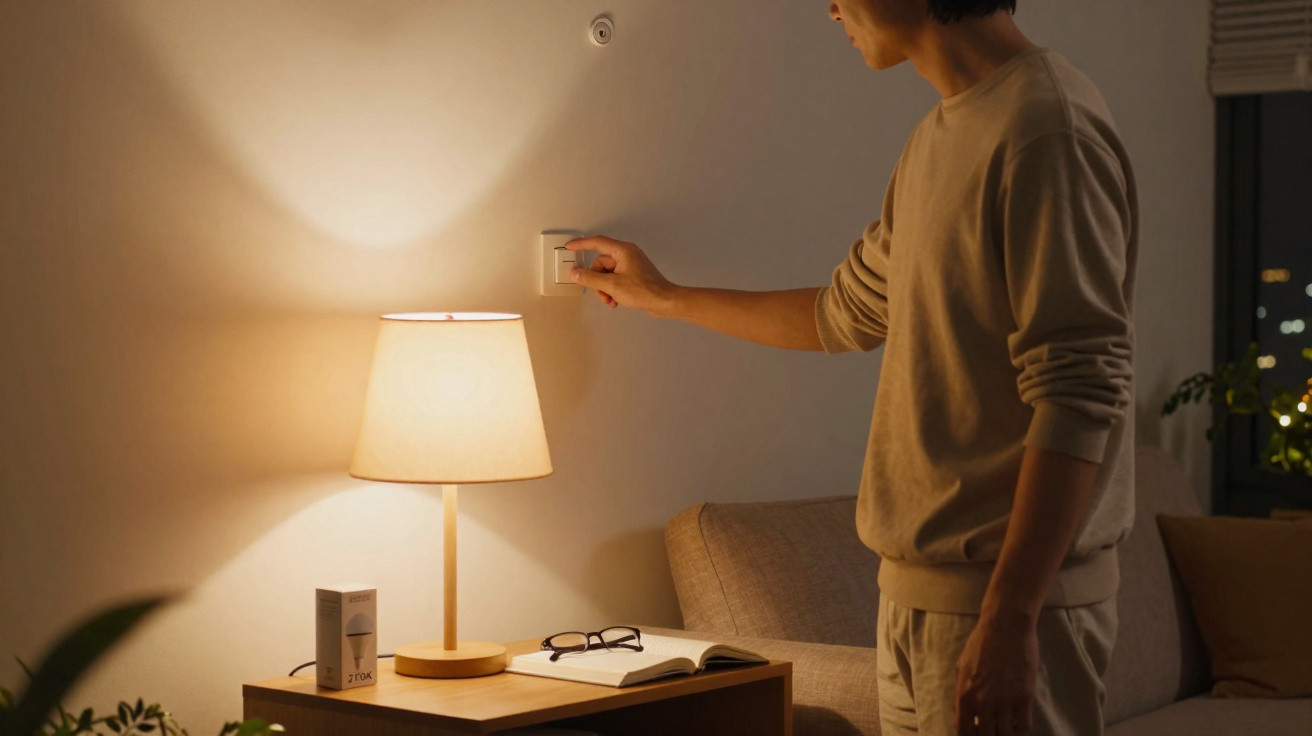
The encouraging news is that you do not need to redesign your entire home to prevent this particular form of light from taking over your evenings. A few deliberate adjustments can often have a surprisingly noticeable effect. Use dimmer switches on main lights, inexpensive warm-toned lamps, or simply adopt a rule that harsh ceiling lights go off after, for example, 9pm. Think of it not as “optimising sleep”, but as gently giving your body an accurate account of the time.
One easy approach is to establish a “second lighting mode” at home. Day mode means bright, cool lighting with everything switched on. Night mode means side lamps, warmer bulbs, fewer sources of light and brightness lowered by a couple of levels. At first, it can feel almost theatrical, as though you are arranging a scene, but your brain responds well to the regularity. After a week or two, you may find yourself becoming “sleepy on schedule” in a way you have not experienced for years.
With screens, perfection is unrealistic. At times, you will look at WhatsApp at 10pm. You will binge-watch a series. That is life. But changing the balance - watching from further away, reducing the brightness and leaving your phone across the room while you actually fall asleep - removes some of the impact. When you notice yourself blinking at a glowing rectangle at 1am, you will at least understand what you are giving up: not only tonight’s sleep, but tomorrow’s sense of timing too.
When light starts to feel like a choice again
Once you begin to notice it, evening lighting stops being background noise and starts to resemble weather - something you can observe, react to and work with. You see that the warm pool from a bedside lamp feels different from the harsh glare of a bathroom mirror. You sense the small internal release that comes when the main overhead light goes off. You may even start to enjoy the modest ritual of “dimming the day” before bed instead of simply collapsing into it.
There is a subtle form of control in that. You cannot manage your boss, your children, the news cycle or the neighbour’s puppy barking at 6am. But you can choose whether your living room feels like a surgery or a sunset at 10 at night. That choice gently alters the signals your brain receives, shaping how you sleep and, in turn, how you show up in your own life the next day. It is a sequence of small decisions that accumulates.
You do not need blue-light glasses, costly technology or an immaculately curated bedroom. What you need is a little more honesty between the lighting in your home and the clock in your body. When those two begin telling the same story again, sleep may no longer seem so mysterious or elusive. It was there all along, waiting while your lights quietly said “day” long after night had started.











Comments
No comments yet. Be the first to comment!
Leave a Comment