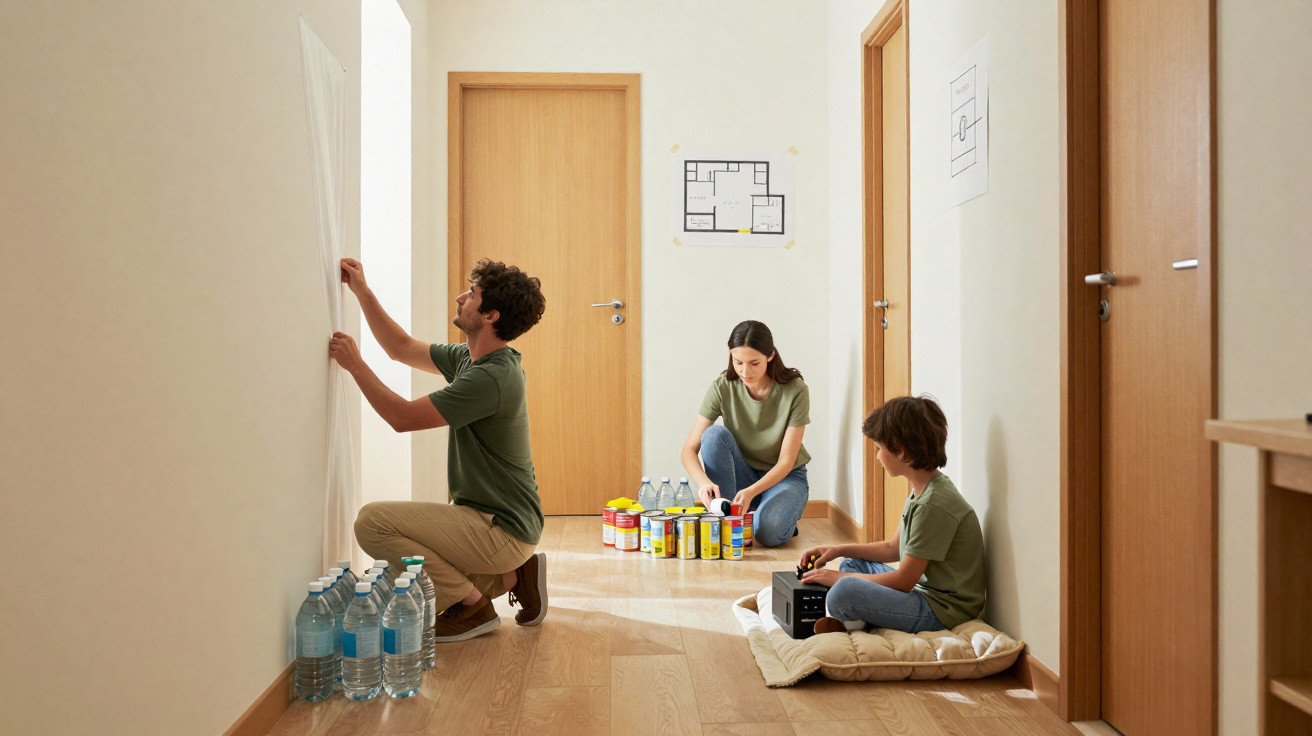
Fear of a nuclear incident has become deeply rooted through wars, threats and deteriorating reactors. Apps and preparedness guides repeatedly suggest taking refuge “somewhere underground”. However, current assessments by disaster protection and radiation safety experts present a more nuanced picture: not every cellar door leads to safety. What matters is how a building is constructed – and exactly where inside it you shelter.
Why many cellars can become a deadly trap
The idea of the safe cellar dates back to the air-raid shelters of the Second World War. Those spaces were heavily reinforced and specifically designed to withstand bombing. Most domestic cellars today bear little resemblance to such bunkers.
Common weaknesses in modern cellars include:
- unreinforced walls with cracks or ageing joints
- timber-beam ceilings or thin concrete slabs with living areas above
- small ground-level windows that can easily shatter in a blast wave
At a greater distance from a nuclear explosion, radiation is not the only danger. The blast wave hurls debris through the air, shatters windows and may cause entire ceilings to fail. If there is a heavy living area above, containing furniture, water pipes and appliances, that load can collapse into the cellar if the structure gives way.
There is also a rarely discussed risk: air quality. Many cellars already have poor ventilation. Sealing one in a hurry after an alert can cut off the supply of fresh air.
The main concerns include:
- carbon dioxide building up when several people occupy a confined space
- smoke and fire gases becoming trapped if the house catches fire
- exhaust fumes or toxic vapours being drawn in from storage areas
An ordinary cellar provides genuine protection only if it has been planned, calculated and built as a designated shelter – simply being below ground is not enough.
What happens inside a building during a nuclear explosion
Researchers at the University of Nicosia used computer simulations to examine how the blast wave from a large nuclear bomb moves through tower blocks and residential buildings. Their scenario involved an explosive yield of around 750 kilotonnes, detonated several kilometres above the ground.
Nobody in a normal building would stand a chance close to the epicentre. At a certain distance, though, the situation changes. The building itself absorbs some of the energy, yet dangerous “air tunnels” can form indoors.
Windows and external doors fail first. The pressure front then rushes into the building through these openings, travelling through corridors, stairwells and gaps. Open doors and long hallways act like nozzles. The airflow accelerates, propelling broken glass, furniture and rubble through rooms.
Conditions are significantly calmer in areas that are:
- far from external windows
- surrounded by several walls and, where applicable, neighbouring flats
- connected only minimally, or not directly at all, to external openings
This central area of a home is also crucial for protection from radiation. High-energy gamma rays can penetrate deeply, but every layer of material weakens them. A concrete layer measuring 15 to 20 centimetres can substantially reduce the dose. Several walls in succession lower it further.
Every additional metre away from the façade and every solid wall between your body and the outside world noticeably reduces radiation exposure.
The “nuclear safe space”: how to find the safest room
Emergency managers refer to the “core area” of a building. This means the internal part of a flat or house, ideally with no direct contact with outside air and surrounded by solid structural elements.
For living spaces, three broadly simple steps can help identify this area:
- Rule out every room with windows – particularly those with large glazed areas.
- Imagine lines crossing over the floor plan and aim for its centre.
- Choose the room there that is enclosed by the greatest number of walls and is close to water connections.
In practice, the same options often emerge:
- an internal, windowless hallway
- a toilet or bathroom without an external window
- a cupboard or pantry in the centre of the home
- a walk-in wardrobe (“dressing room”) in the middle area of the flat
In two-storey detached houses, the ground-floor hallway is often suitable, provided it does not run directly through to the front door. In some building layouts, an internal stair landing between two floors can be beneficial, as long as it is not open all the way to the front door.
Different priorities apply in blocks of flats with several residential levels: middle floors are regarded as the safest – neither directly beneath the roof nor at street level. From there, the same principle applies: move away from external walls and towards the core of the flat.
Preparing the nuclear safe space in everyday life
Nobody wants to spend years living in a constant state of alert. Even so, a few precautions can be incorporated discreetly into everyday life and can markedly improve the chances of survival in an emergency.
Useful supplies for an improvised shelter in the core area include:
- a simple box containing bottles of water and non-perishable snacks
- a torch, power bank and battery-powered radio
- a small supply of individually necessary medicines, such as an asthma inhaler
- lightweight blankets or sleeping bags
- gaffer tape or masking tape, plus a few bin bags for sealing gaps
If a warning is actually issued, every minute matters. The sequence should be familiar:
- close every window and external door in the flat
- switch off ventilation systems and extractor fans
- seal the gap beneath the flat entrance door with damp towels
- move into the prepared room and remain there until an official all-clear is given
The protective effect increases with every minute spent away from the open air. Anyone who stays indoors drastically reduces their radiation risk.
What radiation does to the body – and why walls help
Radioactivity is what frightens many people most. From a physical perspective, several forms of radiation are involved; gamma rays are particularly relevant during a nuclear explosion. They pass through clothing and skin, reach internal organs and can damage cells.
The dose depends on three factors:
- Distance: If the distance from the source doubles, the dose falls to roughly one quarter.
- Time: The shorter the exposure, the less severe the damage.
- Shielding: Concrete, brick, soil, water and even thick timber walls weaken the flow of radiation.
A room at the centre of a house takes advantage of all three factors: the body is farther from the radiation source outside, time spent there should be as long as possible, and several walls act as a type of filter. Fallout – radioactive dust falling from the sky – also largely remains outdoors as long as doors and windows stay closed.
Psychology and practice: staying clear-headed under pressure
The prospect of a nuclear attack causes stress – and that is normal. Many people immediately run through horrifying scenarios in their minds and become unable to act. Having a clear plan helps counter this paralysis.
It is helpful to discuss a few points briefly with your family or housemates:
- Which room will serve as the shelter in an emergency?
- Where is the emergency box kept, and who will grab it?
- Who will look after children, pets and elderly relatives?
People who calmly talk through these issues once tend to respond more systematically when adrenaline takes over. Small notes in the hallway listing two or three key steps can help. They do not replace official guidance, but they provide direction when your mind goes blank.
There is no absolute safety in nuclear scenarios. Yet the difference between a spontaneous dash to an unsecured cellar and a prepared move to an internal shelter can be a matter of life and death. The safest place is often only a few steps away – right in the middle of your own home.
















Comments
No comments yet. Be the first to comment!
Leave a Comment