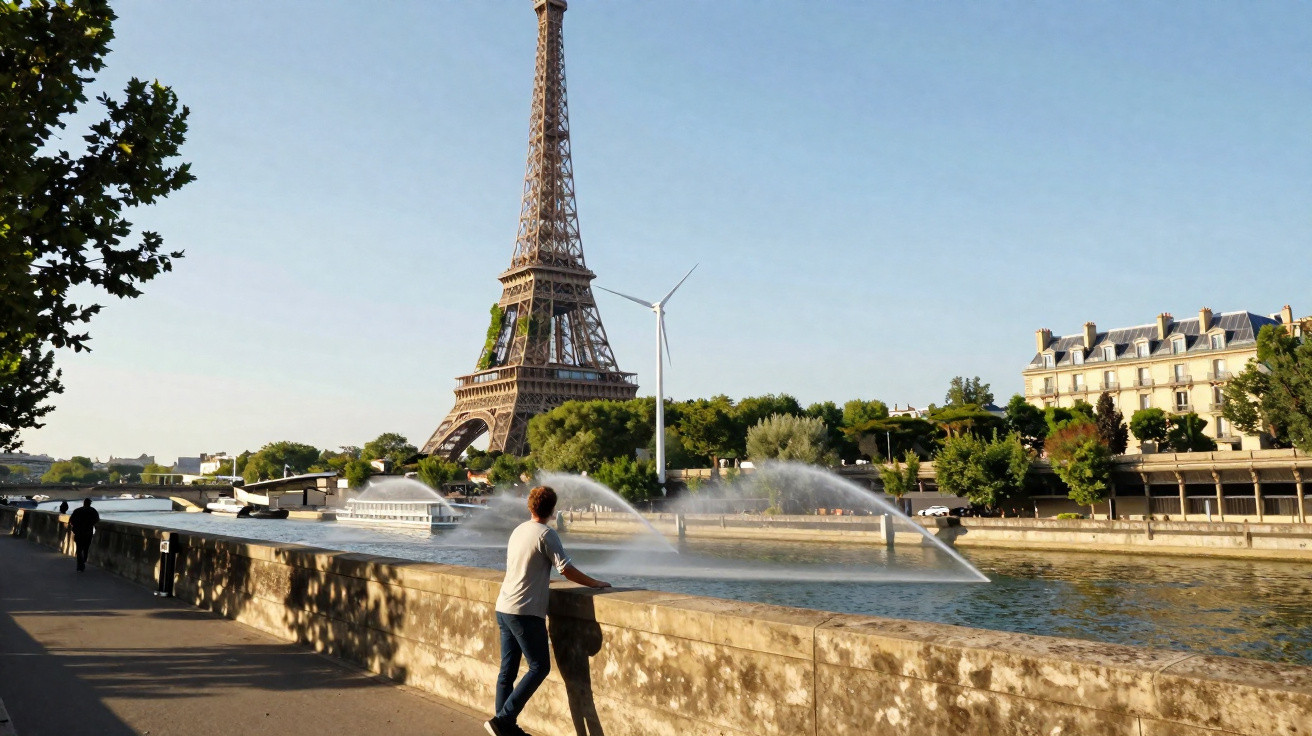
Historic architectural treasures define Paris’s appearance. Yet they were built at a time when climate change, urban heat islands and increasingly dry summers were not part of the conversation. Urban planners, architects and climate researchers are therefore working on a radical transformation: the city’s icons should become more than postcard views, acting instead as active allies in the fight against the climate crisis.
Paris is getting hotter – and its landmarks are under pressure
Forecasts for 2050 are clear: Paris will face substantially more hot days, longer dry spells and, at the same time, a greater risk of flooding. Historic structures are particularly vulnerable to these extreme pressures.
- Stone and metal expand in high temperatures, crack and corrode more quickly.
- Ageing pipes and building systems are often unprepared for intense rainfall and water shortages.
- Dense development intensifies urban heat islands in the city centre, especially around major squares and boulevards.
Many 19th-century buildings – including the quintessential Parisian apartment blocks with balconies and pale stone, as well as museums and monuments – were never designed to withstand summers of 40°C or more. In addition, millions of tourists place extra demands on electricity and water supplies.
“The major challenge is this: Paris must preserve its character while making its built fabric resilient to the climate.”
A bioclimatic strategy: turning historic buildings into climate protectors
The city’s long-term aim is to turn its historic heritage into a kind of integrated bioclimatic system. In practice, this means buildings should respond as intelligently as possible to weather conditions, retain less heat and make better use of natural resources.
By 2050, three objectives are intended to work together:
- Protection from heat and flooding
- Lower energy consumption
- An active contribution to cooling and greening the city
A range of measures could achieve this in ways that remain sensitive to heritage, without damaging the city’s renowned façades.
More greenery around the Eiffel Tower and the Louvre
A key element is the extensive greening of surrounding areas. Along the route from the Trocadéro to the Champ de Mars, more than 17,000 square metres of sealed ground are set to be opened up and planted. Asphalt and paving will give way to trees, planted beds and permeable soils.
The impact can be measured clearly:
- Vegetation provides shade and cools the air through evaporation.
- Rainwater can soak into the ground more effectively, rather than overwhelming the drainage system in a short period.
- Overheated spaces around the Eiffel Tower cease to act as heat stores.
The areas around the Louvre and beside the Seine also offer opportunities to introduce more planting in riverbanks, courtyards and roofs, without radically altering the city’s distinctive character.
The role of classic Parisian apartment buildings
The striking 19th-century apartment blocks shape entire neighbourhoods. Many have high ceilings, large windows and heavy walls. While these features offer some help in hot weather, they will no longer be sufficient in the future.
Possible adaptations include:
- Internal insulation to avoid altering the façade
- External shading, such as shutters or lightweight canopies
- Green roofs and courtyards that create small local pockets of cooler air
- Upgraded water systems to cope better with drought and heavy rainfall
“By 2050, the classic Parisian flat could function like an almost invisible climate shield – nostalgic on the outside, highly modern within.”
The Eiffel Tower with wind power – a landmark generating electricity
Plans to incorporate technical features directly into celebrated structures symbolise this shift. Small wind turbines could, for example, be fitted to the Eiffel Tower, blending discreetly into its steel framework while still producing energy.
Such measures offer several advantages:
- The tower produces part of the electricity it needs itself.
- Their symbolic value is immense: climate action becomes visible.
- Projects involving other monuments may gain acceptance more easily.
The principle is not to add futuristic intrusions, but to use small-scale technical solutions that respect the historic appearance. Photovoltaic panels or solar tiles could be installed on museum roofs while remaining barely visible from a distance.
Louvre and other museums as ecological tools
Major museums are exceptionally sensitive to shifts in temperature and humidity. Indoors, the priority is protecting artworks; outdoors, it is protecting the fabric of the city. Modern climate-control systems, improved insulation and intelligent controls can help meet both requirements.
By 2050, the Louvre could, for instance:
- Use heat from exhibition rooms to supply other parts of the building
- Collect rainwater from its roof areas and pre-filter it for sanitary facilities
- Coat its glass surfaces so they reflect heat while still admitting daylight
At the same time, every kilowatt-hour of electricity saved helps to limit further warming in the city. Each air-conditioning unit that runs less also releases less warm air onto the streets.
What the term “bioclimatic” means
When urban planners refer to bioclimatic buildings, they mean architecture that works directly with the local climate rather than responding to it solely through technology. The goal is a form of dialogue between a structure and its surroundings.
This includes:
- Building orientation that makes use of or avoids sunlight
- Materials that can store or release heat
- Ventilation strategies that work with air currents
- Outdoor spaces with trees, water features and shade
Historic buildings are particularly well placed to support this approach: they already have thick walls, courtyards and substantial roofs. With a degree of technical retrofitting, they can be turned into precisely balanced climate systems.
Heatwaves, drinking water and renewable energy: Paris as a laboratory
Longer heatwaves – described in meteorological terms as heat periods when temperatures remain well above normal for several consecutive days – also put water supplies under strain. Sources dry up more quickly while demand rises. At the same time, heavy rainfall events place the drainage network under pressure.
Paris is responding in two ways: through greater storage and less sealed ground. Roofs, squares and green spaces are becoming water stores that hold back rain and gradually release it into the ground and air. This can reduce urban flooding, while making some of the water available during dry periods.
Meanwhile, the share of renewable energy within the city is increasing. Alongside wind and solar power, concepts such as geothermal energy and heat pumps are being considered; these could be installed beneath large squares or in museum basements, for example. Historic buildings would thus become hubs in a quieter, more climate-friendly energy system.
For visitors from Germany, Paris in 2050 may feel both familiar and unfamiliar: the skyline of the Eiffel Tower, the Louvre and the city’s grand, characteristic avenues will remain recognisable, yet a network of gardens, water features, solar roofs and invisible high-tech systems will grow around these postcard sights. In this way, the city is seeking to avoid becoming an open-air backdrop from a bygone age, instead becoming a laboratory where heritage conservation and climate adaptation strengthen one another.










Comments
No comments yet. Be the first to comment!
Leave a Comment