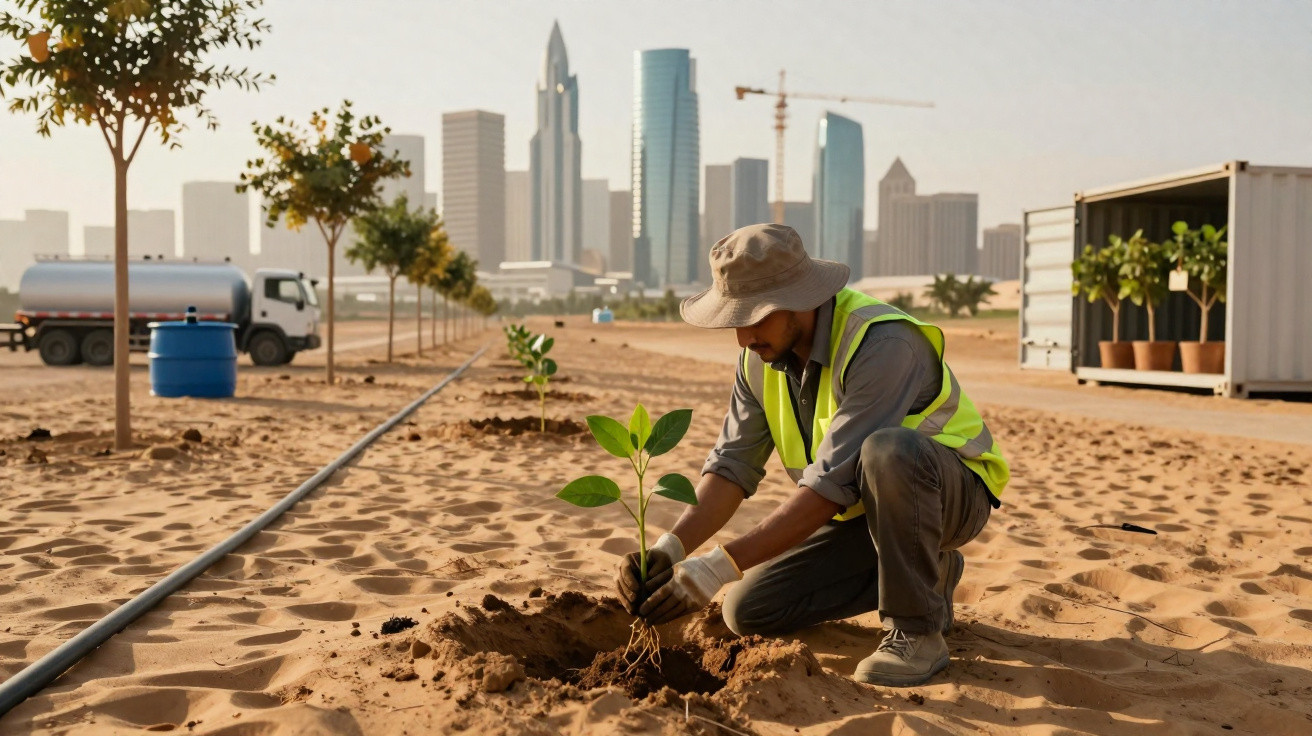
The first thing that strikes you is not the heat. It is the green.
At Riyadh’s outskirts, beige blocks of flats give way to open desert, while long flatbed lorries inch past carrying towering loads of burlap-wrapped trees. Young labourers in dust-covered hi-vis vests leap down, sweat glistening on their faces, and direct palm after palm into prepared pits beside a newly built boulevard that does not yet lead anywhere. Diesel and damp earth fill the air, along with something almost implausible here: the light scent of a forest.
Several hundred kilometres away in Dubai, cranes move above a waterside park as hoses force reclaimed water into trenches. Saplings brought in from Africa and Europe sit beneath shade netting, treated like delicate VIPs.
This is how climate strategy appears when a desert becomes a mega-city, only to discover that it has become too hot to live comfortably.
Desert nations racing to plant forests of shade
Saudi Arabia and the United Arab Emirates now bring in millions of trees annually, aiming to cool cities that have spread faster than their shade cover. Broad motorways, glass skyscrapers and concrete villas have intensified the urban heat island effect, making a late-afternoon walk feel like a test of endurance.
Under pressure from residents and international investors, city authorities are making major bets on greenery. They refer to “climate resilience corridors” and “urban forests”, yet at street level the reality is rows of exhausted workers digging through sand and planting a cooler future, one sapling at a time.
Riyadh’s King Salman Park project shows the scale of this ambition. Still being built, the park is intended to rank among the world’s largest urban parks, effectively covering an area comparable with a small city. Saudi officials say that the broader Saudi Green Initiative is intended to plant 10 billion trees across the country over the coming decades.
Municipal nurseries in Dubai and Abu Dhabi are overflowing. Ships bring in containers of young trees from Spain, Italy, Kenya and even Australia, selected for their capacity to withstand fierce sun and saline soil. One Dubai landscaping manager joked that his real job is now “traffic control for trees”, as he tells drivers where to unload each new shipment of living cargo.
The reasoning is simple: additional trees mean more shade and less heat. Research from Gulf universities indicates that shaded roads can feel 5 to 10 degrees cooler than exposed ones, while satellite imagery often shows substantially lower surface temperatures in neighbourhoods with dense tree canopy.
There is a political dimension, too. As Saudi Arabia promotes futuristic mega-projects such as NEOM and The Line, pictures of green valleys amid glass structures help temper worldwide criticism over fossil fuels. The UAE, having recently hosted COP28, uses images of verdant boulevards and expanding mangrove belts to present itself as a climate-aware centre. These trees are climate measures as well as PR symbols, putting down roots both in desert sand and in the global imagination.
The hidden cost of importing a forest into the desert
Planting a tree on the Arabian Peninsula is nothing like doing so in a wet European suburb. Each sapling arriving by ship or aircraft requires its own small support network: drip irrigation, treated wastewater and, frequently, protective mesh to shield it from wind and sand. Landscape architects now spend more time discussing pipe widths and salt tolerance than visual appeal.
The approach is heavily engineered. Crews plan tree-lined “cooling corridors” along principal roads and walking routes, linking parks, shopping centres and metro stations so that people can travel in shade wherever possible. The priority is not simply beautifying cities, but ensuring they remain bearable after 3 p.m. in August.
People are gradually adjusting to this new green-infrastructure routine. In Abu Dhabi, a Filipino delivery rider explained that he now maps his journeys around streets planted with neem and ghaf trees, cutting a few degrees from an unforgiving shift. In Jeddah, parents schedule late-afternoon outings to recently created coastal parks, where newly imported nursery stock grows beside tough native varieties, all supplied with greywater from nearby buildings.
There are uncomfortable realities, however. A freshly planted boulevard can appear lush in official Instagram posts yet look completely dry in person because the irrigation network is unfinished or funding has been held up. Let’s be honest: once the ribbon-cutting photographs are taken, nobody checks every sapling. Some quietly die in the sand, illustrating that rapid planting is far easier than long-term care.
The drive for shade has prompted serious arguments among local planners. Why purchase thirsty non-native species when the region has resilient trees such as ghaf and sidr, which have endured drought for centuries? Why pursue an imported “European park” look in cities receiving scarcely any rainfall?
Specialists caution against depleted groundwater, the energy demands of desalination and the danger of building water-dependent forests that cannot exist without constant pumping. You can’t air-condition an entire country with leaves alone. An emerging view is that trees are effective only when paired with cooler construction materials, reflective roofs, covered pedestrian routes and fewer dark asphalt surfaces. Without those measures, they are simply green ornamentation laid over an intensely hot challenge.
Between ambition and reality: how the Gulf is learning to green wisely
Beyond the polished visualisations, a quieter move towards practical, almost modest methods is under way. Riyadh’s city engineers now create “tree pits” designed to capture every drop of infrequent rain, allowing it to soak down to roots rather than vanish into drains. Irrigation systems are increasingly connected to sensors that release water only overnight, when less is lost to evaporation.
On the fringes of the UAE, experimental plots combine imported and native species to determine which can withstand stronger winds while using less water. The most successful plants are often unglamorous local shrubs that do not photograph well for brochures but cope with August exceptionally well.
Urban planners also acknowledge something seldom included in press statements: every street does not need greenery. Some districts are now designated for thick canopy, while others use low vegetation and water-efficient shade structures. Attention is increasingly turning to cool bus shelters, arcades and covered footpaths that function whether trees are present or not.
Many people have mixed feelings. They enjoy the new parks and tree-lined promenades but remain concerned about the unseen water costs in a region already dependent on desalination plants. We’ve all been there, that moment when you step under a young tree’s shade, feel instant relief, then suddenly wonder what it costs to keep that little patch of comfort alive.
“Planting trees in the desert isn’t about copying Europe,” a landscape architect in Dubai told me. “It’s about designing shade that respects where we live. If the tree doesn’t make sense with our water, our soil, and our lifestyle, it’s just a very expensive decoration.”
- Choose hardy species first – Ghaf, sidr, date palm and acacia withstand heat, salt and wind much better than delicate imported species.
- Use treated wastewater – Cities in both Saudi Arabia and the UAE are increasingly sending recycled water to parks, central reservations and roadside trees.
- Think shade, not just beauty – When cooler streets are the true aim, branch form, leaf density and height matter more than flowers.
- Cool the ground too – Pale paving, permeable surfaces and narrower roads stop shaded spaces from radiating heat upwards.
- Plan for maintenance – A dead tree is worse than no tree because it squanders water, money and public confidence in climate projects.
What kind of future grows out of a million imported trees?
Saudi Arabia and the UAE are attempting something bold: reshaping the relationship between desert cities and the land on which they stand. Their mega-city growth made everyday life more modern, then more draining, and they are now hurrying to ease that effect with green belts, shade tunnels and huge urban parks that were absent a decade ago.
A central tension remains. These oil-rich countries are financing imported trees and desalination-driven irrigation to cool the urban lifestyles that fossil fuels helped produce. Yet the contradiction also makes the Gulf a possible laboratory for the wider hot, densely populated world. From Phoenix to New Delhi, cities are observing Gulf experiments in water reuse, tree selection and the straightforward practice of placing a tree precisely where people need it most.
The true measure will not be this year’s satellite images or polished climate commitments. It will be whether, 20 years from now, a child walking to school in Riyadh or Sharjah remembers their city as somewhere the street itself offered mercy. A place where summer still scorched, but somebody, somewhere, had arranged enough shade for them to carry on walking.
| Key point | Detail | Value for the reader |
|---|---|---|
| Tree imports at massive scale | Millions of saplings are transported into Saudi and UAE cities to line roads, parks and mega-projects | Helps explain how rapidly expanding cities respond when heat becomes an everyday barrier |
| Water and species choice matter | A shift towards native or robust trees, treated wastewater and smart irrigation rather than “European-style” lawns | Demonstrates what truly functions in hot, dry conditions rather than what merely looks attractive on social media |
| Shade as infrastructure | Trees are combined with cool paving, covered walkways and urban-planning rules | Provides practical approaches that any hot city can adapt to make streets more liveable |
FAQ:
- Question 1 Why are Saudi Arabia and the UAE importing so many trees instead of simply planting local species? Local trees form part of the approach, but the demand for rapid, dense shade around new mega-projects has exceeded the output of regional nurseries. Imported trees address that shortage while planners expand native planting schemes.
- Question 2 Does planting all these trees really cool cities? Shaded streets and parks can feel several degrees cooler, particularly at pedestrian height. Trees do not solve the climate crisis, but they can make everyday life more tolerable during severe summer heat.
- Question 3 Isn’t this strategy wasting valuable water in the desert? That is the principal criticism. Cities are seeking to reduce the impact through treated wastewater and drip irrigation, although the water footprint remains considerable and is still widely debated locally.
- Question 4 Which tree species are proving most successful in Gulf mega-cities? Tough species including ghaf, sidr, date palms, acacia and certain carefully selected imports with strong heat and salt tolerance generally survive best with lower water use and maintenance.
- Question 5 Could other hot cities replicate what Saudi Arabia and the UAE are doing? Yes, if adapted to local circumstances. The central principles-a combination of shade trees, recycled water, cooler materials and streets designed around comfort-are already influencing policy from southern Europe to North Africa.





Comments
No comments yet. Be the first to comment!
Leave a Comment