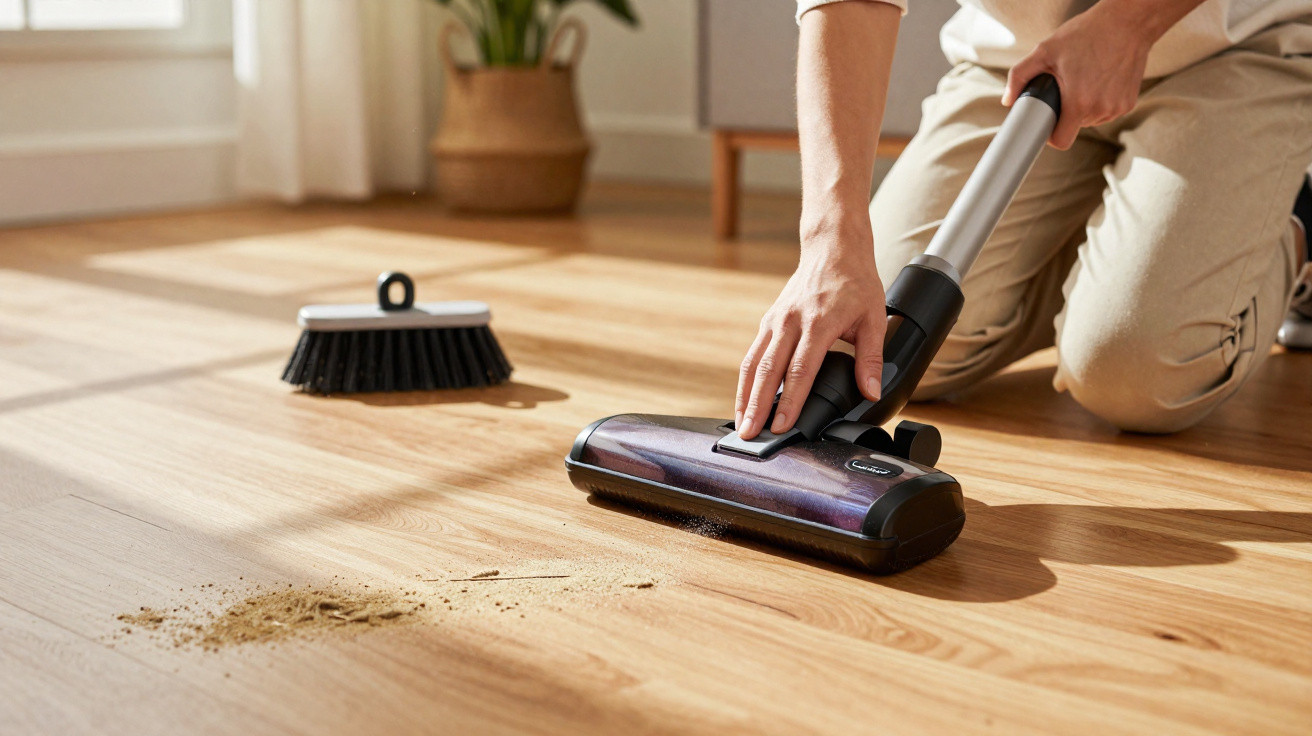
There is a particular sort of guilt that arrives only after you have spent a small fortune on gorgeous hardwood floors.
You know it: that first week spent padding about in socks and calling out “shoes off!” to anyone bold enough to enter wearing boots. You treat those boards as carefully as a brand-new car. Then ordinary life resumes: toast crumbs, drifting clumps of dog hair and the fine grit of the outdoors beneath your feet.
So out comes the vacuum cleaner, and you feel rather pleased with yourself. You are cleaning, not scraping metal chairs along the floor or dropping saucepans. You are doing the sensible thing. That is why it feels so unfair to learn that one of the vacuum’s most commonly used settings – one many of us select automatically – may be quietly marking and scratching your treasured wood. Worse still, there is a good chance you used it this week.
The setting experts say is quietly wrecking your wood floors
Ask a flooring professional which vacuuming habit makes them wince, and they will usually name the same offender: the rotating brush or beater bar setting. It is the mode that can sound rather like a helicopter flying low when it reaches a rug. Bristled rollers work brilliantly on carpet because they dig into the fibres and lift embedded dirt. On hardwood, however, that digging action can become a rapid series of minute scratches.
The problem is worsened by people moving from carpet straight on to wood without changing any controls. The reassuring noise starts, the vacuum glides over the boards and it feels as though you are giving them a thorough clean. Yet, when experts are called in years later, they often find dull tracks in the home’s busiest routes. There are small curves and swirls where the brush has travelled over dust particles and forced them into the finish like moving sandpaper.
One London-based floor restorer described it to me as “death by a thousand micro-scratches”. Individual passes barely show at all. Over months, though, the shine fades. The attractive reflections cast by afternoon sunshine become cloudy, and the owner wonders why their “low-traffic, well-cared-for” oak resembles a supermarket aisle.
Why that whirring brush is the enemy of smooth wood
How the beater bar actually behaves on hardwood
A rotating brush is the hero when used on carpet. It beats and lifts, flicking grit upwards so that suction can remove it. Hard flooring is an entirely different environment. There is no soft pile into which the bristles can settle, so they slide across the surface and push grit or tiny stones along like a plough. Every crunch you hear as the vacuum crosses grit on bare boards is a small alarm.
Anyone who has watched sunlight reveal fine scratches on a wooden table will recognise the marks in question. Most contemporary hardwood floors have a factory-applied lacquer or oil finish. It is this protective coating you walk on, rather than the unfinished timber below. The spinning brush does more than shift dust: it repeatedly scuffs this top layer. Once it becomes thin and hazy, dirt adheres more readily, and cleaning no longer feels rewarding because the original glow never fully returns.
Some vacuum cleaners have supposedly “multi-surface” brush heads said to be suitable for wood. Flooring technicians remain doubtful. In their view, any spinning, bristled part that touches the boards carries a risk. “It’s not about one dramatic scratch,” one expert told me, “it’s about what your floor looks like after five years of the wrong setting.”
The grit you can’t see is doing the real damage
Most of us focus on obvious hazards: stiletto heels, a fallen mug or furniture being dragged across the room. But the usual culprit is the tiny, easily overlooked grit that blows in through an open window or arrives on children’s school shoes. Once it lies on the floor, it simply waits for a rotating brush to force it across the surface under pressure.
Vacuum engineers acknowledge that hard floors can create this sort of trap. They look clean from afar, so we do not always think to handle them gently. You may hear a slight scraping sound as the bar passes over a stray grain of grit and dismiss it. But that brief noise in an otherwise quiet room is precisely when the protective finish takes a knock. The hairline, permanent mark may not be visible yet, but it is there.
That’s the slightly cruel part of this story: the setting we associate with “proper cleaning” is the one that slowly takes the life out of your wood.
The setting you should be using instead
What experts actually do in their own homes
Ask installers or refinishers what they use on hardwood in their own houses, and their answer is almost tediously straightforward: bare floor or hard floor mode, with the brush roller switched off. The most suitable heads have either soft rubber wheels and a smooth underside, or a dedicated hard-floor attachment with non-rotating, gentle bristles. Suction should handle most of the cleaning, rather than vigorous scrubbing.
This is where a reality check is needed. Many people have never changed their vacuum head, much less searched for a tiny “brush off” symbol on the handle. Honestly, hardly anyone does it daily. You want to plug it in, remove the crumbs and then sink into the sofa. Still, that one switch from brush mode to bare-floor mode can be the difference between needing a full sanding after eight years or after fifteen.
If your cleaner has no obvious hard-floor mode, there is often an indication elsewhere: perhaps a small slider that opens a vent in the handle, reducing suction for delicate rugs, or a button marked with a carpet icon and a plank icon. Unsurprisingly, the plank is the symbol your wood floor needs. Flooring professionals say that, if new owners alter just one habit, this should be it.
The underrated power of a simple attachment
Many vacuum boxes include a slim, flat accessory with short, soft bristles. Compared with the large main head, it can seem rather unremarkable, but wood-floor specialists value it highly. Used with moderate suction, it lifts dust without rubbing it into the finish. It is more like dusting the floor with help from the vacuum cleaner than scrubbing it.
Some readers may sigh at the prospect of changing attachments between rooms. Fair enough: life is busy, and floors are not high on the list of dramatic concerns. But if you have paid thousands for engineered oak or solid walnut flooring, trusting it to a setting created for deep pile is slightly extraordinary. As one expert put it: “You wouldn’t wash a silk shirt on the heavy-duty cycle and hope for the best.”
The emotional hit of finding tiny scratches
There is something oddly personal about spotting fresh marks on a hardwood floor. It is not like a chipped plate or scuffed trainer that can be hidden at the back of a cupboard. The floor is everywhere. You see it while wandering in half-awake for a morning coffee, and when evening sunlight throws a band across the living room, making every imperfection stand out.
We have all had the moment when a particular area catches the light at exactly the right angle, revealing faint spiralling scratches that you are sure were not present last year. Your stomach sinks slightly. You think through what has changed, and “I’ve been vacuuming more because the dog’s shedding” suddenly seems less helpful. You did not move furniture or drop anything heavy, but the proof is there: circles around the sofa and beneath the dining table.
Floor repair professionals say this is often the point at which people contact them. It is not that the floor has been destroyed, but that it no longer “sparks joy”, to borrow Marie Kondo’s line. Structurally, the wood remains sound. It simply no longer feels special. That is the painful part: the damage is slight yet widespread, too minor for an insurance claim but enough to make the room feel worn.
How often should you really vacuum hardwood?
The industry advice vs real life
An expert will calmly advise vacuuming or sweeping wooden flooring several times each week, and sometimes every day in a busy home. They will mention avoiding grit build-up and preserving the finish. On paper, that is perfectly reasonable. In reality, many of us manage it only once a week, in a frantic rush before guests arrive, followed by lighting a candle to suggest the home always smells that pleasant.
Those same professionals acknowledge that they do not follow their own textbook advice flawlessly either. Life intervenes: children spill things, pets shed and someone pushes a pram through the front door. The more achievable guidance they offer clients is to vacuum often enough that the floor never feels gritty under bare feet, always keeping the brush roller switched off. If you have fallen behind with cleaning, they would still prefer one careful, brush-free pass to three harsh passes with the wrong mode selected.
There is a certain freedom in that approach. You do not need to become someone who polishes floorboards every evening. You only need to stop treating them with a tool made for fluffier surfaces.
Simple tweaks that keep your floor looking new
In addition to turning off the rotating brush, flooring specialists quietly recommend several minor habits that have a major effect. Use door mats rather than merely admiring them. Put felt pads beneath chair legs, especially the dining chair that everyone pulls back by half a metre. When you spot large grains of grit or stones, pick them up by hand rather than eagerly sending the vacuum over them as though it were a challenge.
Using a dry microfibre mop once or twice a week collects fine dust that is easy to miss, leaving less for the vacuum to deal with. For those who enjoy the shine of a newly cleaned floor, some professionals suggest alternating methods: carefully vacuum in bare-floor mode one day, then give the boards a quick pass with a soft mop the next. It is hardly glamorous, but it slows the visible ageing of high-traffic areas: hallways, kitchen spaces and the strip in front of the sofa where people naturally stand or pace during calls.
Then there are shoes. The sigh from a wood-floor installer when indoor trainers are mentioned says it all. They know the tread traps grit, which then meets either the vacuum’s brush bar or the pressure of your body weight. If a complete shoe ban seems excessive, even a “mostly socks” policy greatly reduces the constant sandpaper effect.
What if your floor already has those tell-tale swirls?
If this has you replaying years of enthusiastic vacuuming in carpet mode, you are far from alone. One expert from a Manchester refinishing company said that nearly every customer begins with the same admission: “I’ve probably been using the wrong thing for years, haven’t I?” They then indicate an area in the hallway that always appears slightly grey and dull, regardless of what they try.
The encouraging news is that light, surface-level wear caused by a beater bar can often be revived without sanding the entire floor back to bare timber. A professional clean and recoat works well on some floors: essentially a deep clean followed by a fresh top layer of finish. Deep gouges and exposed patches are harder and costlier to repair, which is why experts are so eager to prevent the gradual harm caused by everyday routines.
The most useful measure, however, is also the quietest: alter the way you vacuum from now on. Even if the past few years have not been ideal, floors are long-term creatures. How you care for them this year will become apparent when someone visits in five years and says, “Wow, your floors still look amazing.”
The tiny click that saves your floor
There is something particularly satisfying about a tiny adjustment producing such a large result. One small button, one click from “carpet” to “hard floor”, and you are no longer the accidental villain in your floor’s story. Instead, you are the person who learnt, adapted and discreetly protected something they worked hard to afford.
Next time you vacuum and that familiar hum fills the room, stop for a moment. Find the brush symbol, the floorboard icon or the slider you normally overlook. That is the choice that determines whether your hardwood gradually turns grey and scuffed or retains the soft, warm lustre that made you love it in the first place. All it requires is deciding never to unleash that spinning brush on your boards again.










Comments
No comments yet. Be the first to comment!
Leave a Comment