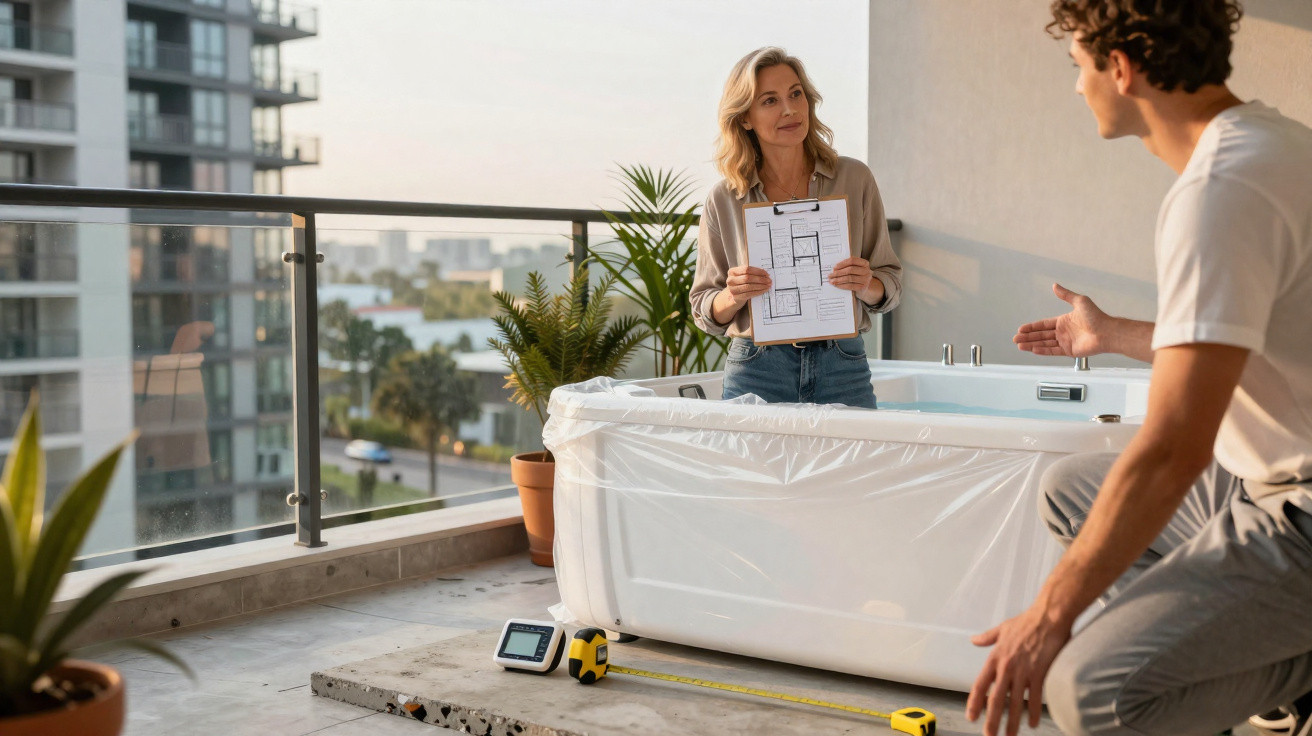
Marie, 57, noticed something was wrong almost as soon as the delivery team had gone. As her brand-new jacuzzi - something she had wanted for years - began to fill, it made a low, unsettling creaking sound. The patio slab appeared to shudder, rather like an old knee on a cold morning. She dismissed it with a laugh, switched on the jets and poured herself a glass of wine. Within two weeks, however, a fine crack had spread across the tiles, while a faint damp odour began drifting up into the living room beneath.
The repair estimate came to: £2,300.
One small choice during installation had effectively consumed her holiday fund.
The jacuzzi dream that becomes a £2,000 headache
There is a particular pleasure in being over 50 and thinking, “Now it’s my turn.” For plenty of people, that pleasure takes the form of a warm, bubbling jacuzzi at home - rather than sore knees in the bathroom or a lengthy journey to the spa.
You imagine relaxed evenings beneath the stars, longtime friends laughing and your shoulders finally loosening. What you do not imagine is paying for structural engineers, plumbers and tile repair specialists. But one poorly judged installation detail can set precisely that sequence in motion.
Consider Jean and Laura, both 62, who had a jacuzzi fitted on their timber deck last spring. When they asked the salesperson whether the weight would be an issue, he said “no problem”. They took him at his word.
At first, it was wonderful. Their grandchildren splashed in the warm water, and Sunday mornings were spent soaking rather than scrolling. Then Laura spotted that the deck was beginning to tilt slightly towards one corner. The boards had started to distort, and moisture had penetrated the supporting joists.
When a professional eventually inspected it, the whole structure required reinforcement and several sections had to be replaced. Including materials and labour, the cost exceeded £2,000 with alarming ease.
This is not an unusual situation. A medium-sized jacuzzi, once full of water and bathers, can weigh more than two tonnes. It is comparable to leaving a large SUV parked on your patio every day, year after year.
Where a slab, deck or floor has not been designed for that load, it will gradually shift and deform. Small openings can develop in the pipework, allowing water to escape where it cannot be seen. Next come stains on the ceiling below, the smell of mould, and the hidden deterioration of timber and insulation.
By the time you can see the damage, a modest treat has become a major renovation job.
The one check that saves thousands: where and how you install a jacuzzi
The best protection comes before the jacuzzi is even delivered: assessing the supporting surface. This means more than looking at a patio and deciding that it seems sturdy. It requires a proper assessment.
Begin with the essentials. Request the jacuzzi’s fully loaded weight: the empty shell, the water and the people using it. Next, compare that figure with the permitted load for your deck, balcony or concrete slab. That capacity figure exists, even if no one has brought it to your attention.
If you are over 50 and carrying out renovations anyway, it is an ideal time to speak with a structural engineer or qualified contractor. Ask directly: “Can this surface carry two tonnes every weekend?”
Many homeowners overlook this because it feels overly technical or excessive for what appears to be an oversized bath. We have all had the thought: “I’m not building a skyscraper, I just want bubbles.”
However, the costliest jacuzzi failures nearly always start with a surface that is marginally too weak, a gradient that is slightly too steep, or joists that are a little too small. The danger is invisible until the water exposes it.
Let’s be frank: hardly anyone studies every technical page of an installation manual. This is why a short inspection by a specialist, costing £150–£300, can often prevent bills running into thousands later on.
The next crucial issue is where water goes when things do not go as planned. That involves drainage, access and preparation for leaks. A jacuzzi requires a completely level, firm base, along with a clear route for surplus water to drain well away from foundations and internal walls.
Without this, water can collect beneath the tub, corrosion can begin on the frame, and the insulation can become saturated like a sponge. As the months pass, the motor has to work harder and electricity costs rise without much notice. Eventually, the pump fails and the technician removes the side panel.
What is found behind the shell will usually determine whether the bill is £200 or £2,000.
Protecting your back, budget and future evenings
For people over 50, a correctly installed jacuzzi is more than a luxury item. It can genuinely support joints, sleep and stress relief. Its installation deserves the same careful approach as planning a kitchen: take it slowly, work through it step by step and have a pencil to hand.
Start by making an honest list: where the tub will go, who will use it and how regularly. Consider access for your future self, rather than only what suits your present energy levels. Will you be able to reach it safely with wet feet? Is there a handrail close by? Are the steps broad and secure, rather than merely attractive in photographs?
Then consider the elements you cannot see: weight, electrical supply and water routes. Those details are what shield you from four-figure repair costs.
Many buyers over 50 place too much faith in the sales pitch and too little in their own comfort and common sense. One familiar error is positioning the jacuzzi directly against a wall “to save space”, leaving almost no room to service it. If the pump breaks down, the technician may need to take apart half the installation simply to reach it. Labour costs alone can then double.
Another common disappointment is placing the jacuzzi at the far end of the garden “for the view”. During summer, it is delightful. On a dark November night, with cold wind and wet, slippery grass, it can suddenly seem a very long way away. Enjoy today’s excitement, but pay attention to what tomorrow’s body may need.
Your future knees will quietly thank you.
There is an emotional aspect too. When something goes wrong, many people feel embarrassed, as though wanting comfort made them “reckless”. That embarrassment can delay the call to a professional, allowing the problem to worsen.
“Most of the expensive repairs I see could have been avoided with one visit before installation,” says Marc, a spa technician with 15 years of experience. “People think I’m here to fix pumps. I’m actually here to fix decisions that were made too fast.”
- Check the load capacity of your deck, slab or balcony before purchasing.
- Arrange a level, reinforced base with effective drainage directed away from the house.
- Leave at least one complete side free for servicing and repairs.
- Have electrical connections protected by a qualified electrician using a dedicated circuit.
- Allow an additional 10–15% of the jacuzzi’s purchase price for safe installation.
A jacuzzi that ages well with you, not against you
Once it has been installed safely, the jacuzzi can become what it was always intended to be: somewhere to settle. After a demanding day, a family lunch or the sort of news that makes your chest tighten, it offers a small, warm place in which your body can relax.
The gap between a tranquil soak and a £2,000 repair often lies in the conversations held before the tub is delivered. It means speaking to the appropriate people, asking the “boring” questions and accepting that this is not simply a piece of furniture: it is weight, water and electricity combined.
The encouraging part is that these safeguards do not spoil the dream; they make it better. When everything is secure and properly planned, you no longer listen out for worrying sounds or fret about the floor underneath. You simply climb into the water, feel the warmth spread and let your shoulders fall.
At that point, the jacuzzi is not a gadget. It is a quiet agreement between who you are today and the decades still ahead.
| Key point | Detail | Value for the reader |
|---|---|---|
| Structural check | Confirm load capacity and that the base is level before installation | Lowers the risk of cracks, sagging decks and expensive repairs |
| Access and drainage | Allow room for maintenance and direct water away from the house | Reduces moisture damage, mould and inflated labour costs |
| Realistic planning after 50 | Consider comfort, safety and future mobility | Helps ensure the jacuzzi remains practical and enjoyable for years |
FAQ:
- Question 1 Can I install a jacuzzi on an existing timber deck after 50?
- Question 2 What is the average cost of a safe jacuzzi installation?
- Question 3 Do I genuinely need a structural engineer, or is a contractor sufficient?
- Question 4 What are the earliest signs that my jacuzzi has been installed badly?
- Question 5 How far from the house should I position my jacuzzi for comfort and safety?








Comments
No comments yet. Be the first to comment!
Leave a Comment