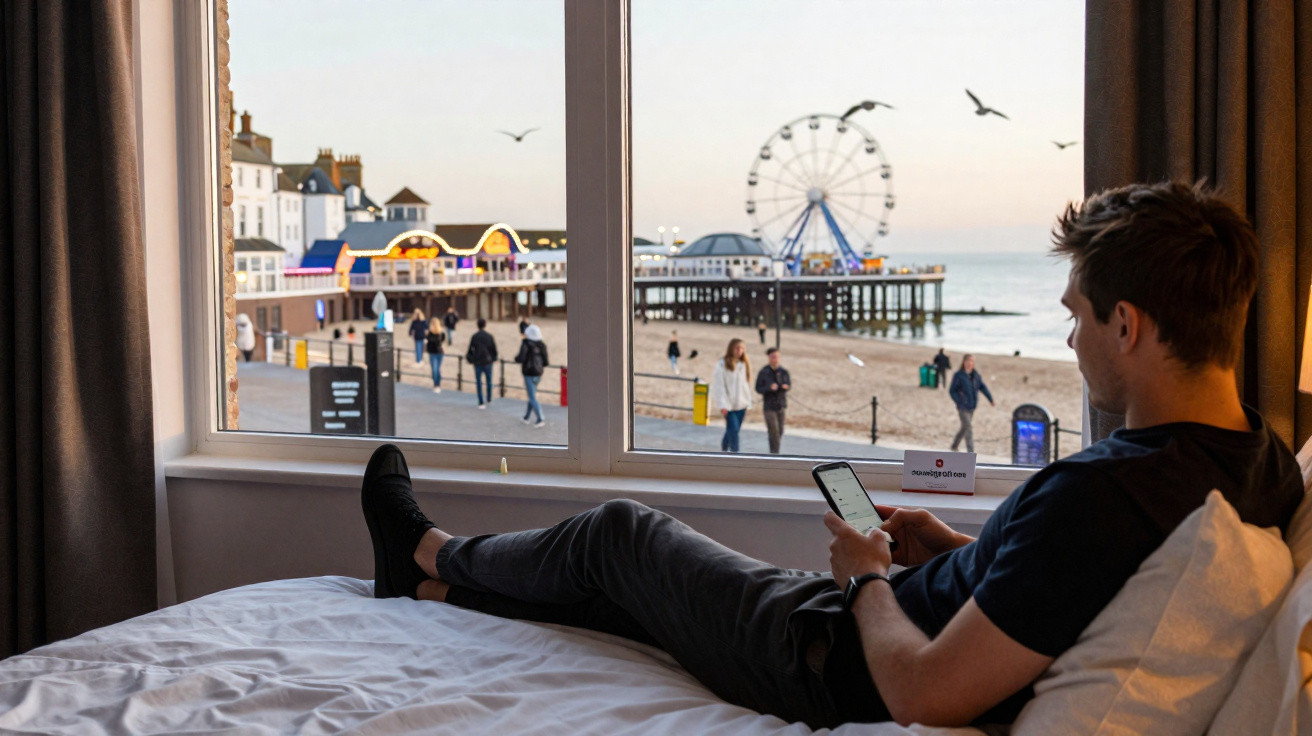
Piers shine long after dark, arcade lights flicker, karaoke drifts on the breeze, and revellers pass Victorian fronts with portable speakers in tow. Hotel managers once promoted a “sea view”; today, they promote silence. Coastal window glazing has become a quiet competitive battleground, set against gulls, fairground rides and bass that slips through glass like a rumour. Guests now ask a newly practical question at check-in: how quiet is the room? The unseen answer is counted in decibels rather than stars.
The evening I understood quite how much the seaside had changed, I was nowhere near the sand. I stood with my ear against a sash window in a Broadstairs guesthouse, listening to the sounds below. A busker on the pier was looping Ed Sheeran, the tide struck the harbour wall, and a delivery lorry came to a hissing stop by 5 a.m. The receptionist handed over my key with a gentle apology: “We’ve had the new glazing put in - you’ll hear the difference.” I did, although I only discovered the key number later.
The new soundtrack of the British seaside
Today’s pier bears little resemblance to an Edwardian promenade. It is a miniature city of loudspeakers, compressors, extraction systems and impossible-to-ignore arcade jingles. Every source creates another layer in the soundscape, and that combined noise reaches hotel rooms sooner than most people expect. Hoteliers discuss summer weekends much as marathon runners discuss hydration: in terms of pace, stamina and recovery. Silence sells beds.
At Brighton, taxis wait with their engines running by the Palace Pier until late; in Blackpool, rollercoaster wheels make a strangely maritime sound; at Southend, wind makes the pier resonate like an enormous reed. One night manager recalled a family arriving after sunset, enchanted by the fairy lights, before appearing at reception at midnight carrying their pillows. The hotel relocated them to a rear room with secondary glazing. Their smiles returned at breakfast. It is not scientific research, admittedly, but it is a recurring pattern.
For hotel owners, the calculation is straightforward. The tide cannot be told to quieten, nor can the neighbouring bar be asked to silence its chorus at ten. The building itself can, however, be treated. Contemporary glazing offers thermal performance alongside acoustic control, allowing the investment to sit within both energy budgets and guest-comfort plans. Hospitality rarely gets three benefits at once, but this comes close. Hoteliers now discuss Rw ratings as car enthusiasts discuss torque.
What decibels should you target near a pier?
The essential figure is this: seek approximately 30 dB(A) in a bedroom overnight, measured as LAeq across eight hours, with LAmax peaks below 45 dB(A). During the day, 35 dB(A) is suitably peaceful for reading or working. This aligns with BS 8233 guidance for restful rooms and with what your ears anticipate in the early hours. If a hotel can maintain 30 dB(A) indoors while the pier is in full swing, you will sleep.
Double glazing controls heat, but sound can still travel through frames and gaps. Laminated acoustic glass and effective seals are more important than simply fitting another pane. Secondary glazing - an unobtrusive separate internal window with a substantial air gap - is the coastal standout, frequently achieving Rw 40 dB or more. Ask what is fitted to the street-facing side and what sits on the room side. Before turning in, take a reading using a phone app; at 1 a.m., you should be aiming for numbers from the high 20s to the low 30s.
Everyone knows the experience: the music fades, the room settles, then one laugh from outside seems to be beside the bed. That is the “peak” your brain retains. Avoid accepting a room above the bar or immediately over the entrance canopy, where conversations collect. Request a higher floor and a room set perpendicular to the pier. If the hotel refers to “acoustic laminate” or “secondary glazing with 100–150 mm gap”, you are in good hands.
Keep the approach straightforward and precise. An effective window is a complete system: glazing, frame, seals, vents and installation. A mediocre system lets sound in through the smallest openings. The smallest draught can undo the most expensive pane.
“We design for 30 dB(A) at the pillow,” says Hannah Lewis, an acoustics engineer who’s worked on three South Coast hotels. “Guests don’t review Rw values - they review sleep.”
- Overnight room target: 30 dB(A) LAeq, with peaks below 45 dB(A).
- Request laminated acoustic glass or secondary glazing with a broad air gap.
- Choose rooms that do not directly face the pier; corner and rear rooms are generally calmer.
- Look for acoustic trickle vents and sound perimeter seals.
- Briefly use a phone sound meter; if it records 40 dB at 1 a.m., ask to change rooms.
What hotels are installing - and how to make the most of it
From the pavement, the retrofit trend appears deceptively uncomplicated. Indoors, it is a matter of millimetres. Many hotels choose 10.8 mm acoustic laminate for the external layer before adding a slim secondary unit with a 100–150 mm cavity. That generous space is crucial: the air behaves like a spring and separates sound energy. When it is done properly, the door clicks shut and the outside world softens, rather like entering a recording studio designed for ordinary people.
Frames have their own part to play. Timber can look magnificent, but it requires a compression seal that genuinely compresses; uPVC works perfectly well when the installer attends to the final two per cent. Trickle vents may be the problem or the solution - acoustic models reduce road noise without depriving the room of fresh air. Let’s be honest: no one really does that every day. You are not living in a laboratory; you are sleeping in a room. The aim is to make the science invisible.
Naturally, hotels also discuss the expense. A standard seaside room may require £1,000–£2,500 of acoustic improvements, covering glass, vents and installation. Owners say the return comes through fewer refunds, longer bookings and reviews glowing about one decidedly unglamorous quality: quiet. Your ears decide your stay.
One understated figure underpins the whole issue. A reduction of 10 dB is broadly perceived as halving the loudness. If a street party measures 60 dB outside the window, an effective glazing system delivering 30 dB indoors does more than take the edge off; it changes the entire night. You wake thinking about the sea rather than the speakers.
The best hotels address more than their windows. They treat the whole stack: soft-close corridor doors, padded architraves, quiet ice machines and rugs on timber landings. This is not luxury for its own sake; it is acoustic discipline. Some properties are even introducing in-room white-noise options, a soft wash of sound to cover the occasional intrusion - an isolated shout, the bottle bin at dawn or an opinionated gull.
Guests also have a role. When booking near a pier during high season, send two questions by email: what is the window specification in sea-facing rooms, and what is the usual night-time dB level at the pillow? Two replies will reveal more than twenty sunset photographs. If the response is considered and specific, you have probably found a good one.
The seaside is not becoming silent. It is becoming smarter. Hotels are not trying to defeat the fun; they are putting it in a frame. A well-designed window lets in the shimmer while keeping out the din, acting like a camera lens for sound. You can still hear the gentle wash of a late tide when you choose to. You will not hear the 1 a.m. chorus unless you open the sash and welcome it inside.
Select your decibels and you select your night. That is the new reality on Britain’s coast. Piers can glitter and sing while your room remains a small refuge of calm. The finest hotels have decided both experiences belong to the same holiday - and are building that balance directly into the frame.
| Key point | Detail | Why it matters to the reader |
|---|---|---|
| Night-time decibel target | 30 dB(A) LAeq, peaks below 45 dB(A) | A clear benchmark for sleeping close to a pier |
| Best glazing choice | Laminated acoustic glass + secondary glazing, wide air gap | A practical solution that works against waterfront noise |
| Room position | Higher floor, not facing the pier, with well-fitted doors and seals | A simple choice that reduces perceived noise without building work |














Comments
No comments yet. Be the first to comment!
Leave a Comment