The pasta is boiling over, the chicken is perilously close to burning, and you are opening a third drawer in succession while trying to recall where the garlic press is kept.
The timer is blaring, your child wants a snack, and a chopping board is perched across the sink like a bridge ready to give way. You are not an incapable cook; your kitchen is simply making the job harder.
I once watched a friend prepare dinner in a kitchen no larger than a shoebox, and the experience was surprisingly calm. There was nothing luxurious about it: no vast island or walk-in larder. Yet each movement was efficient, almost rehearsed. The knife was here, the bin was there, the pan was already heating and the plates were ready. Dinner reached the table as though the whole thing had been practised.
The weekday pressure was the same, as was the chaos, but the result was entirely different. That difference began well before she switched on the hob.
The real issue is not your cooking ability but your kitchen map
Most domestic kitchens evolve like junk drawers. You put an odd spatula in the first available space one day, and ten meals later that drawer has become “the spatula drawer”. There is no system or reasoning behind it, only repetition. Eventually, you end up with an odd map that bears no relation to the way you actually cook.
That is why making one omelette can mean walking across the kitchen three times. The eggs are in the fridge, the pan is beneath the oven, and the salt is hidden behind baking tins you almost never use. From across the room, everything may appear fine, but using the space creates constant friction. Night after night, the kitchen quietly takes your time and patience.
There is a reason restaurant kitchens can seem almost military in their organisation. It is not simply that chefs are fussy. The layout determines whether service runs like a dance or a car crash. At home, you do not need stainless-steel worktops or heat lamps; you need a kitchen layout that suits the way you move when the clock reaches 7 p.m.
Picture tracing every step you take while preparing dinner as a line on the floor. For many people, it would resemble a toddler’s scribble, full of loops, zigzags and stray circles. That is a clue that something is wrong. When your equipment, ingredients and work surfaces are not arranged around the jobs they support, the cost is extra movement and stress.
Professionals researching “kitchen workflows” generally identify three main zones: preparation, cooking and cleaning. In many homes, those areas overlap or are spread far apart. That is where the disorder begins. The encouraging part is that you do not need a complete renovation to straighten out the scribble. A few modest changes to where items are stored can turn that route into something quieter and almost dull. When you are hungry, dull is useful.
Rework your work triangle with what you already own
Begin with the familiar “work triangle”: the fridge, sink and hob. Designers favour this principle because these three points cover most dinner-time activity. You collect ingredients, wash and chop them, then cook. When those points are far apart or obstructed by clutter, a normal evening becomes a small obstacle course.
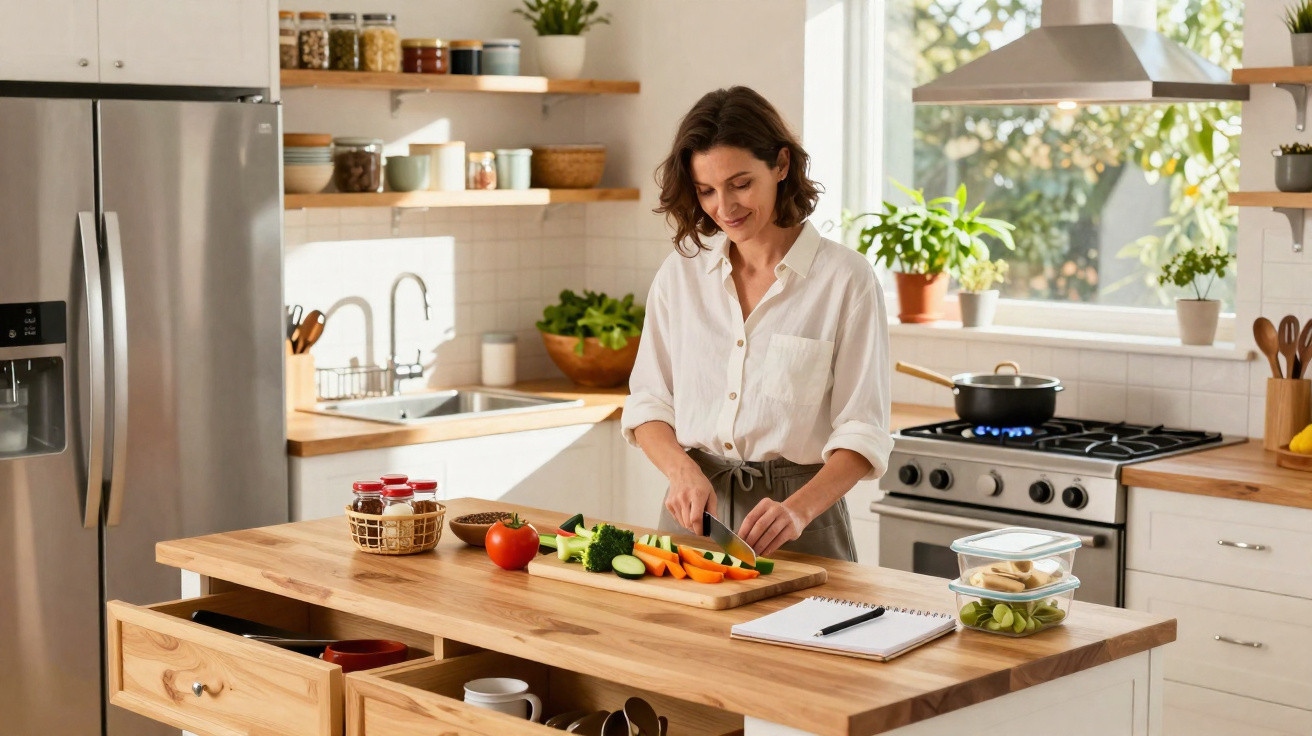
You will rarely be able to relocate the fridge or hob without bringing in a contractor. What you can change is the area around them. Set up a compact preparation zone by the sink, with a chopping board, knife block and bin or food-waste caddy close enough to use without taking a step. Beside the hob, create a small “grab zone” for oil, salt, pepper, a spatula, wooden spoon and folded tea towel. A little clear landing space near the fridge for shopping and leftovers also stops the constant juggling.
A woman I spoke with, Anna, insisted that she disliked cooking. She called her kitchen a battlefield. Her pans were stored in an awkward corner cupboard, the knives sat in a block on the other side of the room, and the chopping board stood behind the microwave. Every meal involved a succession of little searches.
One Sunday, tired of hearing herself complain, she tipped out three cupboards onto the floor. She then wrote down her dinner routine: take vegetables from the fridge, wash them, chop them, put them in the pan, stir, serve, wash up. She relocated the knives and boards beside the sink, the pans and spatulas beside the hob, and the plates to a cupboard directly above the dishwasher. It was the same kitchen, with no new gadgets. A week later, she sent me a message: “Dinner took 20 minutes less, and I didn’t shout once.” That was the effect of layout, not talent.
The principle is straightforward: store tools where they are used, rather than wherever there happens to be room. It sounds so obvious that it barely seems worth saying. Let us be honest: hardly anyone really does this every day. We put objects wherever they fit, then criticise ourselves for being “messy” when cooking feels disjointed.
Rebuilding your work triangle is really about reducing “decision moments”. Rather than wondering, “Where did I put the colander?”, your hand simply reaches for it. Cognitive scientists describe this as creating “affordances”: the room subtly indicates the next action without requiring thought. This is why experienced cooks can appear composed under pressure. Their kitchen suggests the next step. The aim is not perfection, but fewer tiny obstacles between you and a meal.
Small, almost effortless habits that change the 7 p.m. rush
A kitchen layout involves more than cupboards and drawers. It also depends on the small routines that either work with the room or against it. One of the easiest changes is a “landing strip”, as many cooks call it. Pick one uncluttered spot near the hob through which everything passes before going into the pan: chopped vegetables, seasonings, marinades and the tasting spoon.
Rather than chopping at one end of the kitchen then carrying an overloaded board across a wet floor, you turn, set it down and cook. There is less mess and less danger. Add a “mini clean station” as well, with a sponge, cloth and small bin within reach. Cleaning as you go is much less irritating when you do not have to cross the room with wet hands. These low-effort arrangements make helpful habits feel almost automatic.
We have all seen online videos of people preparing 15 flawlessly labelled containers on a Sunday. It is impressive, certainly, but also slightly unrealistic. After a long Wednesday, your mind is tired. You are not going to transfer spices into matching jars or arrange your food-storage containers by size.
Your layout therefore needs to allow for real life. Keep your tallest and most frequently used items at the front, even if the result is not perfectly coordinated. Put children’s cups in the lowest cupboard so they can help themselves, rather than making you zigzag around the kitchen while stirring. Store the heavy cast-iron pan somewhere it can be lifted out one-handed, not in a low space beneath the oven that requires crouching. A system designed for your tired, everyday self will last longer than three days.
One designer I spoke to put it like this:
“A good kitchen layout doesn’t make you behave better. It quietly adapts to how you already live, then nudges you one step calmer.”
Consider the places that make you sigh most often: the drawer that refuses to close, the worktop corner that turns into a graveyard for post, or the spice cupboard where jars vanish. Address only one of these pressure points at a time, treating it as the centre of a small ecosystem rather than a place to stash random objects.
- Bring anything used weekly within arm’s reach of the place where you use it.
- Move rarely used items, such as a turkey baster or fondue set, to high or awkward-to-reach storage.
- Give every pressure point a clear purpose: a post tray here, a coffee zone there, and one dedicated snack basket.
You are not trying to create a Pinterest kitchen. You are giving yourself five peaceful minutes each evening, when everything you need seems to be there precisely as you reach for it.
A calmer kitchen may be only a few evenings away
Once you view your kitchen as a living map rather than an unchanging room, you cannot easily stop noticing its flaws. In the middle of cooking, you may find yourself reaching across the room for olive oil and thinking, “Why doesn’t it just live here?” Those small questions are where meaningful change starts.
In practical terms, minor layout changes affect the rest of your evening. Fewer back-and-forth journeys mean fewer dropped spoons, less shouting, and meals served hotter and on time. The emotional change is more subtle. Cooking no longer feels like another task at which you are failing, and becomes something more neutral, or even pleasant at times. On a good evening, it can feel rather like self-care.
We have all had evenings when everything runs late, the sink is overflowing and we end up eating over the bin, exhausted. Rearranging your kitchen will not remove difficult days, but it can soften them. You create a room that supports you a little, allows for shortcuts and works with your habits rather than rebuking them.
Perhaps you will not overhaul the whole room at once. Maybe tonight you only move the knives or clear a landing strip beside the hob. Tomorrow, you may notice that dinner tastes exactly the same, yet getting there felt different: less frantic and a little more your own. From that point, the map of your kitchen, and your evenings, begins to reshape itself.
| Key point | Detail | Benefit for the reader |
|---|---|---|
| Rethink the “work triangle” | Arrange zones around the fridge, sink and hob, with suitable tools close at hand | Fewer unnecessary journeys and a smoother preparation process |
| Create “landing strips” | Establish a space through which all ingredients pass before cooking | Reduces clutter and the risk of spills or burns |
| Adapt the kitchen to your real routines | Position items according to how often they are used and the realities of daily fatigue | Makes the kitchen an ally, even on busy evenings |





Comments
No comments yet. Be the first to comment!
Leave a Comment