Winter living has undergone a quiet transformation.
With energy bills climbing and wood-burning stoves enjoying renewed popularity, the way homes are heated has changed considerably.
Throughout Europe and North America, pellet stoves are shifting from a niche rural choice to a widely adopted solution. They can reduce heating expenditure, use renewable fuel and suit compact properties. One everyday inconvenience persists, however: the cumbersome 15 kg pellet bags that end up piled in a corner like a small warehouse.
The hidden problem with pellet bags
Anyone heating with pellets will recognise the process. Heavy bags must be carried from a garage or cellar, torn open, inevitably spilling a few pellets, before the remaining fuel is forced into an inadequate space beside the stove. As the season progresses, the arrangement becomes increasingly untidy and impractical.
Loose pellet bags clutter living spaces, create dust, and turn a cosy corner into a storage zone that feels temporary all winter.
Storage may appear to be a small consideration, but it influences the day-to-day experience of pellet heating. If fuel is difficult to manage or looks disorderly, some owners use their stove less often or revert to less sustainable heating choices.
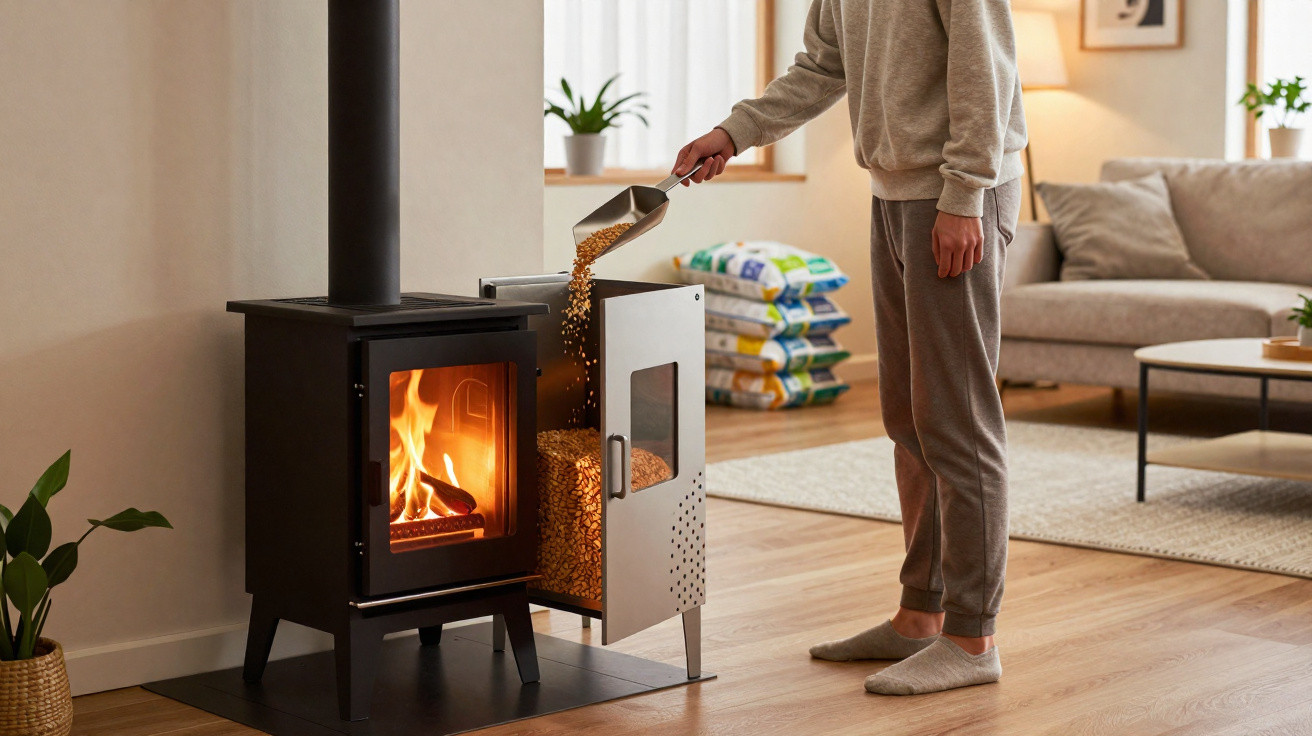
This is where a newer generation of purpose-built pellet storage units comes in, converting a wholly functional requirement into an interior feature. Among the best-known examples is the Granulebox, a steel cabinet designed to replace stacked bags with one streamlined piece of furniture.
A pellet storage unit styled as furniture rather than a bin
Rather than using a plastic tub or an ordinary metal container, this type of storage takes its cues from interior design. The Granulebox, for example, is made from sturdy steel with a powder-coated finish, creating a smooth matt appearance that is highly resistant to scratching.
Its front is more than a plain panel. Laser-cut motifs transform what might otherwise be an uninspiring block into something resembling a decorative side cabinet. The perforations create shifting light and shadow while reducing the apparent visual bulk of the unit beside the stove.
By treating pellet storage like a visible piece of furniture, manufacturers aim to move it from “thing you hide” to “object you keep proudly in the living room”.
A tempered-glass viewing panel, positioned at the front or side, provides an additional practical benefit. It lets you check the remaining pellet level at a glance, without opening the cabinet or judging by its weight. This becomes particularly useful on a cold late evening, when discovering an empty stove is the last thing anyone wants.
Smart capacity for everyday use
Most pellet-stove households purchase fuel in 15 kg bags. A typical design-focused storage cabinet is intended to contain the equivalent of three or four bags, and the Granulebox holds up to approximately 55 kg, or more than three full bags.
For a moderately sized home in normal winter conditions, this can provide several days of fuel autonomy, according to insulation levels and stove output. Rather than fetching another bag each evening, owners can replenish the cabinet at once and leave it for several days.
| Feature | Traditional bags | Design storage box |
|---|---|---|
| Capacity near stove | 1 open bag, sometimes 2 | Up to 55 kg (3+ bags) |
| Handling | Frequent lifting, tearing bags | Refill occasionally, scoop daily |
| Visual impact | Stack of plastic bags | Furniture-style cabinet |
| Dust control | Poor, pellets and dust on floor | Contained, filtered at the base |
Its footprint is also significant in smaller urban properties. Measuring roughly 69 x 37 x 37 cm, the Granulebox is intended to fit beside a stove, between furniture or against a wall without obstructing movement through the room. For many households, this means pellet bags no longer need to be kept in the hallway.
Small details that improve daily life
A scoop designed to work properly
Many people initially fill their stove directly from the bag. This approach is awkward, heavy and untidy. The Granulebox includes a scoop with crisp, origami-inspired folds, whose angled form channels pellets and makes the flow easier to control.
The scoop serves as a simple filter too, allowing fine dust to drop away while the pellets are transferred into the stove hopper. This can limit ash and deposits, helping to maintain cleaner combustion and a more consistent flame.
Integrated dust management
Pellets release fine particles while being transported. In open bags, this dust settles on the floor and can eventually enter the air. Some storage units now incorporate a filter in the base.
Separating pellet dust before it reaches the stove can improve burn quality, reduce maintenance, and keep the air around the appliance cleaner.
The Granulebox has a bottom-filter system intended to collect these fines. Users report less residue within the stove and fewer micro-particles being disturbed when the unit is refilled.
Castors for adaptable positioning
Another practical feature is found beneath the cabinet. An optional set of four castors turns it into a moveable item. Owners can then vacuum behind it, reposition it when changing the room layout or pull it a little nearer the stove for easier access during cold spells.
- Move the box to clean behind and below the stove area.
- Adjust position as furniture changes across seasons.
- Bring it closer to the stove for refilling, then roll it back.
Locally made and built for years of use
The Granulebox is produced in France by small industrial workshops that generally specialise in steelwork and precision cutting. For European buyers who place value on shorter supply chains and local employment, this provenance is meaningful.
Beyond its country-of-origin label, steel and durable coatings address a practical reality: pellet storage is frequently handled. It is knocked by fuel bags, tools and vacuum cleaners. Lightweight plastic containers can crack, distort or become stained after several winters, whereas a rigid metal construction withstands repeated use much more effectively.
Durable storage reduces the churn of cheap products that fail after a couple of seasons, which lowers both waste and long-term cost.
Custom finishes for different interiors
Pellet stoves are no longer found solely in rustic chalets. They are now used to heat city flats, refurbished townhouses and newly built homes, prompting manufacturers to develop a wider visual range.
The Granulebox is available in various colours and patterns, allowing owners to coordinate it with their interior. Deep, restrained shades suit industrial lofts, while paler finishes complement Scandinavian-inspired rooms. More decorative motifs can suit traditional or country-style living spaces.
This ability to customise changes the object’s status. Instead of merely being accepted because it is useful, it can become part of the décor, much like a sideboard or compact console positioned alongside the stove.
Pellet storage and energy performance
Correct pellet storage affects combustion as well as convenience and appearance. Bags left in damp garages or directly on cold concrete can take on moisture, reducing combustion performance. Damp pellets are more likely to crackle, create extra smoke and leave heavier deposits in the appliance.
Keeping pellets indoors in a dedicated cabinet maintains them at room temperature and protects them from damp. This helps preserve their calorific value and supports a steadier flame. Across an entire heating season, maintaining better fuel quality can reduce consumption by a noticeable amount, especially in colder areas.
Storing pellets dry, close to the stove, increases usable heat per kilogram and reduces the risk of ignition problems or flameouts.
The dust filter contributes as well. Fewer fine particles help keep the stove’s air pathways cleaner, enabling it to retain the manufacturer’s quoted efficiency levels for longer between servicing.
An ecological benefit beyond the pellets
Pellet heating already attracts households looking for an alternative to fossil fuels. However, the accessories used with it can reinforce or undermine that aim. Inexpensive plastic bins that quickly split often end up in landfill, and they seldom retain a good appearance in the hot, dry area surrounding a stove.
By using metal, hard-wearing coatings and replaceable accessories, durable storage cabinets reflect the same principle as the stove: buy once and use it for many years. From a lifecycle viewpoint, a cabinet lasting for a decade has a lower environmental footprint than several short-lived containers.
How much space and capacity are actually needed?
Before purchasing a pellet storage box, households can make a quick assessment of their requirements. A typical modern stove in a well-insulated 80 m² home may use between 1 and 1.5 tonnes of pellets annually. During the coldest winter weeks, this may amount to one 15 kg bag every 1–2 days.
With a 55 kg box, a family using its stove each day can generally manage three to five days between refills from the main pellet store. During milder weather, this period may extend to a whole week. In larger homes, two boxes in separate rooms can serve multiple stoves or a hybrid arrangement alongside central heating.
Those in small flats with restricted storage could keep most of their pellet supply in a locked outdoor container or shared cellar, while using an indoor Granulebox as a daily reserve. This keeps the living area tidy while ensuring fuel remains easy to access.
Practical advice for safer, cleaner pellet handling
A dedicated storage unit also provides an opportunity to improve a few pellet-handling habits. Keeping a small brush and dustpan beside the cabinet encourages quick cleaning before dust spreads. Leaving the scoop in the same place at all times makes it less tempting to pour pellets straight from the bag.
For households with children, a closed metal cabinet can feel safer than a pile of open bags. Its stable form and weight make it more difficult to overturn, while its door or lid can be kept out of the reach of very young children. Pet owners also benefit from protecting curious cats and dogs from loose pellets scattered across the floor.
In the wider heating landscape, small design developments such as these rarely attract attention. Nevertheless, they subtly influence how people live with their energy decisions every day. When the routine is easier and the living room remains pleasant to look at, pellet heating has a stronger chance of becoming an enduring low-carbon habit instead of a short-lived experiment.






Comments
No comments yet. Be the first to comment!
Leave a Comment