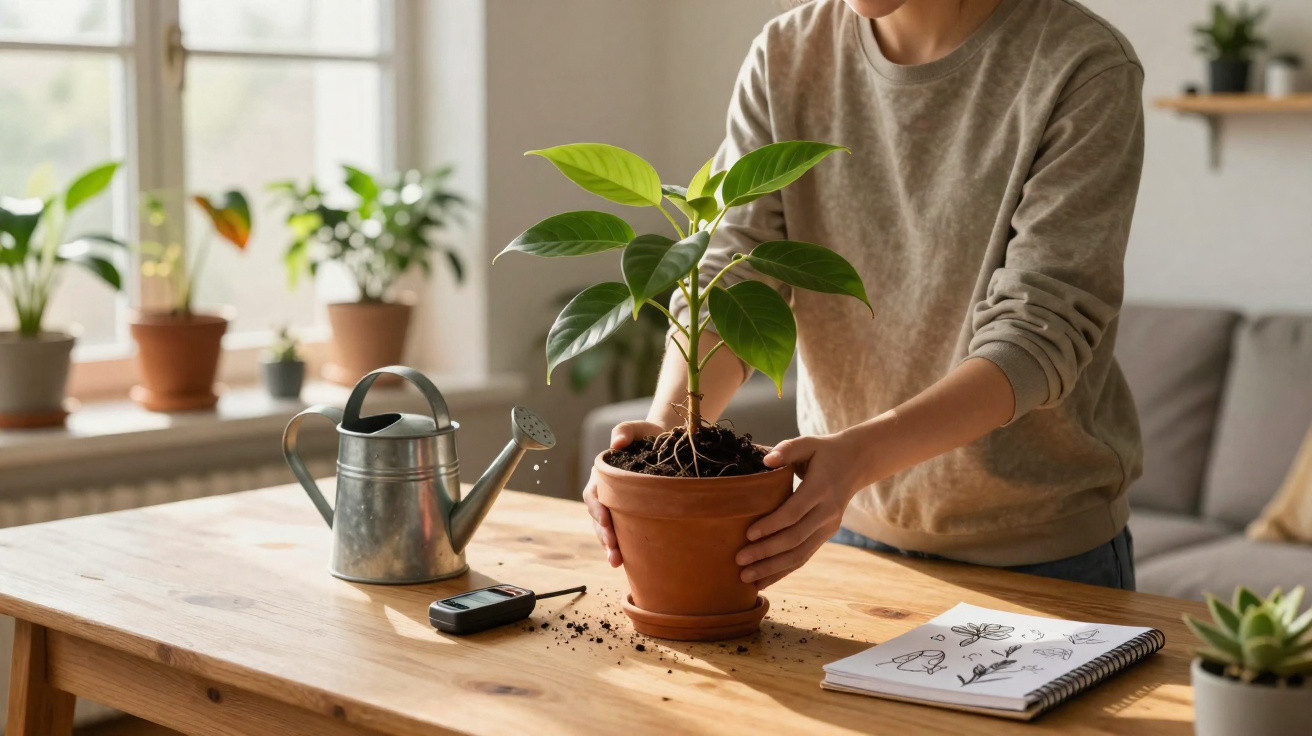
Glossy leaves, an upright arch and nothing to cause concern. By Friday, though, the tips had turned crisp and brown, while the whole plant drooped like soggy confetti.
Its owner insisted she had done everything “by the book”. She watered on the same day, used the same measuring cup and kept it in the same cosy corner. She had even watched three tutorials and followed a plant-care app that sent reminders like an anxious friend.
Yet the plant was plainly issuing an SOS. Quietly. Constantly. Until there was no time left.
Speak to enough people and the same line keeps coming up: “But I watered it right.” The issue is often somewhere else in the pot, below the surface and out of sight beneath the attractive ceramic container and Instagram-friendly styling.
Why some houseplants die is less about the watering can itself than about everything surrounding it. That is where it becomes interesting.
Why “correct watering” still kills plants
In a bright London flat, a fiddle-leaf fig stands like a miserable Christmas tree in June. Its watering schedule has stayed unchanged since it came home. Its once-proud owner is now searching “why is my plant suddenly dropping leaves” at midnight, with a growing sense of dread.
The compost is damp rather than saturated. The pot is fashionable rather than bargain-basement. But the plant is still dying. Meanwhile, a cheap pothos nearby, sitting in an unattractive plastic nursery pot, is producing masses of new growth despite receiving only a small splash whenever somebody happens to remember.
That difference reveals more about houseplants than most care guides ever do.
Plants do not survive on water alone. They depend on a combination of light, air, temperature, microbes, roots and, naturally, human habits. When someone says, “I’m watering correctly”, they usually mean that they are following a rule they read somewhere.
Actual plants do not follow rules. They respond to that particular room, that particular pot and that particular week’s weather. An amount that looks “correct” on paper may therefore be entirely wrong on your windowsill.
Usually, the problem is not a lack of care. It is care given automatically, without paying attention to what the plant is really doing each day.
The hidden killers: roots, light and human routines
A plant expert in Paris once told me about a client who arrived with a half-dead peace lily in a designer pot. The owner kept a spreadsheet for every watering: exact dates, millilitres and notes. It was the sort of meticulous record that might impress a doctor.
But once the plant was lifted from its pot, the reality was unpleasant. Its roots were black and mushy, curled around the base like overcooked noodles. There was no drainage hole. Water had collected beneath decorative pebbles, transforming the bottom of the pot into a swamp.
The owner had watered with religious discipline. For months, the plant had been quietly drowning.
Plant physiologists focus heavily on roots and oxygen, rather than moisture alone. Roots require pockets of air in the growing medium to breathe. In a dense, compacted mix or a pot without drainage, those air spaces vanish.
That means the roots can suffocate even when you are “watering correctly”. For a while, the top of the plant may appear fine; then, one day, the leaves collapse and never properly recover. The timing can feel unpredictable, but it is not. It is when the roots finally stop coping.
Light creates a similar problem. A “medium-light plant” in a dark hallway consumes much less water than the very same plant on a sunny windowsill. Water both in the same way and one will drink, while the other remains in a cold, wet sponge. The person and action are identical, but the outcome is completely different.
How to water like someone who actually watches their plants
Growers who keep whole greenhouses thriving do not work to rigid calendar schedules. They feel the soil. They lift the pots. They study leaves with a calm sort of suspicion.
The easiest approach is to push a finger into the potting mix up to the first knuckle. If it feels dry, there is a real need for water. If it is cool and a little damp, hold off. This small, almost old-fashioned habit outperforms most apps.
Some people take it further by learning a pot’s “weight”. Lift it immediately after watering thoroughly: that is your reference point. Pick it up again a few days later. When it feels surprisingly light, the roots have used what they need. Water then, rather than earlier.
In practical terms, routine rather than cruelty is what kills many plants. People like schedules: “Every Sunday I water all my plants.” On paper, that seems reasonable.
Real life is less tidy. A plant that has just experienced a cloudy week may still be wet on Sunday. It gets watered anyway because the calendar demands it. Over time, that turns into lasting stress for the roots.
On a hectic Tuesday evening, nobody carries out a full plant-inspection round unless they are especially devoted. Let’s be honest: nobody really does that every day.
That is how overwatering takes hold: not through enormous deluges, but through small, regular drinks given to plants that were not thirsty at all.
One horticulturist put it this way:
“Plants don’t need you to be perfect. They just need you to look before you pour.”
Bringing that idea into everyday life means changing how you view plant care: less autopilot, more small checks.
- Water when at least the top 2–3 cm of soil are dry, rather than when the calendar alerts you.
- Choose a pot with a drainage hole and a saucer, even if it sits inside a decorative outer pot.
- Tip out any water left in saucers after 20–30 minutes, so roots are not left sitting in a puddle.
- Keep thirstier plants, such as ferns, separate from succulents so they are not all treated alike.
- Adapt your routine in winter: lower light usually means slower water use and fewer watering days.
Learning to spot stress before it is “too late”
There is a point just before a plant declines completely when it is still quietly asking for help. Its leaves may droop late in the day but lift again overnight. Fresh growth may emerge smaller, while rich green colour fades into something pale and weary.
We often ignore these signs, putting them down to “winter blues” or deciding that “this species is just dramatic”. But these slight shifts are an early-warning system. Notice them in time and you can still put things right.
Treat your home as a collection of mini-climates. The shelf beside the radiator is warm and dry. The bathroom is humid and more forgiving. A north-facing desk is cool and dim. The same plant will use water very differently in every one of these spaces.
Once you begin to recognise those zones, your watering decisions change almost by themselves. Instead of asking, “How often should I water a monstera?”, you start asking, “How is this monstera, in this room, doing right now?”
That small mental shift can be the difference between a home full of guilty-looking, browning pots and a space that quietly appears full of life. And that is the part people end up wanting to share.
| Key point | Details | Why it matters to readers |
|---|---|---|
| Drainage is non-negotiable | Use pots with at least one drainage hole and a loose, airy mix (add perlite or bark for tropicals). Decorative pots can serve as covers, but keep the actual plant in a plastic inner pot that drains freely. | It prevents the silent root rot that kills plants even when you “follow the rules”, and stops watering mistakes from becoming permanent damage. |
| Match watering to light, not the calendar | Plants in bright windows may require water twice as often as the same species in a dim corner. Observe how quickly soil dries in each location over a couple of weeks, then tailor your rhythm to each room. | This avoids giving identical amounts to plants with completely different needs, the classic way to lose plants on one shelf while another group flourishes. |
| Read the soil, not just the leaves | Test the top 2–3 cm of mix using your finger or a wooden skewer. Pair this with the pot’s weight and water only when both indicate dryness. Wilting in wet soil signals a problem; wilting in dry soil is straightforward thirst. | It helps you distinguish overwatering from underwatering, so you stop “treating” a drowning plant with extra water and address the real issue instead. |














Comments
No comments yet. Be the first to comment!
Leave a Comment