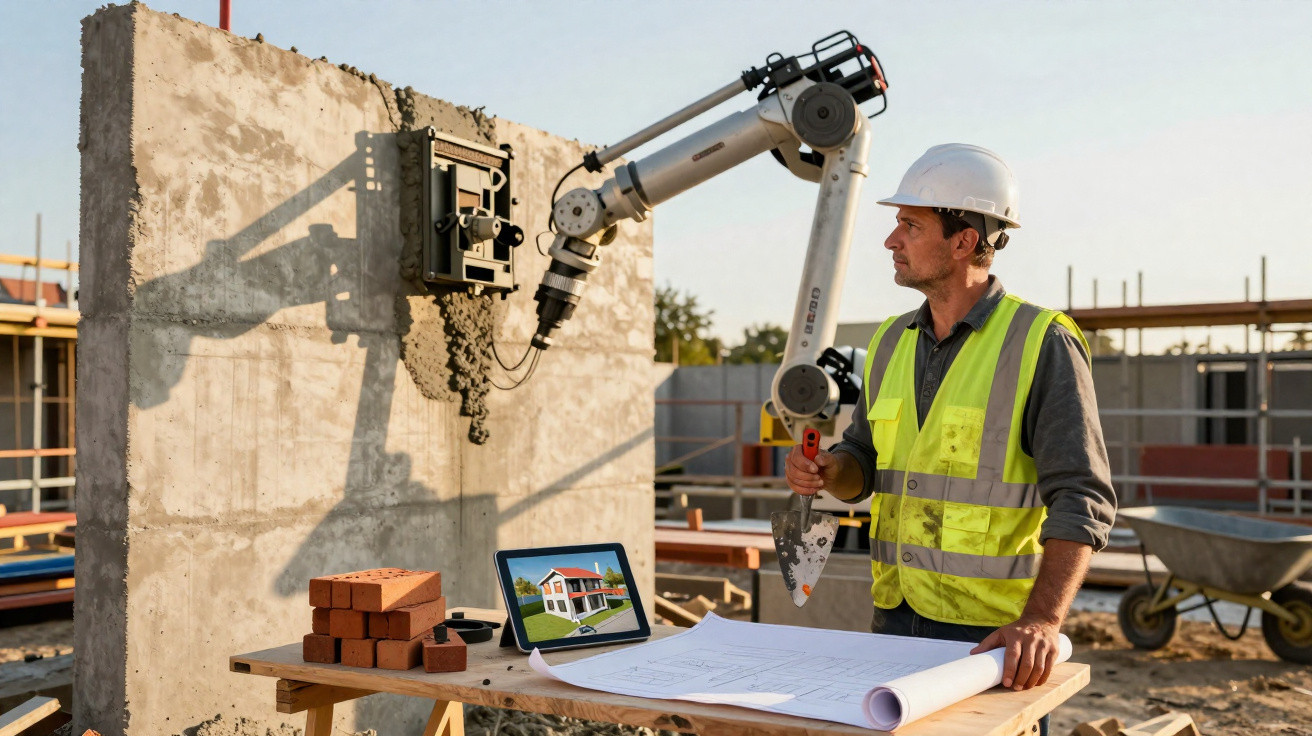
At 7:12 a.m., the first ribbon of concrete emerges from the metal nozzle, giving off a faint plume in the cool morning air. There is no shouting, hammering or radio crackling out 80s rock. Only the gentle hum of servos and the rhythmic sweep of a robotic arm mapping out the edges of a future living room.
By this time tomorrow, the bare slab will be a house. Not a drawing or a pledge, but a house: walls standing, door openings formed and plumbing conduits already positioned.
The only people on site remain at a distance, coffees in hand and high-vis vests still immaculate.
A task that once kept ten workers on scaffolding for weeks now needs two technicians and a laptop.
No one walking past even pauses to look.
When a house is printed faster than a pizza
The first time you watch a 3D-printed house emerge from the ground, it can make your mind briefly stall.
Concrete walls appear from nowhere in rounded, repeating layers, as though a giant is icing a cake at accelerated speed. The shell of a straightforward bungalow can take shape in under a day, with the machine pausing briefly as if it needs to catch its breath.
Nobody is carrying bricks up ladders. Nobody is sawing timber in the rain.
What once involved months of mud, effort and hold-ups now resembles a polished automated dance: one robot, one software file and one carefully controlled deadline.
Look at Icon in the US, for instance, or the start-ups in Germany and the Netherlands putting up demonstration homes every other week. Their time-lapse clips attract millions of views.
A flatbed arrives, unloads a gantry printer roughly the size of a small crane, and within hours the vacant rectangular plot becomes a web of curved walls and openings. At times, a single worker leans against a fence, acting more as an observer than a builder.
Companies promote figures that seem lifted from science fiction: as much as 70% less labour, building schedules reduced from months to just a few days, and waste cut down to what appears to be a few spadefuls of hardened concrete left on the ground.
For investors, the appeal is obvious. For bricklayers, carpenters and casual labourers, it can seem as though an unwanted future has arrived 20 years too soon.
The reasoning is easy enough to understand. Housing shortages are severe, skilled tradespeople are getting older, and younger people are no longer rushing to swing hammers in the heat. Robots appear to offer a tidy answer.
The equation then falls into place: fewer workers, fewer “problems”, more predictable schedules and better margins. There is no need to manage ten subcontractors if one machine can extrude walls from a digital file and never request overtime.
There is an unspoken consensus in boardrooms and town halls: if a robot can build a wall more accurately, quickly and cheaply than a person, the market will pick the robot.
Jobs do not disappear through a dramatic redundancy announcement, but through the quiet click of “export to printer”.
The quiet instructions that erase a trade
Observe the technicians at work and the change becomes uncomfortably obvious. Instead of trowels and tape measures, they hold tablets. They calibrate printers, upload software and check tolerances on screens glowing even more brightly in the morning sun.
When something blocks, they do not reach for a hammer. They reset a pump, adjust a setting and restart the print path. Physical strength matters less; code matters more.
On paper, this is called “upskilling”. On site, it means a 52-year-old mason stands by the fence wondering which button he should have pressed, and when he missed the course that decided there was no place for him in the future.
Cities enjoy announcing pilot schemes: “100 3D-printed affordable homes”, “Entire neighbourhood built by robots”. The press-release photographs are clean and optimistic. Two men in hard hats stand beside curved concrete walls resembling enormous hand-made ceramics.
No one photographs the workers who were never called to that site.
In Mexico, part of a village was rebuilt with printed homes in a fraction of the time a conventional crew would have required. In Texas, an entire community appeared while a fleet of printers worked through the night. There were fewer damaged backs and fewer accidents, but also fewer wages flowing into local economies that were already fragile.
The narrative is always presented as “tech versus the housing crisis”, rather than “tech versus the people who used to build your street”.
Let us be honest: almost nobody reads the labour-impact section of those glowing technology reports.
We are drawn in by the promise of cheaper housing, greener materials, less noise and fewer delays. Those benefits are genuine, without question. Yet the cost is gradual and spread out, which makes it easy to miss. The carpenter who once framed ten houses annually now frames six, then four, before taking side jobs repairing plasterboard in ageing blocks of flats.
Then, one day, his daughter sees a story titled “Robot builds house in 24 hours”, shares it with a heart emoji, and never links it to the man at the sink washing dust from his hands and wondering why the phone rings slightly less each month.
Progress always looks cleanest when you crop people out of the frame.
How not to get crushed under the concrete nozzle
For people working in construction, the most useful step now is not fighting robots but getting as close to them as possible. Learn the software that supplies them, the codes that direct them and the sensors that keep them on course when the wind rises.
Every new machine on a site creates two types of worker: those who stand back and watch, and those who approach and ask, “Can you show me how this thing works?” The latter group has a future.
That could involve evening CAD classes, a weekend course in automated-machinery operation, or simply agreeing to help the next time someone needs assistance setting up a printer.
It remains the same world of walls and roofs; only the shape of the tools has changed.
Naturally, that sounds straightforward from behind a keyboard. When your knees hurt and bills cannot wait, “retraining” may sound like a cruel joke. You may have spent 20 or 30 years learning how concrete responds beneath your fingers, how timber expands as humidity changes, and how a house “feels” stable before an inspector has signed it off.
Then a laptop kid tells you to learn G-code.
We have all experienced that moment when the rules quietly change and nobody sends the memo. The biggest error is acting as though it is not happening. The second is deciding that you are too old, or too “hands-on”, to learn the new elements.
Your sense of how buildings live and breathe is precisely what many people who only understand software do not possess. That is your advantage.
Those attempting to bridge this divide are still a small minority, but they are out there. Some unions, training centres and even a handful of forward-thinking construction managers are quietly advocating hybrid roles: part craft, part code.
“Robots won’t replace builders,” one site manager in Copenhagen told me. “But builders who work with robots will replace builders who don’t.”
They refer to roles such as:
- On-site print supervisors who adapt designs when the ground is not perfectly level
- Maintenance technicians with plumbing or masonry experience, rather than only IT knowledge
- Safety coordinators who understand both scaffolding hazards and servo-arm blind spots
- Retrofit specialists who combine printed extensions with older brick and timber buildings
These are not imaginary job titles. They are already appearing on job boards, hidden among the buzzwords and glossy promises.
Who gets a home, who loses a livelihood
There is a harsh contradiction within this story: the same technology that could finally make housing affordable for millions may also remove earning power from the very communities it claims to serve. A robot can print a neat row of small homes in a low-income area, providing new roofs while quietly taking away the last local construction jobs not already absorbed by large contractors.
But pretending robots do not exist will not reverse anything. The more pressing question is this: as the shift gathers pace, who gets a place at the table?
Some cities are considering ideas that feel almost radical in this setting. They include requirements for every 3D-printed housing development to fund upskilling schemes for displaced workers; co-operatives in which builders collectively own and hire out printing machines rather than being replaced by them; and public technical schools where former bricklayers teach structural fundamentals to children who assume everything is simply “an app”.
None of it is tidy or fully developed yet. Policy trails press releases, while training budgets trail investment rounds. The cranes and printers are already on site while the rules are still being drafted in some half-empty municipal meeting room.
Yet this untidy, imperfect territory is exactly where something more human than a simple “robots win, workers lose” narrative might take shape.
On your feed, a house built in 24 hours appears to be pure magic. On site, the reality is more complex: less dust, less noise and fewer men by the food van. A smoother supply chain, a rise in the share price and a quiet shrinking of the blue-collar middle.
Whether any of us care will probably depend on where we are standing when the robot arm begins to move: on the scaffolding that no longer exists, or in the shade beneath its aluminium frame, holding the tablet.
The houses will continue to arrive. The question is who is written into their walls, and who is quietly removed between the layers.
| Key point | Detail | Value for the reader |
|---|---|---|
| Robot-built houses cut labour sharply | 24-hour 3D printing replaces weeks of conventional work with a small number of technicians | Helps readers understand how rapidly their employment landscape can change |
| New hybrid skills are emerging | Jobs combining trade knowledge with software and machine operation are increasing | Provides practical directions for workers who do not want to be left behind |
| Policy and training still lag | Few programmes genuinely prepare existing workers for automation on construction sites | Encourages readers to demand support instead of simply accepting “inevitable” change |
FAQ:
Question 1 Are robot-built houses actually safe to live in?
Yes, provided they are built correctly, they comply with the same building regulations as traditional homes. Printed walls are tested for strength, fire resistance and insulation, while inspectors must still approve them before anyone moves in.Question 2 Will robots really take all construction jobs?
No, but they will change the nature of most construction work. Many routine, repetitive tasks will decline, while jobs in supervision, finishing, retrofitting and maintenance grow.Question 3 What kind of training helps if I work in construction now?
A grounding in CAD, 3D modelling and automated-machine operation is a strong starting point. Combining this with your existing understanding of structures, materials and site safety makes you much more difficult to replace.Question 4 Do robot-printed homes really reduce costs for buyers?
They can reduce structural and labour costs, particularly for uncomplicated designs. Whether buyers see those savings depends on land prices, regulations and how much developers choose to pass on.Question 5 Is there any way communities can benefit without losing jobs?
Yes, if local people are trained to operate and maintain the technology, or if projects are required to hire and upskill nearby workers. Community-owned printing co-operatives are another emerging approach.











Comments
No comments yet. Be the first to comment!
Leave a Comment