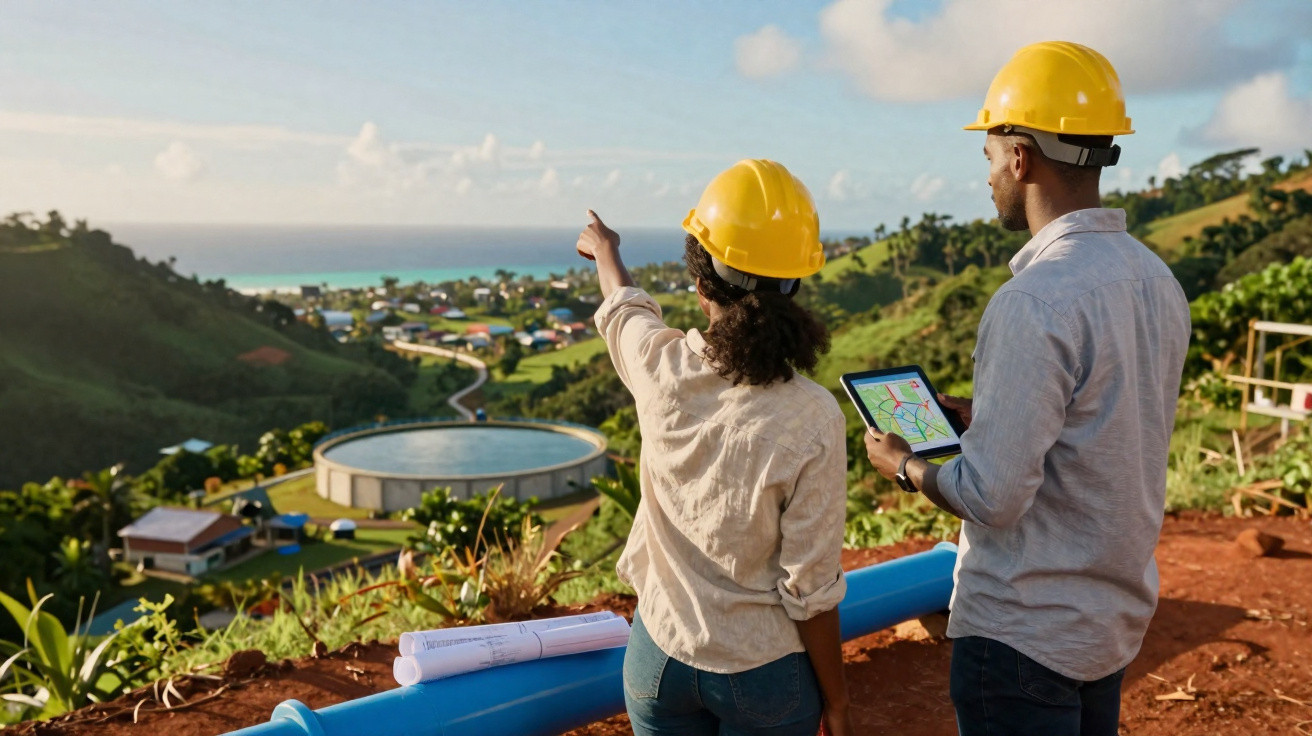
Jamaica, the Caribbean’s third-largest island, is placing a major bet on French engineering group Vinci to make its drinking water supply more secure. Under a new €144 million scheme, vital pipelines in the country’s northwest will be expanded and strengthened, helping protect almost one million people from worsening water shortages.
France supports Jamaica amid mounting climate pressure
Jamaica spans just under 11,000 square kilometres, but its landscape poses persistent challenges for those managing water resources. The majority of the population is concentrated along coastal areas surrounding Kingston and Montego Bay. Meanwhile, steep central mountains rise to more than 2,200 metres, capturing rainfall that often fails to reach the heavily populated coast.
Tropical conditions make the situation even less predictable. The island alternates between severe dry periods and destructive cyclones capable of damaging vulnerable infrastructure. Rain often arrives in the wrong location or at the wrong moment, while urban communities can spend days or weeks under stringent water restrictions.
For Jamaica, securing drinking water now sits at the crossroads of public health, economic growth and national security.
Against this backdrop, the government has selected Vinci Construction Grands Projets, the major French contractor. Vinci has secured a €144 million contract to design and construct 68 kilometres of large-diameter potable water pipelines in north-west Jamaica. The project is part of the Western Water Resilience Project, a flagship initiative intended to strengthen the island’s water infrastructure against climate pressures.
A €144 million network designed for the next 50 years
The scheme aims to distribute treated water more dependably throughout the northwest, where tourism, agriculture and growing residential areas are expanding rapidly. Although Vinci’s contract covers 68 kilometres of pipes, the practical route presents almost twice that distance in engineering complexity.
The pipeline will need to follow existing roads, skirt around villages, avoid unstable land and protect wetlands. Every section presents its own difficulty, whether a steep slope, soft ground or a flood-prone valley that must be crossed without causing harm.
Vinci intends to install large-diameter ductile iron pipes. The material is resistant to corrosion, withstands regular pressure fluctuations and can accommodate ground movement caused by heavy rainfall or earthquakes. With appropriate maintenance, engineers anticipate that the network will remain in service for more than 50 years.
Construction is expected to last about 36 months. Around 100 people will work continuously on the project, including civil engineers, surveyors, equipment operators, environmental experts and local technicians. As work progresses, the teams will move along the route as a “technical village”, establishing temporary bases along the alignment.
Emergency drought measures prepared the ground
The Vinci agreement follows several worrying dry seasons. In July 2025, the Jamaican government made available 350 million Jamaican dollars (about €1.9 million) after rainfall and reservoir levels fell sharply.
This emergency funding paid for water-truck deliveries to drought-hit communities, storage tanks for at-risk households and urgent assistance for essential infrastructure. It also supported more lasting agricultural measures, ranging from drip irrigation to stronger protection for smallholdings affected by drought.
In addition to emergency expenditure, the government has allocated roughly 22 billion Jamaican dollars (around €119 million) for long-term drinking water, sanitation and irrigation programmes. Officials state that more than 900,000 residents are expected to benefit as the new systems enter operation.
- Western Water Resilience Project: improvements and extensions in the west and northwest, including Vinci’s new pipeline contract.
- Rio Cobre water supply system: intended to supply about 57,000 cubic metres of water per day to urban areas.
- Kingston and St Andrew upgrades: specific works intended to avoid a repeat of the difficult shortages experienced in 2022.
Taken together, these investments demonstrate an important change in approach: water policy is no longer regarded simply as a public-service matter, but as a strategic defence against climate disruption.
Working with nature rather than against it
The pipeline alignment passes through rivers, wetlands and environmentally sensitive habitats. Jamaica’s National Environment and Planning Agency is therefore playing a close role in the project. Engineers must create a durable network while minimising the marks left on the landscape.
Every river crossing is being approached with surgical precision. Teams assess the crossing point, required depth and most suitable construction technique. At some sites, they will drill beneath riverbeds so that the watercourse remains undisturbed. Elsewhere, the construction timetable will be adjusted to prevent disruption during fish-spawning or bird-nesting periods.
The project is deliberately not an “express job”: environmental safeguards are built into both the route and the calendar.
This more deliberate and systematic method is particularly important within a small island ecosystem, where damage to one wetland can speed up erosion, intensify flooding or undermine livelihoods dependent on fishing and tourism.
Vinci brings longstanding knowledge of Jamaica’s terrain
Vinci is not entering Jamaica without prior experience. The company has worked on the island since 1999 and has already delivered a number of significant water and infrastructure contracts.
Its teams understand which slopes become unstable after a week of unrelenting rain and which soils move when a hurricane strikes. That local expertise proved relevant in 2025, when Hurricane Melissa affected the island and interrupted services.
Following the storm, Vinci teams assisted with emergency repairs in Montego Bay, Jamaica’s second-largest city. Their work concentrated on restoring drinking water as quickly as possible despite damaged pipelines, obstructed access roads and an unstable electricity supply. The lessons from that response are now informing the design of stronger, more resilient systems.
Part of Vinci’s broader global water portfolio
Jamaica forms part of a wider pattern for Vinci, which has gradually expanded its hydraulic work in climate-stressed regions worldwide. The group points to several similar projects:
| Country | Project type | Period | Scale | Main constraints |
|---|---|---|---|---|
| Qatar | Urban drinking and treated water networks around Doha | 2015–2021 | Tens of kilometres | Extreme heat above 45°C, aggressive desert soils, rapid urban growth |
| Australia | Transfer pipelines and secure urban water supply | 2017–2023 | Long-distance links | Prolonged drought, climate extremes, vast distances |
| Morocco | Backbone networks for major cities | 2016–2022 | Metropolitan systems | Sensitive crossings, dense urban areas, ecological standards |
| Algeria | Large-diameter conduits linking dams and cities | 2014–2020 | Regional corridors | Mountainous terrain, population growth, continuous service needs |
| Chile | Long-distance pipelines and hydraulic works | 2013–2019 | Hundreds of kilometres | Andean relief, seismic risk, hard-to-reach sites |
| Peru | Water transfer for urban and agricultural use | 2012–2018 | Long-distance routes | High altitude, complex geology, variable flows |
This record gives Jamaican authorities confidence that the French company can manage demanding terrain, lengthy alignments and rigorous environmental requirements.
Managing water across the whole island
Although the north-west pipeline has attracted most attention, Vinci is also contributing to the expansion of the Rio Cobre water treatment plant, which is expected to become Jamaica’s third-largest drinking water facility. The plant alone should provide around 57,000 cubic metres per day.
The key issue is the way these components work together. A water network connects catchment areas, treatment plants, storage tanks and taps in homes or hotels. Raising pressure in one part of the system can reduce leakage elsewhere. Strengthening a main now can prevent a disastrous rupture when the next hurricane arrives.
On a small island, every new pipe changes the balance of who gets water, when, and at what pressure.
Decision-makers must balance tourism needs-luxury resorts with swimming pools and green gardens-against those of hillside communities dependent on communal standpipes. Industrial estates, hospitals and schools place additional demands on the system. One breakdown can affect several sectors simultaneously.
What the project means for daily life in Jamaica
For residents, a more robust network offers practical improvements. Fewer unexpected interruptions mean less time spent waiting for water trucks. More consistent pressure lets households use straightforward filters rather than relying on large private storage tanks. Businesses can clean, cook and manufacture without stopping whenever reservoir levels decline.
There are also public-health benefits. A dependable piped supply reduces dependence on unsafe wells and rivers, lowering the risk of water-borne illnesses. Improved pressure management and newer pipes also reduce contamination caused by backflows when the network periodically runs dry.
Major construction work, however, creates temporary disruption of its own, including road closures, dust and machinery operating near homes. People are likely to experience months of traffic delays on certain sections of the route. Public information campaigns and transparent schedules generally help maintain confidence during these disruptive stages.
Key concepts and risks surrounding the project
A number of technical terms frequently arise in discussion of projects of this kind:
- Potable water: water that has been treated to satisfy health standards for drinking and cooking.
- Non-revenue water: water lost through leaks, theft or metering errors that produces no income for utilities.
- Resilience: a system’s capacity to continue operating, or to recover rapidly, after shocks including droughts and hurricanes.
Although the new pipeline will improve resilience, certain risks will remain. Climate models point to longer dry spells and more intense storms across the Caribbean. Should demand continue to rise, particularly through tourism and urban sprawl, Jamaica may require additional investment in desalination, recycling or more stringent water-conservation policies.
There is also a financial consideration. Major infrastructure funded in foreign currency may put pressure on public finances if exchange rates change sharply. Long-term maintenance will need reliable funding so that today’s new assets do not become tomorrow’s vulnerable points of failure.
Nevertheless, by incorporating French engineering expertise into its national strategy, Jamaica is making its position clear: in a warming climate, safe tap water is not considered a luxury, but essential infrastructure alongside energy, transport and digital networks.














Comments
No comments yet. Be the first to comment!
Leave a Comment