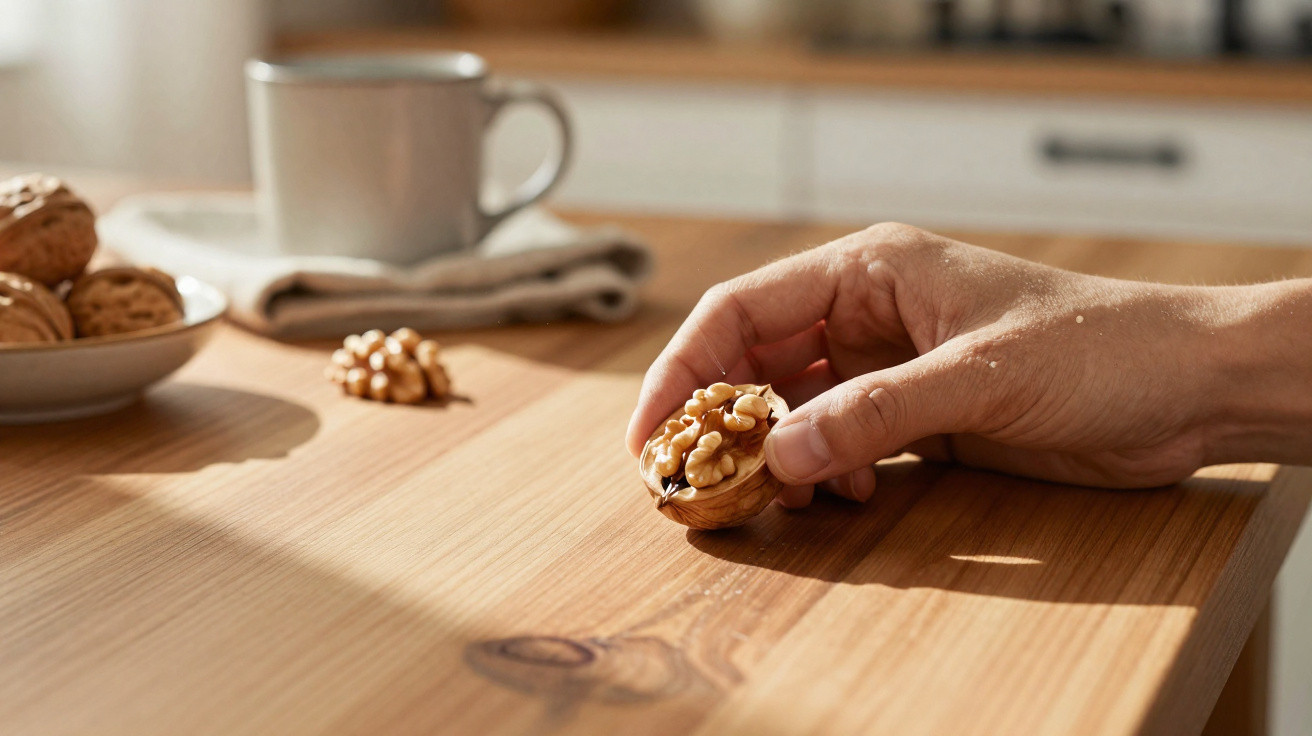
It could be the edge of the dining table, the armrest of a favourite chair, or the vintage chest of drawers you found after a rainy Saturday spent browsing. One moment the wood looks immaculate; the next, a pale line catches the light and seems to announce, “Look at me.” You trace it with a fingertip, wishing it were only dust. It isn’t.
Later, somebody says almost offhandedly, “Have you tried rubbing a walnut on it?” It sounds absurd: a snack used as a repair tool? You give it a go, slightly amused by yourself. Then the mark becomes softer, darker and less obvious. It does not vanish with cinematic magic. It simply looks… less upsetting.
That small scene, with a cracked walnut in your hand in the kitchen, leads to a larger question.
Why does a walnut work on scratched wood?
Seeing it for the first time can seem like another social-media gimmick: a hand, a scratched tabletop, a walnut rubbed slowly across it, then a before-and-after image that appears almost magical. But on actual furniture, it is not quite such a ridiculous trick. It is a quietly ingenious one.
As the shell has been cracked, the nut warms a little between your fingers. Press it into the scratch and the colour begins to alter. Pale, exposed timber gains a warmer shade. The bright raw line becomes less shiny and starts to merge with the surrounding grain. The result will not be flawless, but the damage no longer draws your eye immediately. That modest change can alter how you feel about the entire piece.
There is a reassuringly simple explanation. Walnuts contain plentiful natural oils and pigments. When worked into a scratch, their oils penetrate the dry, exposed wood fibres. The damaged patch shifts from looking parched and chalky to appearing nourished and faintly glossy. Because the walnut flesh resembles many mid-toned woods in colour, it gently stains the affected area. Your brain registers less contrast, making the scratch seem far less dramatic.
At a microscopic level, the softened walnut leaves tiny particles behind in the groove as well. They will not fill a deep gouge, but they can soften fine, crisp edges. This is not a carpenter’s repair; it is smart camouflage, borrowing colour and lustre from the nut itself. For most of us, that is precisely what is needed for a well-used piece of furniture that carries memories as readily as plates or books.
How to use a walnut on scratches without making things worse
The process is almost deceptively straightforward. Hold a shelled walnut half in your hand. It should be raw and unsalted, with no elaborate preparation required. First, wipe the scratched spot with a soft, lightly dampened cloth, then allow it to dry. The aim is simply to remove dust and crumbs so the oil can reach the timber.
Next, rub the walnut firmly over the scratch in the direction of the grain. Several short, repeated strokes are more effective than a single long pass. The nut will become a little softer as it warms; allow this to happen. After 20–30 seconds, pause for another minute, then lightly buff the area using a clean, dry cloth. This final stage distributes the oil, lifts away any surplus and makes the sheen more even. Repeat if the mark is still demanding your attention.
Let’s be honest: nobody really does this every day. The walnut method will come back to you when a mark becomes irritating enough, rather than becoming part of a daily furniture-care routine. That is perfectly fine. It is a speedy rescue, not a new furniture-care religion. Even so, a few sensible precautions are worth following.
Avoid this technique on very pale woods, including bleached oak, pine and maple, if you want to retain their light colour. Walnut may darken the scratch too much, leaving a brown line instead. Always test it first beneath the table or at the rear of a leg. Do not use it on high-gloss lacquered finishes or plastic veneers: the oil will remain on the surface, smear and may leave a greasy halo.
Be especially cautious with antiques or particularly valuable furniture. If you feel unsure, contact a professional restorer rather than experimenting with something from the snack bowl. Nor should you expect it to work miracles on deep gouges or chipped edges. The walnut trick is closer to concealer than surgery: it softens, disguises and reassures, but it cannot replace missing timber.
There is another reason this uncomplicated step can feel so gratifying.
“I’ve watched people’s shoulders literally drop when the scratch fades,” says a London-based furniture restorer. “It’s not just the table they’re fixing, it’s the guilt they’ve been carrying about damaging it.”
This minor repair becomes a gentle act of care. It tells both the object and yourself that imperfections deserve attention rather than shameful concealment. On a tired table in a busy kitchen, that matters more than a showroom-perfect finish.
Before cracking open a walnut, keep this short practical checklist in mind:
- Use only raw, unsalted walnut halves.
- Try it first on a concealed part of the same item.
- Work with the grain, never against it.
- Buff carefully to prevent oily marks.
- Remember that this is camouflage, not a complete repair.
What this tiny hack says about how we live with objects
There is something almost tender about a walnut meeting a scratch: you, a piece of fruit and a marked surface that has witnessed everyday life. It is a tiny action, yet it feels unexpectedly personal. Rather than discarding the table or hiding it beneath an oversized table runner as though nothing happens in your home, you take a different approach.
You do just enough to make the damage easier to live with. You are not erasing its history or preserving the object in a frozen state. You are simply reducing the contrast so your eyes can relax. In a wider sense, it reflects how we handle the rest of our homes: we mend, soften and adapt. We do not begin from scratch whenever something gains a small scar.
Once you understand the natural oils found in walnuts, similar gentle solutions become noticeable everywhere. A little olive oil on a dry chopping board. Some beeswax along the seams of a worn leather bag. A lemon slice used to lift a stain from a cutting surface. None is a grand gesture; each is an everyday way of saying that this item still belongs here.
That is also why the walnut trick is so easy to share. You demonstrate it to a friend over dinner, send it in a text or mention it to your parents when they complain about scratches on their sideboard. It travels not merely as a useful hack, but as a small philosophy of care packaged in a kitchen ingredient.
| Key point | Detail | Benefit for the reader |
|---|---|---|
| Natural walnut oils | Walnuts release tinted oils that absorb into exposed wood fibres | Explains why the method works rather than merely showing how to copy it |
| Best use cases | Shallow scratches on mid-toned, real wood with a matt or satin finish | Prevents frustration with items where the trick is unlikely to work well |
| Mindset shift | From “perfect surfaces” to cared-for, lived-in furniture | Makes a simple hack part of a more relaxed, sustainable way to own things |














Comments
No comments yet. Be the first to comment!
Leave a Comment