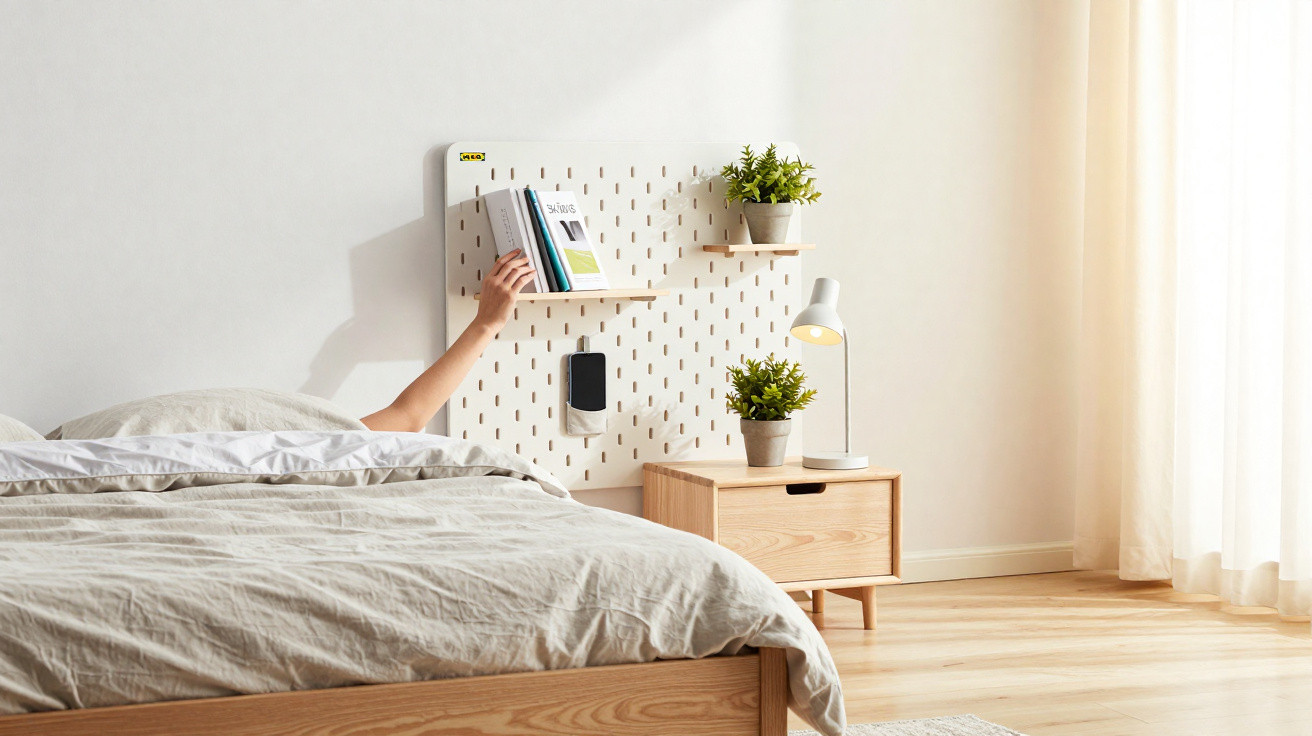
A glass of water perches on a stack of books. Your phone is plugged into the sole socket behind the bed, with the lead pulled taut. The alarm clock is almost hidden beneath hand cream, a hair tie, two receipts and the book you promise yourself you will read again “one day”. When you try to put down your keys, they skid onto the floor. Your bedside table is trying its hardest. The space in your bedroom? Less so.
Now imagine that same setup without a cumbersome table or bashed shins: simply a compact, ingenious item hanging unobtrusively from the bed frame and carrying the things you genuinely need.
One $5 IKEA item can transform the entire arrangement.
The $5 IKEA trick that quietly replaces the bedside table
The star of this idea looks fairly unremarkable on the shelf. In IKEA, you will find it in that puzzling section of hooks, clips and small accessories you never knew you needed until reaching the till. It has a straightforward name: the SKÅDIS container with hook, or a closely related item from the same range. It is a small plastic holder with a hook, designed to attach to boards, rails and, importantly, bed frames.
For roughly $5, this modest container clips to the side of the bed and handles the one task for which a bedside table has always been unnecessarily large: keeping out of your way.
Look on TikTok or Reddit and it appears under countless names, including “bedside cup”, “floating pocket” and “the thing that saved my tiny room”. One London tenant posted a photograph of their 7 m² bedroom, where there was literally no room to fit a conventional bedside table. They fastened two IKEA containers to their metal bed frame: one held a phone and charger, while the other stored lip balm, earplugs and a small notebook.
All at once, the side of the bed stopped being wasted space. It became useful storage within easy reach, with no legs on the floor. The carpet seemed more spacious, the room felt more open, and mornings became less like picking a route through a cluttered obstacle course.
This little solution has such an impact because it achieves three things simultaneously. It clears the floor, making a room appear larger more quickly than any paint colour. It leaves nighttime necessities close by, so there is no need to hunt for your phone beneath the bed at 2 a.m. It also encourages gentle editing. Since the container is compact, only the items you really use remain at your bedside.
A bedside table encourages piles; a small hook-on cup encourages purpose. That is the understated change offered by this $5 piece of plastic: it reduces the “landing zone” beside your pillow and, in turn, the mental clutter that comes with it.
How to turn your bed frame into a smart storage rail
The basic approach could hardly be easier. Take the SKÅDIS container, or a similar IKEA hook-on pocket, check how its hook fits over the edge of the bed frame, and locate the position where it holds securely without moving. On metal frames, it will often grip a horizontal bar. With wooden frames, the upper edge is usually suitable.
After clipping it in place, fill it only with genuine bedside essentials: a phone, charging lead, hand cream, sleep mask and perhaps a pen. Avoid adding anything else. You should be able to reach in without looking, take out an item and find exactly what you expected. That is the point at which a small storage accessory becomes more than attractive and starts to be truly practical.
The mistake most often made is using this $5 container as a miniature rubbish drawer. Expired receipts, hair clips from 2019 and half a chocolate bar saved “for later” all get dropped inside. The holder becomes full, dust builds up, and before long you are facing the same nagging irritation created by an overflowing bedside table.
There is a gentler alternative. Set one clear rule, such as: “Only what I touch after lights out or before getting up.” That one guideline excludes the wallet, miscellaneous post and sunglasses. And, yes, a glass of water should still sit on a stable surface rather than hang from a hook. Realistically, no one follows this perfectly every day, but checking the container once a week is enough to prevent it becoming another magnet for clutter.
In compact homes, this IKEA hack becomes a quiet statement about how space should work. One interior designer I spoke with put it bluntly:
“People think they need more furniture. What they usually need is fewer legs touching the floor and smarter use of the vertical surfaces they already have.”
To get the greatest benefit from the concept, many people living in small spaces create a compact “bedside kit” around their hooked container:
- One SKÅDIS or similar IKEA container attached to the frame for a phone + small items
- A second container or fabric pocket positioned lower down for tissues or a paperback
- A slim wall light or clip-on lamp overhead, leaving the top of the chest of drawers completely clear
- A power strip concealed beneath the bed, with only one discreet lead running to the container
With just a few adjustments, the side of the bed becomes a vertical command centre, while the old bedside table quietly disappears from the room.
What happens when the bedside table disappears
A bedroom changes when that squat, bulky table is finally removed. You start noticing the skirting boards. You vacuum the corner that may have been inaccessible for years. That newly available triangle of carpet suddenly suggests possibilities: somewhere to stretch in the morning, a dog bed, or a laundry basket that no longer needs to sit half in the hallway.
For some people, taking away the bedside table prompts a broader thought: how much furniture remains simply because it has always been there? A chest of drawers used largely as a dumping ground, a chair that exists only to collect clothes, or a second bedside table in a room where just one person actually reads in bed.
There is another, subtler advantage that will not show up on a floor plan. With less horizontal surface available for clutter, the pre-sleep “stuff spiral” eases. Fewer objects within reach mean fewer prompts to scroll, scribble, snack or worry just before going to sleep. Of course, IKEA’s little white plastic container will not cure insomnia on its own. Still, many people describe the same modest result: the room feels lighter, calmer and simpler to reset each morning.
That may be why this $5 solution has struck such a chord online. It is more than a product. It gives people permission to challenge an assumed piece of furniture and recover a little valuable bedroom space, both on the floor and in their minds.
| Key point | Detail | Value for the reader |
|---|---|---|
| Replace the bedside table | Attach a $5 IKEA hook-on container to the bed frame | Create more floor space and reduce visual clutter without losing essentials |
| Restrict what you keep | Store only items used immediately before sleep or just after waking | Cut clutter and bedtime stress naturally, with very little effort |
| Use vertical space | Pair containers with wall lights and concealed power strips | Make a cramped area beside the bed into a smart, adaptable storage zone |
FAQ:
- Question 1: Which exact IKEA product works best to replace a bedside table?
Answer 1: The SKÅDIS container with hook is a popular choice because it attaches securely and is ideally sized for phones and small belongings. Some people also adapt the SKÅDIS hook for use with other small boxes, or choose IKEA’s soft hanging pockets when their bed frame is too thick for rigid plastic hooks.
- Question 2: Will it fit my bed frame?
Answer 2: Most metal frames and plenty of wooden frames are suitable. The hook requires a lip or bar to grip. Where a frame is especially thick or upholstered, you can add a thin rail or a SKÅDIS pegboard panel to the frame and hook the container onto that instead.
- Question 3: Can it hold a glass of water?
Answer 3: Not safely. The container works well for dry belongings, such as a phone, glasses case, lip balm and earplugs. For water, use a small tray or narrow shelf mounted higher on the wall, or a floor-standing bottle tucked slightly beneath the bed.
- Question 4: Is this sturdy enough for children’s rooms or rented homes?
Answer 4: Yes, provided it is properly hooked on and not overloaded. It is lightweight, has no sharp corners and can be repositioned without drilling, making it well suited to tenants and bunk beds. Just do not put heavy items inside that could fall onto little toes.
- Question 5: What if I still want a bedside table?
Answer 5: You do not need to choose one option exclusively. Many people retain one narrow table on one side and use a hook-on container on the other. The important thing is to minimise bulky surfaces and let at least some of the floor remain open, while keeping bedtime routines comfortable.










Comments
No comments yet. Be the first to comment!
Leave a Comment