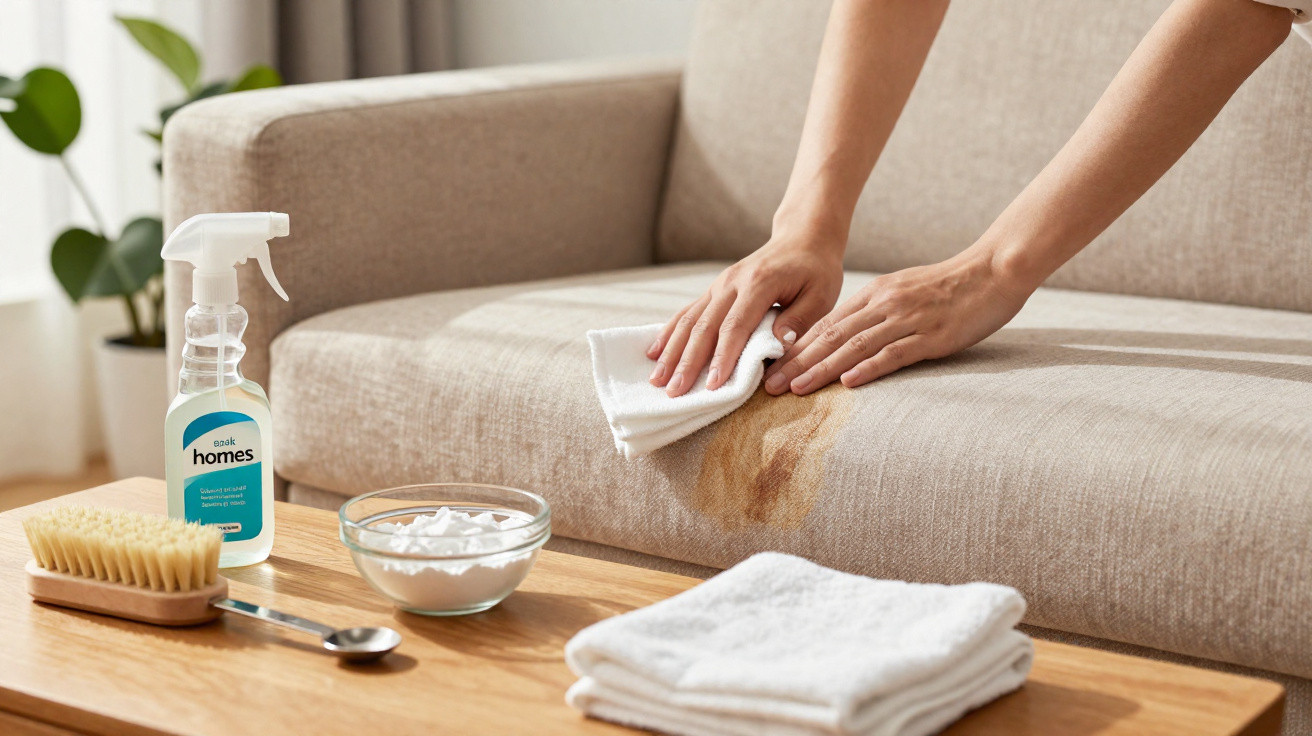
First, it was a drop of coffee.
Then came a glass of juice during a cartoon marathon, a glass of wine on Saturday night, and the cat deciding to lie right in the middle of the pale cushion with muddy paws. Before you know it, the living-room sofa - once a source of pride - is covered in little brown, yellowish, almost grimy reminders. Old stains that seem woven into the fabric. You scrub, wipe it with a damp cloth and try an all-purpose cleaner. Nothing changes. Worse still, sometimes the stain simply spreads.
In daylight, these marks become even more noticeable. Anyone who has guests over knows that quiet discomfort, as though the sofa is telling a story nobody wants to hear. Professional cleaning is expensive, and a new cover is hardly cheap either. So a question comes to mind for countless households: is there a genuine, low-cost way to restore some dignity to a stained sofa? The answer is, quite literally, already at home.
Why old sofa stains seem impossible to remove
When a stain is fresh, it looks like a straightforward issue: water, a cloth, perhaps a little mild washing-up liquid, and that is it. Real life, however, does not happen in slow motion. A child spills juice just as everyone is leaving, someone wets the sofa while rushing to answer the doorbell, or the dog jumps up immediately after a walk. Nobody stops their day to launch a full-scale campaign against a stain. It stays there, drying out, sinking into the fibres and mixing with dust and the skin’s natural oils.
Then routine takes over, tiredness sets in, and the sofa gradually becomes a record of domestic mishaps. An informal survey among upholstery-cleaning firms in Brazilian capitals points to a curious pattern: more than 70% of call-outs are not for fresh stains, but for dirt that has been there for months, sometimes years. One woman in Belo Horizonte said she only realised her sofa’s true original colour after seeing an old photo on her mobile phone. The contrast between the “before” and the “now” was the prompt she needed to seek help.
From a practical perspective, the persistence of an old stain makes sense. Coffee, wine, grease and pen ink all contain pigments and oils that cling to fibres. Once dry, they become fixed as if they belong to the fabric itself. Generic products, applied without care, often make matters worse: they spread the stain, force dirt deeper in and leave a ring. There is an almost unspoken belief that “old stains do not come out”. But that is not entirely true. With the right ingredients and a little method, many of them will lift - even those you had already accepted as permanent.
The homemade sofa-stain method that works: a realistic step-by-step guide
Among the many online tips, one simple routine has been winning over those who try it: a combination of bicarbonate of soda, white vinegar, mild washing-up liquid and warm water. There is nothing elaborate about it. The key lies in the order of use and treating the fabric gently. First, vacuum the area thoroughly to remove loose dust. Then make a solution using 1 tablespoon of mild washing-up liquid, 1 tablespoon of white vinegar and 250 ml of warm water. Lightly dampen a clean cloth and press it onto the stain without scrubbing hard.
Once the area is damp and the stain has softened, add the bicarbonate of soda. Sprinkle a thin layer over the stained patch and leave it for 15 to 30 minutes. The mild reaction between vinegar remaining in the fabric and the bicarbonate helps loosen residue, while the powder absorbs grease and odours. Next, use another cloth dampened only with water to lift away the excess bicarbonate by dabbing. Finish with a dry cloth to remove extra moisture and, if possible, point a fan towards the sofa. It may sound labour-intensive, but for most of the time the mixture is simply working on its own.
“The magic is not in the ingredient, but in the patience.”
This phrase circulates in domestic-cleaning groups and neatly captures the spirit of the method. A few points can help prevent disappointment:
- Always test the mixture on a hidden part of the sofa before applying it to the middle of a cushion.
- Do not soak the fabric; only dampen it. An overly wet sofa can encourage mould.
- Repeat the process on very old stains. Sometimes two or three rounds make a difference.
- Use a light-coloured, clean cloth, preferably microfibre, so you can see whether dirt is actually lifting.
- On very delicate fabrics, such as certain linen blends, use less vinegar and rely more on diluted washing-up liquid.
Common - and entirely human - mistakes when cleaning a sofa
Everyone has felt the urge to grab the first product within reach and attack the stain vigorously. Kitchen degreaser spray, hand sanitiser, scented floor cleaner. In that stressful moment, the rule becomes: the stronger, the better. Very often, the outcome is the opposite. The stain fades unevenly, the fabric becomes rough and a chemical smell fills the room. Let us be honest: nobody reads the full label or tests a hidden area while wine is still running down the upholstery.
Another classic mistake is scrubbing as though there is no tomorrow. The scene is always similar: a cloth wrapped around the hand, circular and almost aggressive movements, and the feeling that the sofa’s dignity can only be saved through physical force. In practice, the fibres open up, the fabric develops a raised texture and, in some cases, the stain spreads into a ring larger than before. Anyone with a microfibre or suede sofa will often recognise the effect immediately.
Using water that is too hot is another frequent slip-up, especially when it is applied directly to fabric without dilution or thought. Greasy spills such as sauce, cheese and butter tend to react badly to extreme heat, becoming set rather than loosening. Overdoing neat vinegar in the hope of “disinfecting everything” is another common error: it leaves a strong smell and may stain more delicate textiles. The person trying is not to blame; the problem is the myth of the “miracle product” that does everything by itself. In real life, a sofa is more delicate than it looks.
What cleaning professionals say really works
A domestic cleaner who has worked in São Paulo for 12 years put it this way:
- “Expensive products do not always clean better than basic kitchen supplies.” She says she has seen sofas come back to life with a simple mixture of washing-up liquid and bicarbonate of soda, after clients had spent money on imported sprays.
- “Pressing is better than scrubbing.” Dabbing with a damp cloth “draws” dirt out, rather than pushing it further into the fibres.
- “The contact time does half the work.” Leaving the mixture to act stops people feeling compelled to keep scrubbing.
- “Drying matters as much as cleaning.” A sofa that remains damp inside develops odours and can even harbour hidden mould.
- “Not every stain will disappear 100%.” In some situations, the realistic aim is to fade the mark until it no longer bothers you in everyday life.
How to keep your sofa clean without becoming a cleaning slave
After dealing with old stains comes another stage: the fear of making new ones. Some owners of newly “revived” sofas begin living as though their lounge were a museum, almost banning drinks and children from the room. That is not sustainable. A home is meant to be used, with life happening in it and coffee resting on the sofa arm while conversation flows. The most practical answer is to create small, simple routines that prevent build-up without turning anyone into a prisoner of cleaning.
One such routine is weekly vacuuming. Five minutes is enough. Go over the seat, backrest and corners where crumbs hide. Another particularly useful habit is dealing with stains while they are still fresh whenever possible: a damp cloth with a small amount of mild washing-up liquid resolves half the dramas. For people with young children or pets, washable throws in strategic areas can be helpful allies, without turning the sofa into a pile of loose fabrics.
The household method using bicarbonate of soda, vinegar and washing-up liquid does not need to become a sacred ritual; it is simply a resource to have available when things get out of hand. Perhaps the biggest change is not to the sofa itself, but to the way you view it. Rather than seeing a “huge problem”, see an item that responds well to occasional care without anxiety. Once you understand how stains behave and what genuinely works on them, that feeling of helplessness eases a little. And the living room seems able to breathe again.
| Key point | Detail | Value for the reader |
|---|---|---|
| Method using household ingredients | Combined use of mild washing-up liquid, white vinegar, bicarbonate of soda and warm water | Provides an affordable, accessible way to refresh the sofa without paying for costly services |
| Avoid scrubbing hard | Apply the product with a damp cloth by dabbing, while respecting the fabric | Reduces the risk of damaging fibres, spreading the stain and creating visible rings |
| Contact time and drying | Allow the product to work and make sure the upholstery dries thoroughly afterwards | Improves cleaning effectiveness and prevents mould, odours and persistent marks |
FAQ:
- Question 1 Can I use this method on every type of sofa fabric? Not on all of them. With highly delicate materials, such as some linen blends or velvets, it is best to test a hidden area, use less vinegar and focus more on well-diluted washing-up liquid.
- Question 2 How many times can I repeat the process on the same stain? In general, up to three applications, allowing the sofa to dry completely between each one, are safe. If there is no visible improvement, professional cleaning may be needed.
- Question 3 Does vinegar leave a strong smell on the sofa? It does leave a slight smell at first, but the odour usually disappears as it dries. If it bothers you, use less vinegar and rinse more thoroughly with a cloth dampened in clean water.
- Question 4 Does bicarbonate of soda stain dark fabric? Usually not, provided it is used sparingly and removed thoroughly afterwards. On black or very dark sofas, it is worth testing a hidden section first.
- Question 5 Does alcohol work better than this homemade method? Alcohol can help with specific stains, such as pen ink, but it dries out and may stain certain fabrics. The washing-up liquid, vinegar and bicarbonate routine is more versatile and gentler for general use.













Comments
No comments yet. Be the first to comment!
Leave a Comment