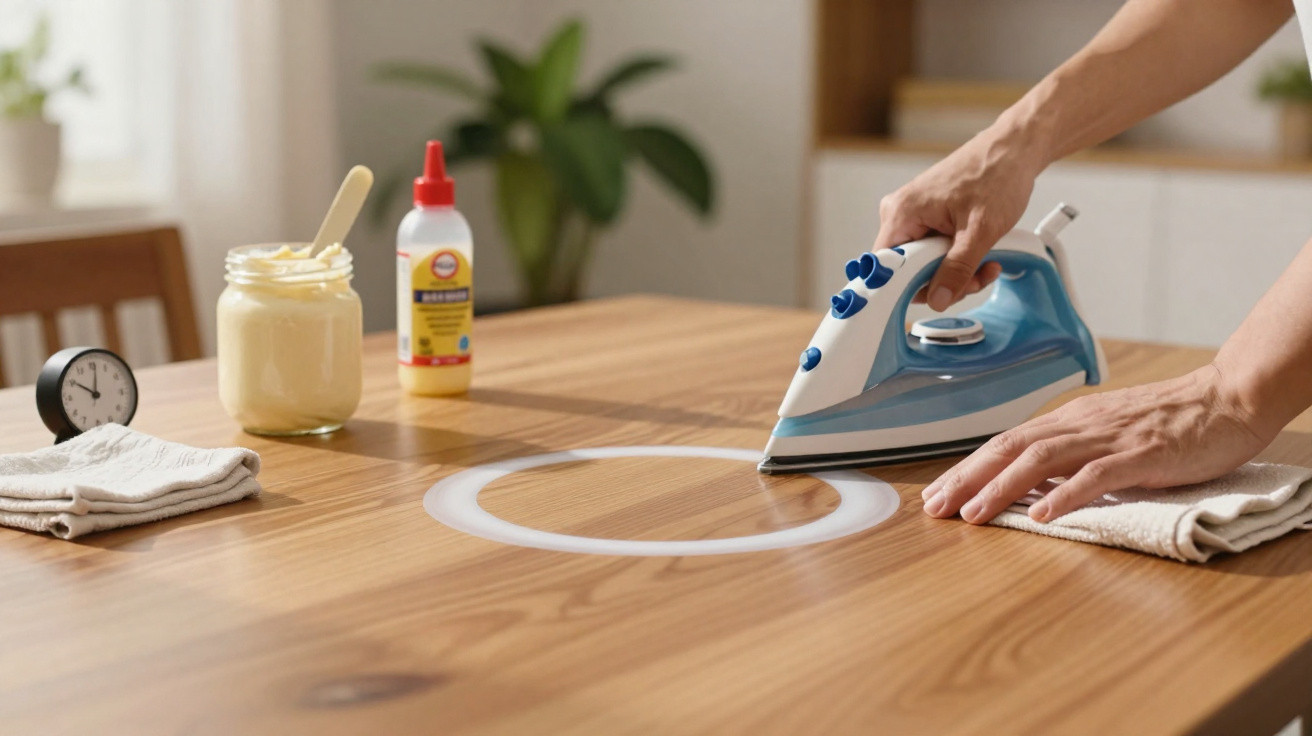
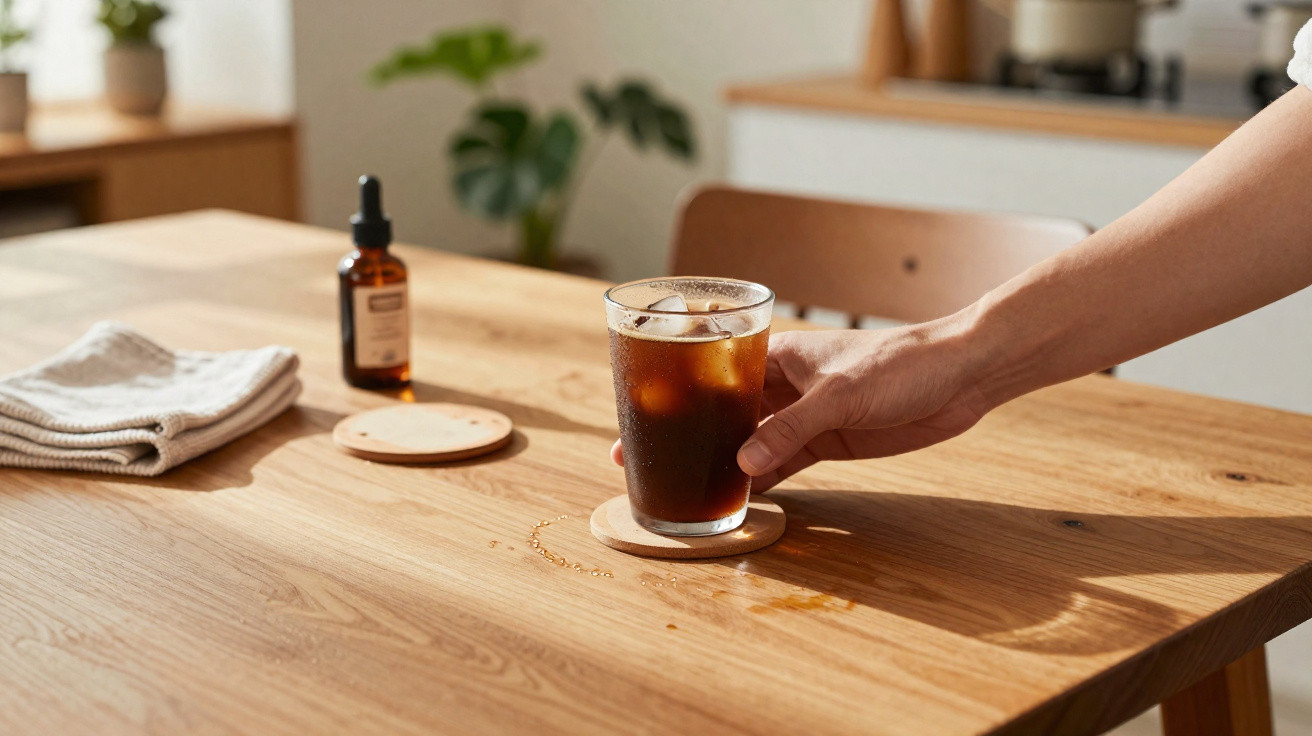
The glass rested on the timber for under a minute. It was a slow Sunday afternoon: ice cubes were melting, somebody laughed, and the coaster was forgotten. When you eventually pick up the glass, a pale, perfectly formed ghost ring is waiting on your costly oak table.
You try your sleeve first. No change. Then washing-up liquid. Still nothing. Suddenly, that tiny mark seems enormous.
That evening, while scrolling endlessly through your phone, you find a “magic” kitchen remedy endorsed by thousands. According to the post, one ordinary ingredient and three minutes are all it takes to make the table look new again.
The clips are strangely compelling, while the comments are frantic. One viewer calls it “witchcraft”, while another says it “destroyed my $3,000 dining table”.
One method, two completely conflicting results.
So there you are in the kitchen, product in hand and slightly nervous about a water ring.
And the question is: am I about to fix my furniture… or ruin it?
From viral miracle cure to furniture nightmare
It often begins with a brief TikTok or Instagram video. A hand hovers above a cloudy white ring on a wooden table, then drops a spoonful of mayonnaise, toothpaste or baking soda onto the mark. There is a quick rub, followed by an “after” reveal: the ring is gone, the timber appears immaculate, and the comments fill with heart emojis and “life-changing!” reactions.
After one 15-second clip, a household condiment is transformed into a worldwide furniture-restoration hack.
Keep scrolling, however, and the tone shifts. Someone demonstrates that same method on a dark walnut table, but the “after” image reveals a larger, duller area, as though the finish has been stripped away. Their caption says: “Don’t try that mayo hack. It RUINED my furniture.”
Then come screenshots from furious Reddit discussions. Homeowners swap tales of patchy varnish and cloudy streaks. What began as an enthusiastic trend becomes a source of uncertainty.
In truth, the technique is far from new. For decades, furniture restorers have discreetly relied on oily pastes and mild heat to draw moisture from timber finishes. The modern difference is its reach: millions now attempt the same hack on vastly different tables using wildly different products.
The online rush overlooks important detail. Stains are not all alike, finishes do not respond identically, and supposedly harmless kitchen remedies are not always harmless. That is the dividing line between a miracle cure and a disaster.
What is actually happening beneath a white ring
The chalky white rings left by cold drinks are not normally marks in the timber itself. In many cases, moisture or heat has entered the transparent finish - whether varnish, lacquer, shellac or polyurethane - producing tiny droplets trapped beneath the surface.
In other words, the ring sits in the upper coating, much like condensation within a pane of glass, rather than being a bruise in the wood.
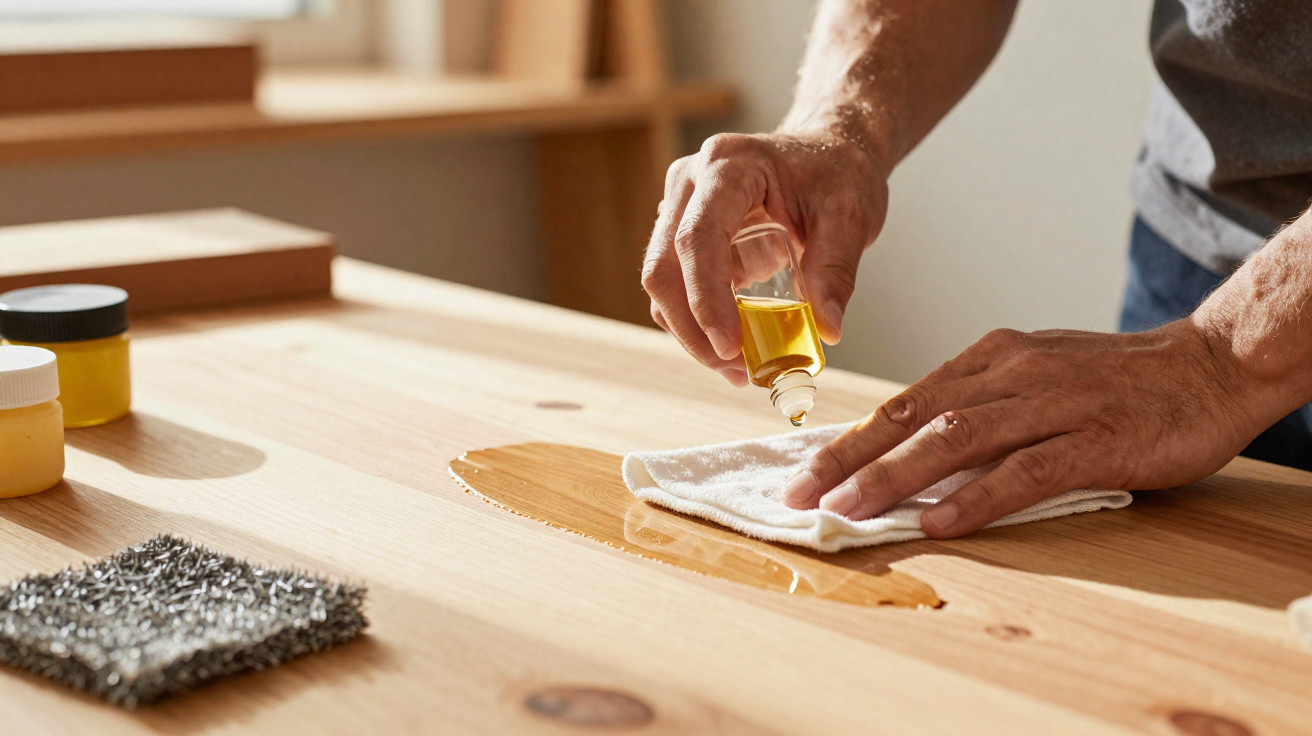
That explains why oil combined with a mild abrasive may sometimes help. Mayonnaise, toothpaste, baking soda and even petroleum jelly can displace moisture or slightly soften the coating, allowing trapped water to escape. A hair dryer or a warm iron at a low setting may have a similar effect by gently driving out the water as vapour.
When conditions are right, one wipe can make the ring fade as though by magic.
Problems start when the importance of those conditions is overlooked. A dark stain usually means that moisture has reached and oxidised the timber fibres. No kitchen remedy will repair that. And when a finish is delicate - such as aged shellac, thin lacquer or a cheap factory coating - an oily abrasive paste may polish through or remove it.
The original ring may vanish, only to be replaced by a broader, lifeless patch. That is the point at which a clever hack becomes an expensive regret.
The mayo-and-heat method people swear by - and sometimes regret
The most celebrated form of the trick is remarkably straightforward. Put a small dab of mayonnaise on the white ring, spreading it only slightly beyond the stain. Depending on whose advice you follow, leave it there for anything from 10 minutes to overnight. Next, wipe it away carefully with a soft cloth, perhaps using a small buffing motion.
Many people combine this with gentle heat: moving a hair dryer set to low over the area for a few seconds at a time, or using an iron on low with a clean cotton cloth between its soleplate and the wood.
When the approach succeeds, the explanation is simple: oil in the mayonnaise enters microscopic cracks in the finish and helps force out moisture, while warmth encourages the trapped water to evaporate.
The cloudy appearance clears, the coating becomes less hazy and the surface recovers its sheen. It can seem almost implausibly easy, as if you have got away with something.
Social media users apply the same basic idea with other products. White toothpaste provides light abrasion, while others use a baking-soda paste or olive oil mixed with salt. Each option aims to alter the surface just enough to release the moisture without noticeably scratching the shine.
When the balance is right, the sense of relief is genuine - and highly shareable.
Where “harmless” stops being accurate
This is where the picture becomes more complicated. The kitchen method is not inherently bad, but timber finishes can be temperamental and we seldom know exactly what coating we have. A mass-produced dining table from a large retailer will not respond like a French-polished family heirloom.
What online clips fail to mention is that no single piece of advice suits every furniture surface.
One furniture restorer told me she now spends around half her time correcting “DIY miracles gone wrong”. Dark tables arrive with pale ovals where somebody has over-buffed a water ring, while high-gloss surfaces show cloudy halos caused by heat-distorted coatings.
At times, the stain has disappeared but the finish has become thinner, leaving a slight hollow that catches the light indefinitely. That is when people resort to dramatic descriptions: ruined, destroyed, wrecked.
The emotional reaction is understandable. A costly table represents more than wood: it may hold savings, memories and family meals. If a casual online remedy damages it, that can feel like a betrayal.
We placed our furniture in the internet’s hands. What we wanted was a cure, not a gamble.
How to use the mayo or heat trick without gambling with your table
If you decide to try mayonnaise or heat, approach it as a test rather than a certainty. Begin with a very small area in a spot normally out of sight - beneath a table runner, behind a lamp or along the rear edge.
Use very little product. A pea-sized dab is sufficient for a modest ring; the table does not need marinating.
Initially, leave it for only five to 10 minutes, then wipe the area and inspect it. Provided nothing has changed and the coating still appears even, you may repeat the process once or twice for a longer period.
Use a soft, clean microfibre cloth or an old cotton T-shirt, never an aggressive scouring pad. Think of polishing a lens rather than scrubbing a pan.
For heat, proceed gently and gradually. Keep a hair dryer three hand-widths away, continuously moving it for only a few seconds. Alternatively, set an iron to low, place a dry cotton cloth underneath it, and touch it down and lift it off lightly, like a chef checking a pan.
Stop at once if the finish begins to shine unevenly, ripple or feel sticky.
Classic mistakes that turn a small ring into a major problem
Impatience is usually where things go wrong. When the ring remains after five minutes, people leave the product on for twice as long. They then apply more of it and rub harder, assuming that more effort must deliver better results.
Social-media “after” images rarely reveal how many slow, gentle and unexciting attempts were actually needed.
Misidentifying the stain is another common mistake. If a mark is grey or dark, particularly on oak or walnut, water has generally gone through the finish and discoloured the timber. At that stage, heat and DIY pastes might clear surrounding cloudiness, but they cannot resolve the central issue.
You may reduce the visible symptom while gradually wearing away the protective surface.
And there is the ordinary reality: let us be honest, nobody really does this every day.
Most of us overlook coasters until the table already appears worn. Then we try every hack at once - oil, heat, magic eraser and furniture polish - creating a combination of chemical reactions that no professional would deliberately use.
What professionals say about viral furniture hacks
Ask three restorers about the mayonnaise method and you are likely to receive three cautious variations of “it depends”. They do not necessarily dislike the technique; what concerns them is its presentation as foolproof.
One London-based restorer described it to me as “a last mile solution for certain modern finishes, not a universal reset button”.
Another put it more bluntly:
“The hack isn’t ruining expensive furniture. The lack of context is. People treat a £10,000 table like a £10 cutting board because a video got 1.5 million views.”
Professionals suggest a simple first check that costs nothing: shine a torch across the surface from a low angle. If the ring appears deep and the surrounding finish is already crazed or cracked, kitchen remedies carry a high risk.
If the surface is smooth and the ring looks milky, a cautious attempt at home may be reasonable.
They also stress that viral ideas are not automatically wrong. Within limits, heat and oil can genuinely assist with trapped moisture. The more sensible approach is to regard each method as a dial rather than an on-off switch, stopping the moment the result begins to worsen instead of afterwards.
As one restorer told me off-camera, “I’d rather talk someone through a stain on the phone than charge them three hundred pounds to fix ten minutes of panic.”
Why this “harmless trick” keeps going viral
There is a reason these videos repeatedly appear in your feed: they satisfy a particular urge. A minor but embarrassing domestic mishap - water on a table - is met with a solution that feels personal, inexpensive and human.
There is no branded spray or specialist equipment, only mayonnaise from the kitchen or toothpaste from the bathroom.
At a deeper level, these clips promise more than restoration: they offer control. In a world where so much seems beyond reach, saving a damaged surface with a spoonful of kitchen gunk can feel like a small triumph.
We like believing the answer is already sitting in a cupboard, waiting to be discovered.
On a bad day, though, that belief meets the reality of fragile coatings and expensive finishes. A harmless trick turns into a warning story, and screenshots of damaged tables spread with the same force as the initial hack.
The internet moves on; your table does not.
Perhaps the most truthful lesson is neither “never try this” nor “this always works”. Instead, whenever another miracle remedy appears in your feed, ask a quieter question: what is the risk if this goes wrong, and am I comfortable with it?
Because the true difference between genius and disaster is not mayonnaise versus no mayonnaise. It is how much you are prepared to stake on a stranger’s 15-second fix.
| Key point | Detail | Why it matters to the reader |
|---|---|---|
| Understanding white stains | They often sit in the varnish rather than the timber | Helps you choose a gentle method before undertaking major work |
| Using the trick safely | Test discreetly, use small amounts and apply mild heat | Reduces the risk of “ruining” an expensive piece of furniture |
| Knowing when to stop | Dark stains and cracked varnish are danger signs | Prevents a small ring from becoming a genuine professional restoration job |










Comments
No comments yet. Be the first to comment!
Leave a Comment