She glances at the digital clock lit up in the corner above the meeting-room door. It reads 9:41. She looks again at 9:44, then at 9:49. Her work has barely progressed, while the minutes thunder by like passing traffic.
The student sitting in an exam hall knows the same sensation. So does a nurse working overnight, or a barista watching the small clock on the coffee machine. Their eyes stay fixed on the passing seconds, while their minds circle one silent question: “Will I have enough time?”
One day, a manager in that office discreetly took down the wall clock. At first, nobody noticed. Then somebody did, and the whole day somehow felt lighter.
That small adjustment revealed a far larger secret than anyone had imagined.
When time seems to watch you
Something unusual happens when a clock remains within your line of sight. You are not merely checking it; it can feel as though it is checking you. Minutes stop being neutral measurements and become a scorecard, silently assessing how “productive” you have been.
That is time anxiety: the pressure in your chest when the day appears to vanish. You look at your phone “just to check”, only to feel a sudden surge of panic. Too late. Not enough time. Already falling behind.
It does more than disturb your peace of mind. It can also destroy concentration. Your focus breaks into fragments, each one interrupted by a glowing number elsewhere in the room.
In 2022, a small London design agency carried out a straightforward experiment. For one month, it switched off every visible clock in its main workspace. There was no wall clock, no time shown in the corner of computer screens, and phones were silent and face down during deep-work sessions.
Staff could still check the time, but doing so required a deliberate physical action: reaching for a phone, pressing a key or asking a colleague. By the second week, something unexpected had happened: they were checking it less often.
One designer said her 90-minute task “felt like five minutes, but in a good way.” The agency monitored self-reported stress and recorded a 23% fall in feelings of “racing against the clock”. The workload itself had not changed; only time’s visibility had.
Psychologists describe this as the distinction between objective time and subjective time. Objective time consists simply of the numbers. Subjective time is the way an hour feels physically and emotionally. When clocks surround you, your attention is repeatedly pulled back towards objective time.
That shift can intensify time anxiety. The more closely you watch the numbers, the more every minute can feel like a judgement of your value. Your mind moves from “doing the thing” to “monitoring how long the thing is taking”.
When the clock is moved out of view, the experience changes. Your sense of time can become rooted in the task, conversation or moment directly in front of you. The hours still pass at exactly the same pace, but your nervous system no longer feels as though it must sprint.
How to hide the clock without losing control
Keeping clocks out of sight is not about living in a world without time. It is about arranging your surroundings so that time helps you rather than pursues you.
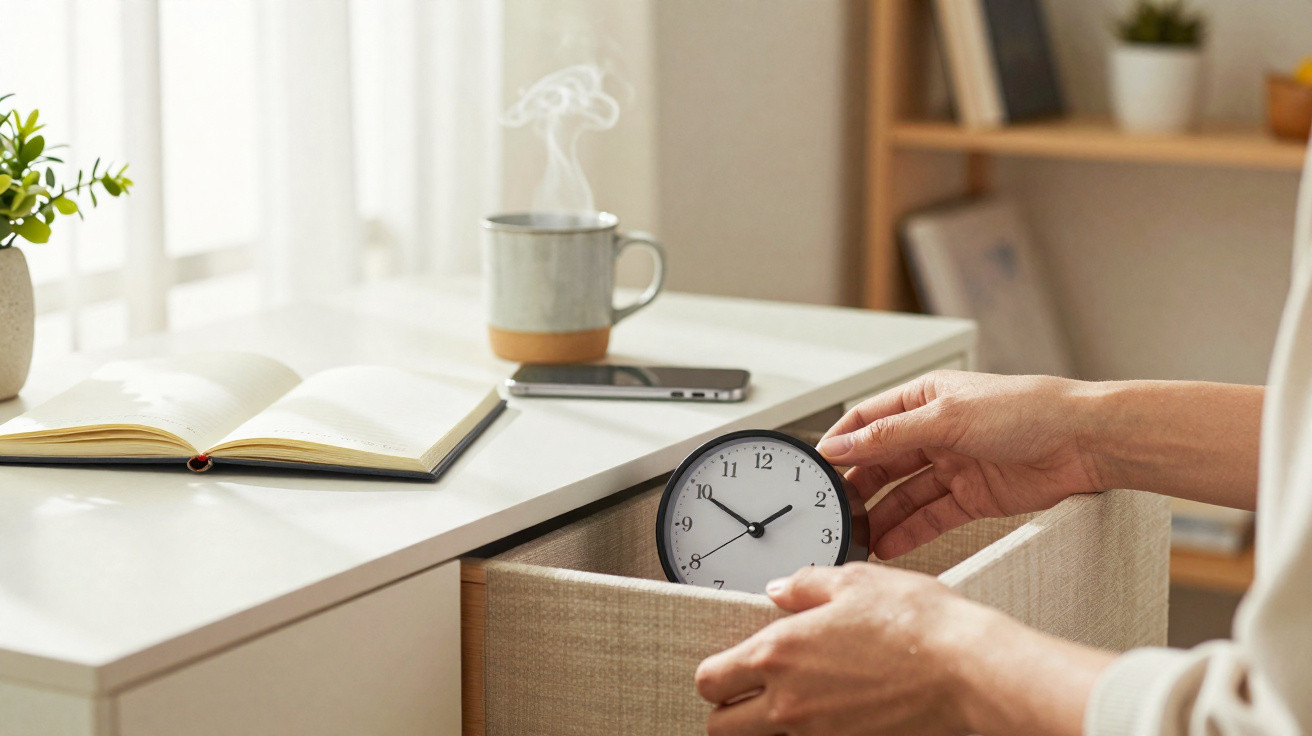
Start simply by removing or covering any clock that is permanently visible in your main working area. During focused sessions, disable the time display on your desktop. Place your phone face down, or leave it in another room, for blocks of 25–50 minutes.
Next, establish deliberate moments for checking the time. For example, decide to look at it only during natural pauses: once you have finished a batch of emails, a chapter or a design draft. The clock then becomes a tool you use intentionally, rather than a permanent neon signal at the edge of your vision.
One fear tends to arise immediately: “If I don’t see the time, I’ll lose control of my day.” It is a genuine concern. School and work have taught many people to monitor the clock as a means of survival. Being late means trouble.
Instead of stopping all at once, create gentler boundaries. Choose timers over continual displays. If you need to leave at 5:30, set an alarm for 5:20, then put the clock away and immerse yourself in your task.
Time becomes a behind-the-scenes assistant rather than a manager glaring over your shoulder. Your energy moves from controlling every minute to fully experiencing it. Let us be honest: nobody genuinely does this every day without ever checking the time, and that is fine. The aim is a more relaxed, kinder rhythm, not a strict system.
One therapist who supports chronically anxious professionals told me:
“The most stressed people I see can always tell me the exact time… but they can’t tell me the last time they felt absorbed in something.”
The observation stays with you because it expresses a quiet reality: intense awareness of time often means reduced awareness of the life taking place within it. Hiding the clock creates room to become absorbed again.
A few practical changes often make a difference:
- Position wall clocks behind your main sightline rather than directly in front of your desk or bed.
- Keep one central clock at home instead of displaying glowing numbers in every room.
- Replace the large digital time widget on your phone’s lock screen with something neutral.
- During meetings or deep work, use a subtle vibration alarm instead of watching a screen.
- Allow yourself one or two daily “time windows” for planning, then let the remaining hours escape constant monitoring.
Letting time recede into the background
After the clocks are out of view, there can be a moment when the day suddenly feels unexpectedly spacious. The impulse to check the hour may still be strong, but if you sit with it for even 10 minutes, it begins to ease.
You might begin relying on different signals instead: the changing light outside your window, the rhythm of completed tasks, or the feeling in your body when you are hungry, tired or content. Time stops acting like an enemy and becomes a quiet background presence.
For some people, this modest change brings other questions to the surface: “If I’m not measuring myself every 15 minutes, what actually matters in my day?” That may feel uncomfortable, but it may also mark the start of a different relationship with work, rest and presence.
| Key point | Detail | Benefit for the reader |
|---|---|---|
| Clocks trigger time anxiety | Persistent visual time cues keep your brain in monitoring mode | Helps explain why you feel tense even on ordinary days |
| Hiding clocks boosts focus | Checking the time less often supports deeper immersion in tasks | Provides an easy way to feel calmer and more productive |
| Use intentional time checks | Set alarms and check the time only at planned points | Preserves structure without the strain of continual clock-watching |







Comments
No comments yet. Be the first to comment!
Leave a Comment