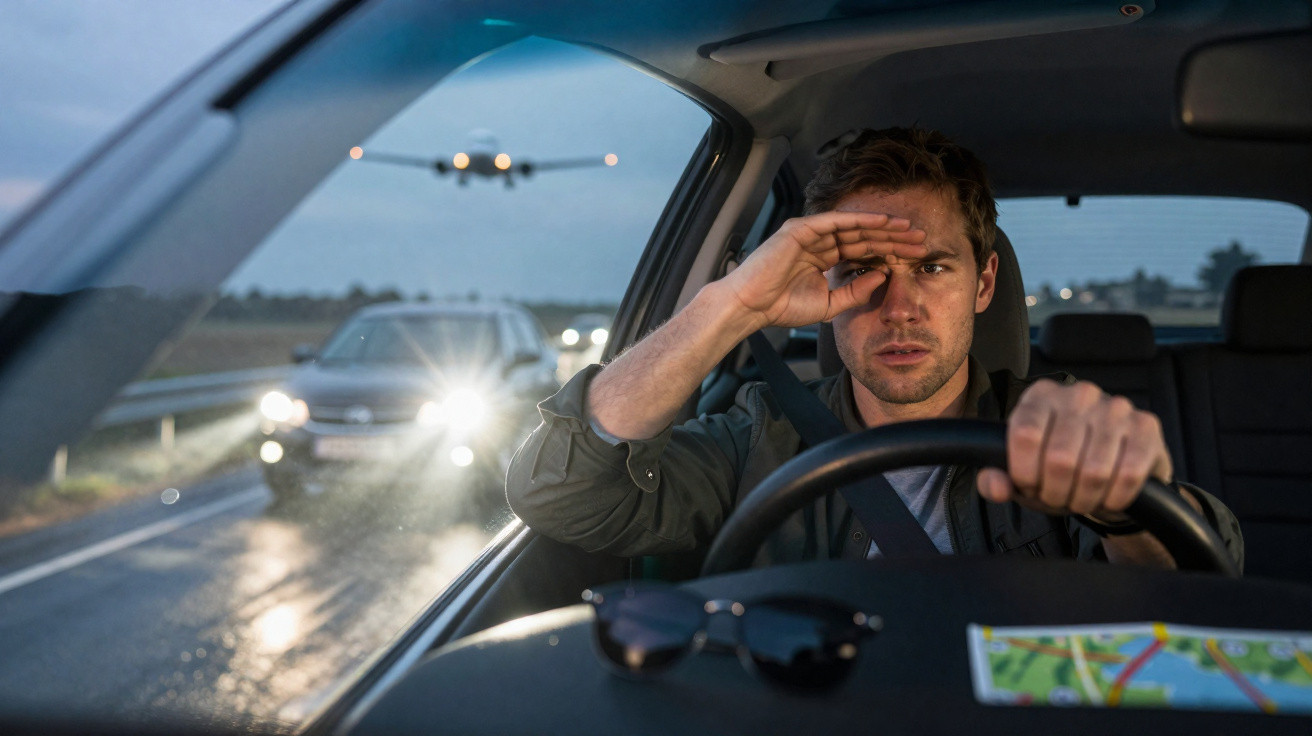
A white-blue burst crosses the windscreen and, for an instant, the road vanishes. You blink, tighten your hold on the wheel and hope there is no cyclist ahead or corner you have read wrongly. The passing motorist continues on, perhaps unaware that they have made your night journey a gamble.
Above, a jet settles onto its final approach, its landing lights slicing through low British cloud like stadium floodlights. A passenger lowers the window shade. Below, a dog walker stops and squints skywards, asking when light became so unforgiving.
From Highways England engineers to aviation safety inspectors, the same concern is repeatedly raised: lights on roads and in the air are becoming brighter, harsher and more distracting than our eyes can comfortably tolerate. The science behind the concern is more unsettling than many people appreciate.
Why UK experts say our lights have crossed a line
Speak to UK road safety specialists today and one expression comes up again and again: dazzle and discomfort glare. This is not simply irritated motorists complaining about “kids and their LEDs”. Research by the RAC, the AA and the Department for Transport all points to a steep increase in complaints about glare from newer vehicle headlights.
What was once a yellowish patch of illumination has turned into a sharp, clinical beam. LED and xenon systems reach much farther along the road, but their extra range brings a severe downside. Eyes adapted to gentle daylight and candlelight must now cope with headlamps that act more like compact searchlights.
A recent RAC survey found that nine in ten UK motorists believe modern headlights are excessively bright. That is not a marginal complaint; it represents almost everybody.
Choose any wet November evening on the A1 and the issue is easy to see. A small hatchback fitted with factory LEDs crests a hill. The driver approaching in an older saloon automatically glances towards the verge before looking back, their eyes streaming. Moments later, a 4×4 with aftermarket “upgraded” bulbs appears, its front sitting slightly high. Its beam lands directly on the other vehicle’s windscreen.
Police and parish councils on rural routes in Yorkshire and Devon are recording a growing number of local glare complaints. Some older motorists now say they avoid driving after dark entirely. This reflects Road Safety Foundation research showing greater visual stress, slower recovery after glare and an expanding number of “near misses” that are never reflected in collision figures.
Aviation regulators are receiving comparable reports, although the causes differ. More people are using high-powered handheld lasers and living near flight paths, leaving pilots increasingly exposed to powerful, focused light during the final stages of landing. At the same time, landing lights are becoming brighter to satisfy stricter visibility standards, with their light reflecting from low cloud and mist into surrounding neighbourhoods.
In technical terms, modern lighting complies with legal thresholds. That is the uncomfortable point UK experts continue to stress. The problem is not brightness in lumens alone, but how light is directed, where it falls and how the eyes of an ageing population respond. Blue-rich LEDs scatter more within the eye, producing halos and starbursts, particularly for people with early cataracts or dry eyes.
Optometrists describe this as “disability glare”: you may not be completely blinded, but your contrast sensitivity drops sharply for vital seconds. On a dark B-road, those seconds may be when a deer runs out, a cyclist swerves or an obscured junction comes into view. Lighting that should theoretically make travel safer for one driver can quietly raise the danger for everybody nearby.
What you can actually do about blinding lights – on the road and under the flight path
The first and least exciting answer is remarkably straightforward: have your own headlights aligned. UK test centres say a surprisingly large number of cars, including fairly new ones, are being driven with beams aimed a few degrees too high. That small difference changes useful reach into hazardous glare for oncoming traffic.
Any MOT tester will say this is common rather than exceptional; they see it every week. A simple beam inspection and adjustment costs less than a tank of fuel. If a car is loaded with luggage or children in the rear seats, using the headlamp levelling dial can greatly reduce the glare sent into other drivers’ eyes.
If you have “upgraded” from halogen bulbs to inexpensive LEDs, treat that as a warning sign. Many of these kits are incompatible with the reflector design and scatter light in every direction. Returning to suitable road-legal bulbs with the right beam pattern can immediately make you a more considerate road user.
UK road safety trainers also quietly wish that more people adopted a few modest habits. When a brightly lit vehicle approaches, look slightly left, using the white line or verge for guidance. This keeps the strongest glare away from central vision. Keep the windscreen thoroughly clean inside and out, as a thin layer of dirt or nicotine turns each approaching LED into a smeared halo.
Lower the dashboard brightness as well. Modern digital instrument panels can be dazzling in their own right. A brightly lit cabin makes your pupils contract just enough to worsen contrast outside, leaving your eyes less able to cope with each burst of glare. On a dark motorway, reducing instrument lighting by a few settings can make the scene beyond the glass feel calmer and more defined.
For those living beneath busy flight paths, ordinary blackout blinds and heavier curtains can have more effect than many people acknowledge. Numerous UK households close to airports discreetly move bedrooms away from direct runway approach paths. It is a small but determined way to take the night back from intense landing beams.
Glare also involves pride and anxiety. Motorists do not welcome being told that their impressive new car is damaging other people’s eyesight. Older drivers may not want to admit that driving at night has become stressful or even frightening. For that reason, experts often argue for “shared responsibility” rather than blame.
Eye examinations are another underused option. If headlights are beginning to resemble exploding stars, early cataracts or another condition could be involved. Modern lenses and anti-reflective coatings can lessen the effect of blue-heavy light. Yet many people delay visits to the optician for far longer than they would care to admit to a doctor. Let’s be honest: nobody really does that every day.
For pilots, airlines and air traffic controllers, light management is already embedded in safety culture. Aircrew use tinted visors, alter cockpit illumination and practise laser-strike procedures. The UK Civil Aviation Authority regularly warns against powerful lasers near airports, reminding the public that such “pranks” can temporarily blind a crew during seconds when precision is most essential.
“Light is not just brightness; it’s a drug for the eye,” says one UK road safety researcher. “In the right dose, aimed the right way, it saves lives. In the wrong dose, at the wrong angle, it quietly steals your vision at the moment you need it most.”
Behind the scenes, UK and European regulators are gradually moving towards tighter requirements for headlamp design, colour temperature and automatic anti-dazzle technology. Adaptive headlights that shape their beam around other road users already exist, but remain largely confined to premium cars. Some campaigners believe these systems should become standard rather than a luxury option.
- Check and adjust: headlight aim, bulb type and dashboard brightness.
- Protect your eyes: regular tests, proper lenses, cleaner glass.
- Change habits: drop speed at night, look slightly left of glare, question “upgrade” bulbs.
A similar effort is under way in aviation: improved shielding, more intelligent light angles and tougher action against deliberate laser misuse. Shared skies, just like shared roads, require that one person’s desire for visibility does not become a risk for everyone else.
The quiet battle over who owns the night
A broader question sits beneath all this glare: who owns the night now? Over the past twenty years, technology has flooded darkness with brighter cars, busier flight schedules and LED streetlights that make midnight resemble a blue-tinted afternoon. Somewhere in that shift, our eyes, nervous systems and sleep patterns have been put under pressure.
At a human level, the accounts are uncomplicated. There is the new driver who fears a dual carriageway after dark because every SUV seems like a camera flash. There is the pensioner who arranges winter shopping around daylight because the ring road at rush hour has become an ordeal. There is the West London family who joke about “runway sunrise” when an early-morning arrival turns their bedroom into a photographic studio.
Technically, the answer is not a return to weak yellow pools of light or grounding aircraft. It is to treat brightness as a resource that must be shared: better optics, tighter controls on retrofit kits, wider adoption of adaptive beams and frank public communication about glare risks. None of this is glamorous, but all of it quietly determines how safe darkness feels.
The emotional impact of dazzle receives little attention too. There is the sudden flash of panic when the road disappears, and the weary late-night question: “Do I really want to drive back along that unlit stretch?” Such brief moments shape meaningful decisions: jobs accepted or declined, routes avoided and evenings out abandoned. Across the country, they amount to more than a handful of frustrated drivers.
On a cold, clear evening, when traffic eases and an aircraft glides low with lights blazing through the sky, both realities can be felt at once. We need light to travel, work and connect cities and families. We also need darkness that allows our eyes to rest and our minds to feel secure. As UK experts describe it, the next stage is not about choosing one over the other. It is about recognising that when light becomes too bright and too harsh, it ceases to help and begins to harm - not through dramatic catastrophes, but through thousands of squinting, unsettled seconds that rarely reach the news yet quietly shape life after sunset.
| Key point | Detail | Why it matters to the reader |
|---|---|---|
| Modern headlights feel too bright | LED and xenon lamps produce harsh, blue-rich glare that is difficult for our eyes to handle | Helps explain why driving at night can suddenly feel more stressful |
| Simple checks reduce dazzle | Accurate beam alignment, legal bulbs and cleaner glass substantially reduce glare | Offers practical steps to make driving safer for you and others |
| Glare is a shared safety issue | Drivers and pilots alike face rising visual stress from intense lighting | Encourages more understanding, collective solutions instead of blame |











Comments
No comments yet. Be the first to comment!
Leave a Comment