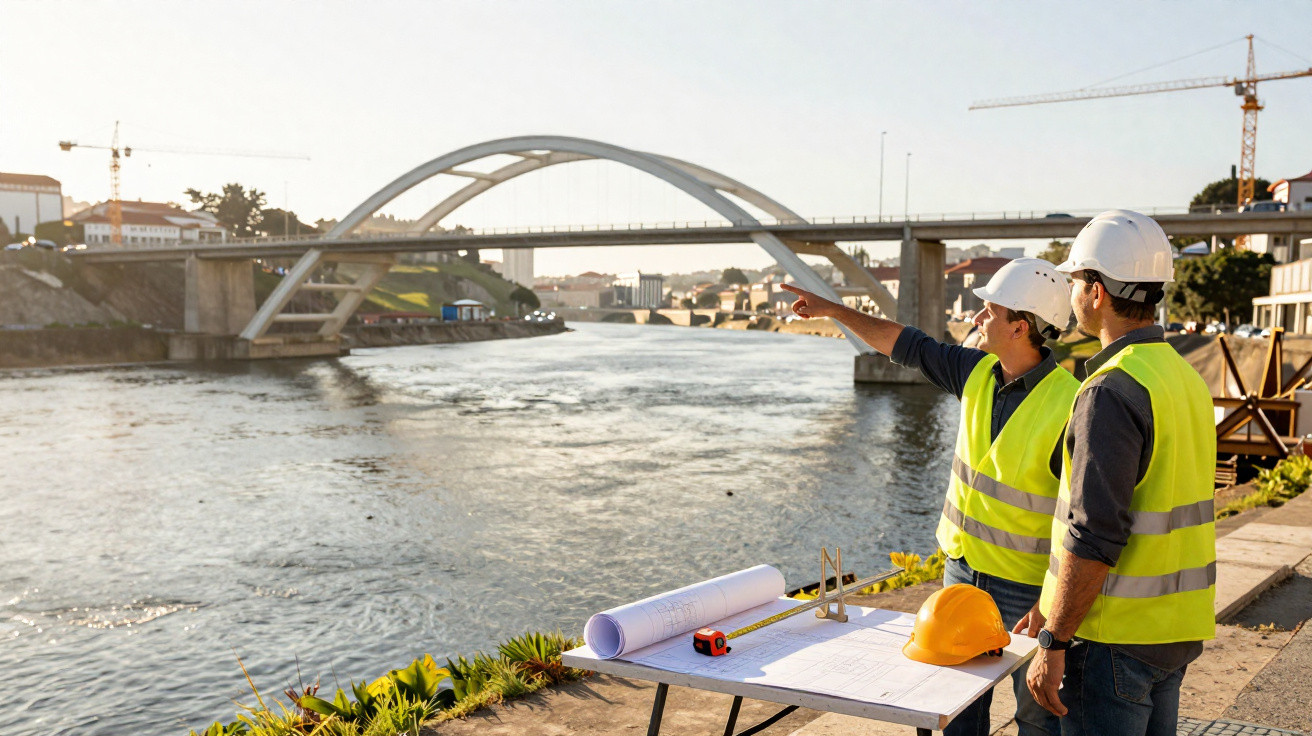
The crossing over the River Lima has entered its final construction stage. Workers from several nationalities have christened it "Viviana".
From the summer, it will be possible to cross the River Lima in Viana do Castelo by car, on foot or by bicycle using a new bridge. The link between national roads 203, in Deocriste, and 202, in Nogueira, is now nearing completion. The structure itself has been finished and is being painted grey. Work is still under way on surfacing the walkways, fitting protective barriers and parapets, installing public lighting and putting telecommunications infrastructure in place.
Built in record time - around a year and a half - the bridge was nicknamed "Viviana" by its multinational workforce. "Because we are in Viana. When I arrived here, the beam was already called Viviana," says site manager Artur Patrão of ACA Construction (Alberto Couto Alves), who assures that the new crossing "will be ready in the summer".
The €20.2 million project, funded through the Recovery and Resilience Plan (PRR), is subject to a physical and financial completion deadline ending on 31 August this year.
A sign at the entrance to the site states that the purpose of the bridge - the fourth crossing over the Lima in the municipality - is "to strengthen resilience and territorial cohesion, by increasing the competitiveness of the productive fabric and enabling a reduction in contextual costs".
Space for everyone
"It is a very important piece of infrastructure for Viana. It will take a significant amount of heavy traffic directly to the motorway," Artur Patrão said as he showed the JN reporting team around the deck. It is 816 metres long and has a 10-metre-wide carriageway, plus two 2.5-metre walkways, one on each side, designed for pedestrians and cyclists.
"What is planned is a cycle lane and a pedestrian route, exactly the same. These are not what you would call ordinary pavements. They are 2.5 metres wide, meaning they are very substantial and safe walkways for people to use," the project manager explained.
The crossing is supported by 24 rows, each comprising two piers. In the deepest part of the river, the piers are 9.10 metres high. It connects to two roundabouts and, including its access ramps, has an overall length of almost two kilometres.
The contract was awarded in December 2024, and the works have gone through two winters and several storms. Patrão says that "around 60,000 tonnes of earth" were used to create stable ground.
Major challenges
"To build the bridge, we created a temporary platform reaching halfway across the river. We narrowed the flow. Once the platform was in place, we began the indirect foundations. We built a cofferdam [a temporary enclosure constructed in water], with metal structures surrounding the foundations and preventing both soil and a large volume of water from getting inside. We pump out the water and the men work safely inside, in dry conditions," he explained, summarising that in that area "it was as if the river did not exist".
The foundations were then built from there, making it possible to raise the whole structure step by step, using beams and piers. Thousands of tonnes of concrete and steel were needed for the project. The site manager sets out the figures: "Each deck section - there are 24 - uses 350 m3 of concrete. If we multiply that by 24, we are talking about 8400 m3 of concrete just in concrete alone (around 21,000 tonnes)."
According to Artur Patrão, one of the biggest difficulties was the construction system, which had to be adapted because medium- and high-voltage power lines run along the river's left bank.
A launching gantry was brought in from Poland and is already being dismantled before being sent to Lithuania. "It was a blue metal structure which, underneath where we were standing, formed the deck shape, closed up, we installed the steel, poured the concrete, then it opened and moved forward [to repeat the process]," he described, adding: "I had never built a bridge using this system." Once the deck reached the middle of the river, the land-based platform was removed and transferred to the other half of the river.
A boost for businesses
Mayor Luís Nobre believes the new bridge, together with the new Neiva Valley road, which is also under construction, "is strategic infrastructure for improving the connection between the two banks of the Lima and strengthening the municipality's territorial cohesion". It is also "a means of access for the new business parks in Nogueira and Cardielos and for DS Smith [a packaging factory] in Deocriste, which will thereby gain access to the main routes and the seaport". The mayor considers it "fundamental to economic development and mobility in the municipality's rural area".
"When we go through Gaia, they say it is Dad's bridge"
Site manager Artur Patrão, a 39-year-old civil engineer from Santa Maria da Feira and director of works on the new bridge, has already been "the boss" on the construction of several crossings and, according to his team, "finishes projects ahead of schedule". "I worked on the Santo Ovídeo viaduct in Gaia, that white metal viaduct, and then on the bypass in Celorico de Basto, which had a bridge over a river and several viaducts. Before working in Portugal, I spent seven years in Angola, where I worked on the refurbishment of one bridge and built a new one too," he said. "It is what I enjoy doing most," he admits.
He says he caught "the bug" while working on building sites in his village during the summer. "When I went to university, I simply continued on that path," he says. He admits to a feeling of "belonging" and enjoys crossing bridges with his family: "I have two young children, Afonso, who is nine, and Anita, who will be six, and when we go through Gaia, they say it is Dad's bridge."
Workers
90 is the average number of workers involved in completing the project. During the contract, there were around 70.
Several nationalities
Portuguese, Brazilian, Indian and African workers from various backgrounds have built the new bridge. "That is what has helped save the workforce to some extent. There are fewer and fewer Portuguese workers," Artur Patrão commented.
Communication through gestures
Patrão points to the "communication difficulty" with Indian workers. "They do not speak English, they do not speak Portuguese or speak it very poorly, and we do not speak Indian. We communicate through gestures. Although there is always someone who communicates better, it is always an obstacle."
Find out more
Rare machine
A "Bridge by Bridge" machine, which makes it possible to work beneath the bridge, was used to repair imperfections in the concrete structure before painting. "We either had to bring in a boat and put structures on top of it, or use this type of equipment, which is rare."
Expands in summer
To guard against the effects of natural thermal expansion in the materials caused by changing temperatures, two 25-centimetre expansion joints were created, one at each end. "They allow the bridge to expand and the deck to move without people noticing," Artur Patrão explained.
15 metres is the width of the bridge deck, including the lanes for road traffic, pedestrians and bicycles.




Comments
No comments yet. Be the first to comment!
Leave a Comment