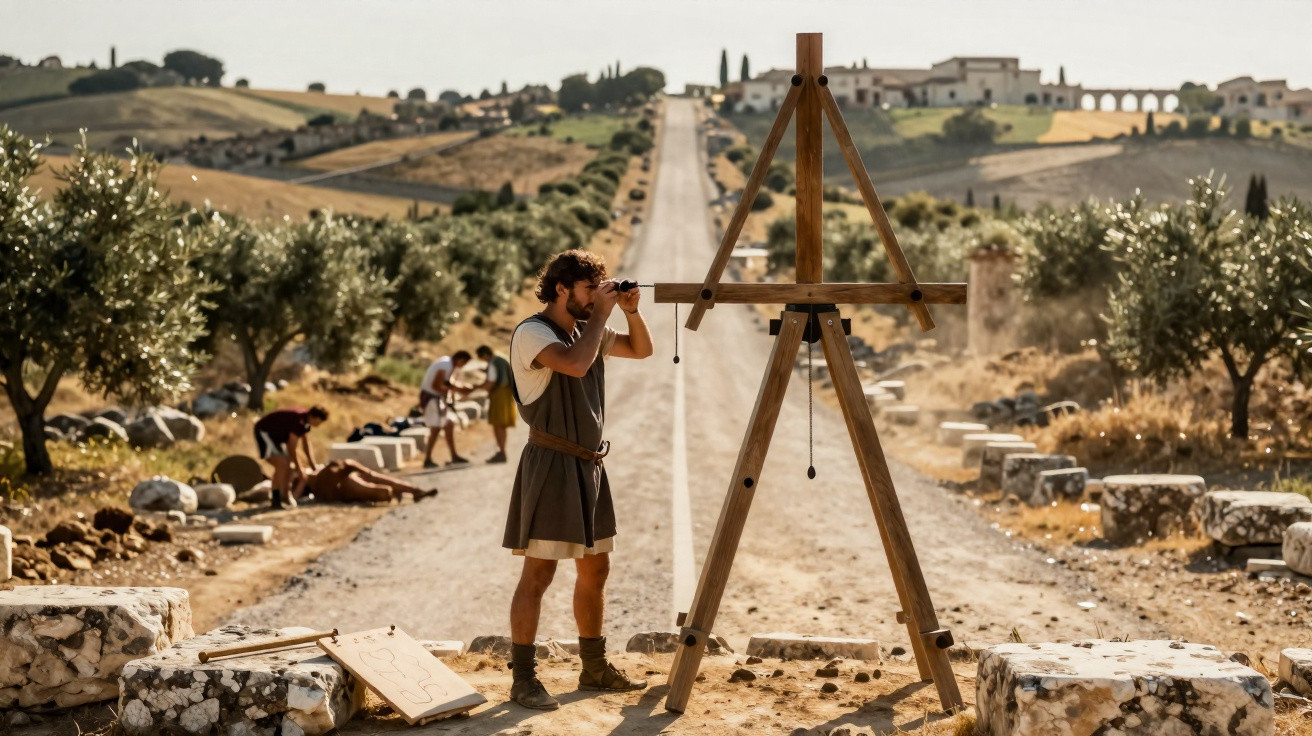
Roman roads became renowned for their near-straight appearance, even when covering vast distances. This was not a matter of chance: it resulted from a combination of surveying instruments, military planning and intelligent adjustments to the terrain before construction began.
Why did Roman roads seem so straight?
The Romans favoured direct routes because straight roads shortened journey times and made it easier to move troops, trade goods and communications between towns. In flat areas, this aim was more achievable, allowing long alignments with few bends or detours.
This pattern can be seen on well-known routes such as the Via Appia in Italy and Stane Street in southern England. However, their reputation for perfection should be treated cautiously, as not every Roman road ran straight from start to finish.
The preference for direct lines offered clear benefits:
- Empire: direct routes linked towns, ports and frontiers.
- Surveying: instruments helped maintain long alignments.
- Flat terrain: made routes with almost no bends easier to create.
- Logistics: troops and goods could travel more predictably.
- Obstacles: mountains, rivers and valleys required adaptations.
Which instruments helped the Romans align roads?
Roman surveyors used measuring tools to establish directions, angles and levels. Instruments identified by specialists include the groma, the dioptra and the chorobates, each serving a role in the planning of the project.
The groma was particularly significant for setting out alignments and right angles. Using rods, cords and hanging weights, it enabled the mensor, the Roman surveyor, to set lines across the landscape before the road was cut into the ground.
How did Roman surveyors keep direction across the terrain?
The task did not rely on one person simply looking towards the horizon. Several surveyors could be stationed along the proposed route, lining up posts or visual markers to create a continuous, controlled and consistent direction in the field.
Straight lines before paving
A road began as a measured layout.
Alignment came first, followed by adaptation to the relief, and only then by physical construction.
A straight route was desirable, but it could not disregard rivers, slopes and difficult ground.
Once the direction had been set, the Romans assessed the landscape. If the route encountered an excessively steep climb, a difficult crossing or an important settlement, its course could be altered to retain usability, safety and functionality.
The process brought together steps such as:
- Selecting the destination and establishing the route's main axis.
- Using instruments to align visible points in the landscape.
- Marking sections with posts, stakes or natural landmarks.
- Altering the route in response to rivers, mountains and slopes.
- Building firm layers for drainage and movement.
Why were not all Roman roads perfectly straight?
The idea that Roman roads were absolutely straight lines is exaggerated. On plains, they could maintain striking alignments, but in mountainous or uneven regions, more practical routes were needed for carts, animals and ordinary travellers.
There were also older roads that the Romans reused after conquering an area. Rather than removing the entire local network, they often incorporated existing tracks, adapting sections for military movement, trade and imperial administration.
Detours were mainly caused by:
- Mountains, valleys and slopes that were difficult for wheeled vehicles.
- Rivers, flooded ground and more suitable crossing points.
- Towns, forts and settlements that needed to be linked.
- Older routes incorporated into the Roman network.
What does this engineering reveal about Rome?
In explaining how the Romans built such straight roads, the central point is that their precision came from combining technique, labour and political purpose. The road was an instrument of control and integration.
The Roman straight line was not merely aesthetic. It reduced uncertainty, organised territory and brought distant parts of the empire closer together. This is why many of these routes still fascinate archaeologists today: they demonstrate ancient engineering capable of combining surveying, strategy and durability.










Comments
No comments yet. Be the first to comment!
Leave a Comment