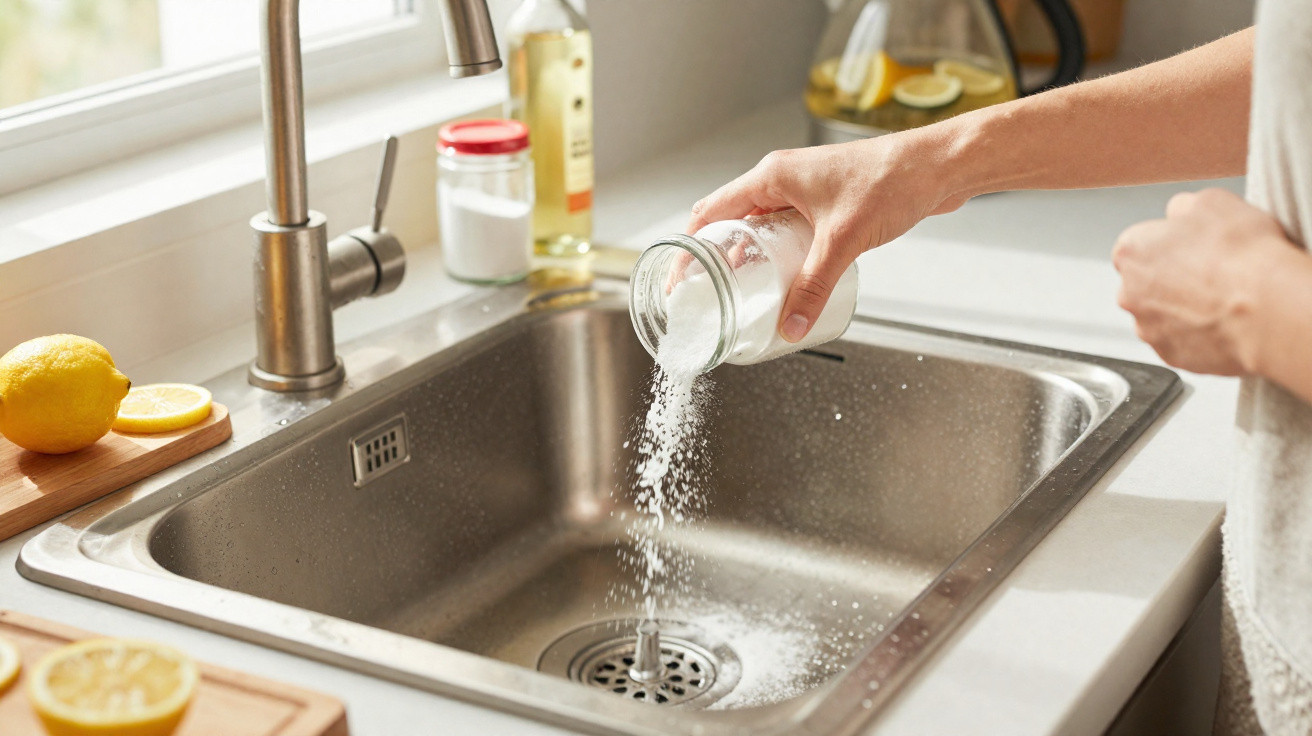
In many cases, all you need is a simple powder from the kitchen cupboard.
A blocked kitchen sink is a familiar household problem: pasta water, grease and food scraps all build up until the pipe eventually becomes clogged. Rather than immediately reaching for harsh supermarket chemicals, more and more people are choosing household remedies. One particularly inexpensive powder can clear the drain again within minutes, without any corrosive fumes.
Why kitchen drains clog so quickly
The kitchen sink has to cope with more than any other drain in day-to-day life. Frying fat, leftover sauces, starch from pasta and potatoes, plus coffee grounds and tea leaves, often end up going down the plughole. They may seem to disappear at first, but they actually collect in the trap and pipes.
- Fats and oils cool down and solidify.
- Starchy leftovers combine with grease to form sticky clumps.
- Coffee grounds and tea leaves settle in bends and joins.
- Hair and fibres from washing-up cloths get caught in these deposits.
The result is that water initially drains more slowly, then a musty smell develops and, eventually, the pipes start to gurgle. Once water is left standing in the sink, a complete blockage may be imminent.
The powder that quickly clears the drain again
Many people rely on one particular household remedy, which is otherwise mainly used for baking or cleaning: citric acid. This fine powder breaks down deposits in the pipe while also tackling unpleasant odours.
“One tablespoon of citric acid, followed by a generous amount of hot water: in many cases, the drain will run freely again within a short time.”
How to use citric acid in the drain correctly
The method is straightforward and takes only a few minutes:
- Remove as much water as possible from the sink.
- Sprinkle one or two tablespoons of citric acid directly into the drain.
- Wait briefly so that the powder can spread through the pipe.
- Then pour in a larger quantity of very hot, but not boiling, water.
- Leave it to work for several minutes, then check whether the water is draining normally again.
The combination of acid and heat loosens grease deposits and build-up from the inside of the pipe. For a preventative effect, it is worth establishing a regular routine:
- Put one tablespoon of citric acid into the drain once a week.
- Rinse through with hot water, for example after washing up.
This can often stop heavy deposits from forming in the first place and avoid costly emergency call-outs.
Citric acid does more: everyday descaling
The powder has another major household benefit: it removes limescale. In areas with hard water, kettles, coffee machines and taps can quickly become affected by limescale.
Descaling a kettle with citric acid
Only a small amount is needed for a kettle:
- Add around one or two teaspoons of citric acid to the empty kettle.
- Fill it with water until the limescale marks are covered.
- Bring it to the boil, then leave it to stand briefly.
- Pour away the water and rinse the kettle thoroughly.
The white limescale marks visibly dissolve in the process. Compared with many ready-made descalers, citric acid is usually considerably cheaper and does not require aggressive additives.
If you do not have citric acid: alternatives for the drain
If there is no citric acid in the cupboard, another familiar combination is likely to be available at home: sodium bicarbonate (often sold as “bicarbonate of soda”) and vinegar. Used with hot water, this mixture can also deal with blocked drains.
How the bicarbonate of soda and vinegar method works
For a blocked kitchen drain, use the following method:
- Tip roughly three to four tablespoons of bicarbonate of soda into the drain.
- Slowly pour in the same amount of vinegar.
- It will start fizzing immediately; let the mixture work for several minutes.
- Then rinse through with plenty of hot water.
The foaming reaction loosens deposits and flushes away small blockages. For stubborn cases, the process can be repeated after a few hours.
How to prevent the sink from blocking again and again
A few simple habits can prevent many problems in the kitchen drain. The most important rule is simple: anything that does not belong in the pipe should not be put there.
“The less grease, food waste and small particles disappear down the drain, the less often there is a risk of a complete blockage in the pipe.”
Avoid common day-to-day mistakes
- Never push food scraps into the sink; scrape them into the bin or food-waste bin instead.
- Do not tip coffee grounds and tea leaves into the sink simply for convenience. These particles settle stubbornly.
- After frying, allow fat and oil to cool, pour it into an old jar or container, and dispose of it with general waste.
- Use a sink strainer so that scraps do not enter the pipe in the first place.
- Run hot water regularly after washing up to help prevent grease deposits.
When household remedies reach their limits
Despite these methods, there are situations in which powder and foam are no longer enough. Several signs can point to a more serious issue:
- Water backs up in several drains at the same time.
- The pipes gurgle loudly when water is running elsewhere.
- Water rises out of the trap even though nothing is being used.
- A persistent smell remains despite there being no visible dirt.
The blockage is then usually deeper within the pipework. In these situations, a traditional plunger, a drain-cleaning spiral or, ultimately, a professional service will often be the only solution.
Chemical drain cleaners: quick help with drawbacks
Standard shop-bought drain cleaners may work powerfully, but they also carry several risks. Many products contain aggressive alkaline substances that can burn skin and eyes. If they come into contact with delicate seals undiluted, they can also damage the material over time.
There is also an environmental burden for wastewater treatment works. Some ingredients are difficult to filter out. Anyone who uses household remedies such as citric acid, bicarbonate of soda and vinegar more often can significantly reduce this impact.
Practical tips for everyday kitchen use
Anyone wanting to keep their sink in good condition over the long term can introduce a small routine. One easy-to-remember example is:
- Once a week: add a spoonful of citric acid to the drain, followed by hot water.
- After major cooking sessions: rinse briefly with very hot water, particularly after dishes containing plenty of fat.
- Empty the sink strainer regularly so that it does not become a trap for dirt itself.
If there are children in the household, the subject can be approached playfully. For instance, explain that the drain “only likes water” and that leftovers belong in the bin. This means fewer “uninvited guests” end up in the pipe, and the next blockage is less likely to happen soon.
Citric acid is also useful elsewhere in the home: on taps, shower heads and limescaled aerators. One point is always important: do not use it on acid-sensitive materials such as natural stone, and rinse thoroughly with water afterwards. This keeps the kitchen clean and the drain clear, while the emergency bottle of drain cleaner can stay in the cupboard.

















Comments
No comments yet. Be the first to comment!
Leave a Comment