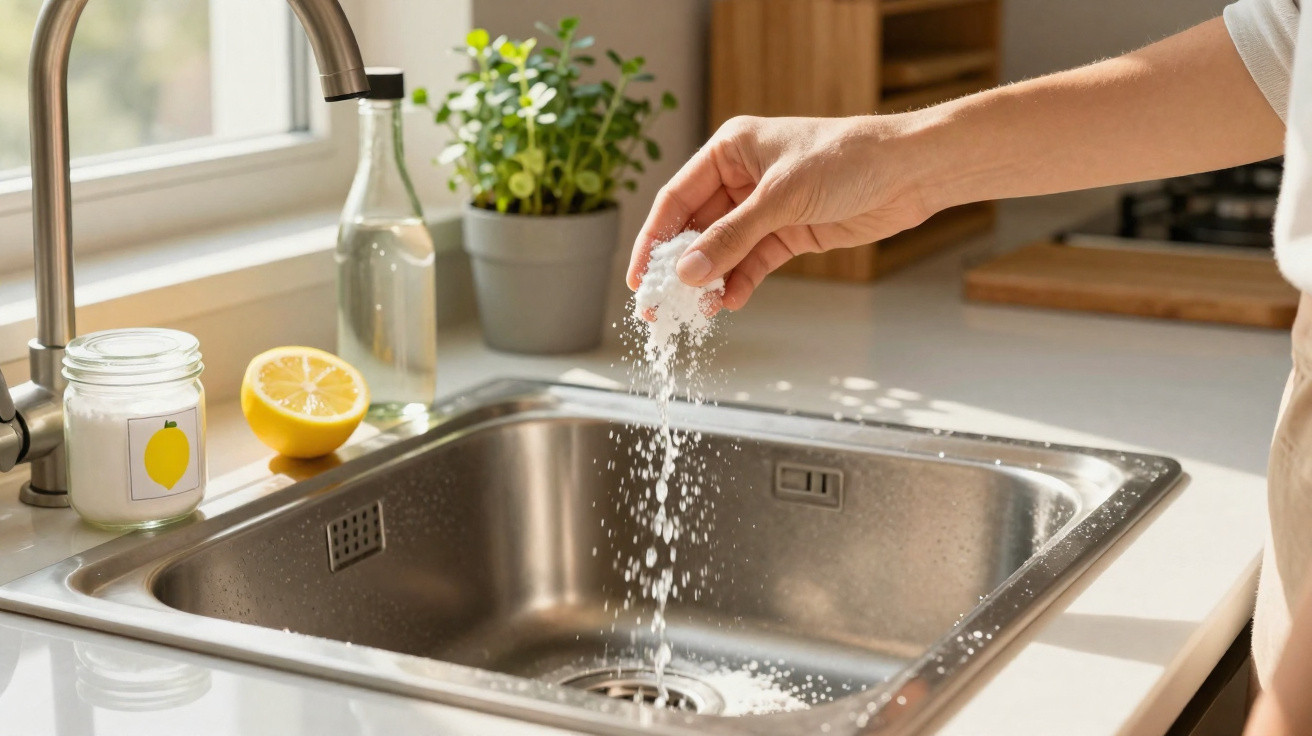
Blocked kitchen drain, unpleasant smell, nothing will drain away – and the plunger barely helps?
One unassuming household remedy can deal with the issue within minutes.
When this happens, many people reach in frustration for harsh supermarket drain cleaners. They smell unpleasant, can often damage pipework and place a burden on the environment. Yet many cupboards already contain a powder that breaks down grease, neutralises odours and can get a drain flowing again surprisingly quickly – without resorting to aggressive chemicals.
The kitchen powder that clears a blocked drain
The product is citric acid. The granules or powder are found in many kitchens, commonly for baking or descaling. Down the drain, however, it has another remarkably powerful use.
A tablespoon of citric acid and hot water can get a slow-running or partly blocked drain moving again in a short time.
It is straightforward to use, costs only a few pence and requires no tools.
How to use citric acid step by step
- Step 1: Put one or two tablespoons of citric acid powder directly into the drain.
- Step 2: Boil a kettle of water.
- Step 3: Pour the boiling water slowly into the drain in stages.
- Step 4: Wait a few minutes, then check whether the water is draining faster.
The heat softens grease and soap residue, while the acid breaks down limescale deposits and loosens build-up on the pipe walls. Together, these effects are often enough to release a blockage so that it can be flushed away.
Why citric acid works so effectively in pipes
Over time, kitchen drains collect a combination of grease, food scraps, soap and limescale. This coating becomes sticky and gradually narrows the pipe. Citric acid tackles precisely this type of build-up.
It delivers several benefits at once:
- Limescale remover: It attacks and removes mineral deposits.
- Grease remover: When used with hot water, hardened grease loosens more easily.
- Odour reducer: Bacteria lose the material they feed on, leaving the drain smelling more neutral.
- Kind to pipes: At normal quantities, it does not harm plastic or metal pipework.
Using hot water is essential. Lukewarm water will barely shift the deposits, whereas boiling water softens the layers, makes them swell and washes them away.
Regular use helps prevent blocked drains
Using this method as prevention rather than waiting for an emergency means less trouble with clogged pipes. In day-to-day use, one spoonful of citric acid each week followed by hot water is usually sufficient.
A practical routine is:
- Once a week, perhaps after a thorough kitchen clean, add citric acid to the drain.
- Pour freshly boiled water over it, then avoid running the tap for a few minutes.
- Afterwards, briefly run cold water through the drain.
This prevents the typical grease-and-limescale coating from building up properly in the first place, keeping pipes cleaner for longer.
A useful extra benefit: descaling kitchen appliances too
Citric acid is not only suitable for drains. Many households already use it to descale kettles and coffee machines. This saves money while avoiding aggressive cleaning products.
For a kettle, it is generally enough to:
- add one or two teaspoons of citric acid to the empty kettle;
- fill it with water;
- boil it once and leave it to stand briefly;
- rinse thoroughly until there is no remaining smell or taste.
Doing this regularly also lowers energy use, as less limescale builds up on the heating element.
If you have no citric acid: cupboard alternatives
If there is no citric acid at home, a slow drain can also be treated with other household remedies. Traditional options include combinations that create a mild “fizzing effect”.
For example, bicarbonate of soda and vinegar work well together when citric acid is unavailable. They react with one another, creating carbon dioxide bubbles that mechanically loosen deposits.
| Use | Household remedy | Strengths |
|---|---|---|
| Clearing a drain | Citric acid + boiling water | powerful against limescale, effective on grease, reduces odours |
| Mild blockage | Bicarbonate of soda + vinegar + hot water | fizzing action loosens soft deposits |
| Descaling a kettle | Citric acid | inexpensive, gentle on materials |
Even the best household remedy will eventually be ineffective against a completely blocked drain. If no water drains at all, the blockage is usually further down the pipe. At that point, the only options are removing the trap, using a drain auger or calling a professional.
Common mistakes that gradually clog every drain
Many blockages are not caused by a one-off “accident”, but by kitchen habits that continue for years. Several of these are easy to stop.
These items should never go into the sink
- Food scraps: Pasta, rice and vegetable pieces swell and can get trapped in the trap.
- Coffee filters or loose coffee grounds: These form a thick sludge when mixed with grease.
- Tea leaves: They catch on deposits that are already present.
- Hot fat and oil: They remain liquid briefly, but solidify again inside the pipe.
Anything that can cool down and harden belongs in the general waste bin, not the sink. A simple sink strainer catches food waste before it enters the drain. It costs only a few pounds and may save the expense of an emergency call-out.
Fats and oils: the hidden pipe killers
Cooking fats and edible oils are particularly risky. At first, they appear harmless because they run down the drain warm and liquid. Once inside the cooler pipe, they solidify again, cling to the walls and trap additional particles.
Better practice:
- Wipe greasy frying pans with kitchen paper before washing them.
- Put larger quantities of cooled fat into an old jar and dispose of it with household waste.
- Do not treat washing-up liquid as a “grease-dissolving trick” – it merely moves the fat further along rather than making it disappear.
How risky are chemical drain cleaners really?
Many shop-bought drain cleaners rely on highly corrosive ingredients. Although they may dissolve grease and hair quickly, they can also attack seals, older metal pipes and, potentially, your skin.
There is also the impact on sewage treatment works and waterways. Residues enter the wastewater system, must be removed through complex treatment and still partly reach the environment. Choosing gentler products such as citric acid significantly reduces this burden.
For personal safety, the basic rules are:
- Never mix different chemical cleaners.
- Always ventilate well during use and avoid contact with your hands.
- If a chemical cleaner is already in the pipe, do not pour any further products down it.
When it is better to call a professional
Some warning signs indicate that the issue lies deeper than the trap. An installer should inspect the pipework if several kitchen or bathroom drains gurgle at once, water backs up into the sink while washing up, or the drain blocks again after every household-remedy attempt.
In blocks of flats, the cause is often in the shared vertical waste pipe. A tenth attempt with powder and hot water will not help when the blockage is several metres away. A specialist company can use a camera, high-pressure equipment or an auger to deal with it precisely, without dismantling the entire kitchen.
Why this household remedy pays off in the long term
Regular use of citric acid not only protects pipes, but can save money over time on chemical cleaners, emergency call-outs and repairs. It is inexpensive, versatile and already stored in many kitchen cupboards.
There is another advantage: the kitchen smells fresher. As deposits are loosened, the gases produced when food remnants decompose disappear too. This is especially noticeable in open-plan kitchens.
For households with children or pets, avoiding aggressive drain cleaners offers reassurance. Citric acid is not a toy, but it is considerably less dangerous than highly concentrated caustic solutions. Used in sensible quantities, combined with hot water and a little care when using the sink, it usually keeps the drain exactly as it should be: unobtrusive.

















Comments
No comments yet. Be the first to comment!
Leave a Comment